
Qualitative Phase Analysis and Determination of Crystallographic Parameters of Fluorspar
DOI:
https://doi.org/10.70882/josrar.2026.v3i4.270Keywords:
XRF, XRD, REEs, TiO2, CaF2Abstract
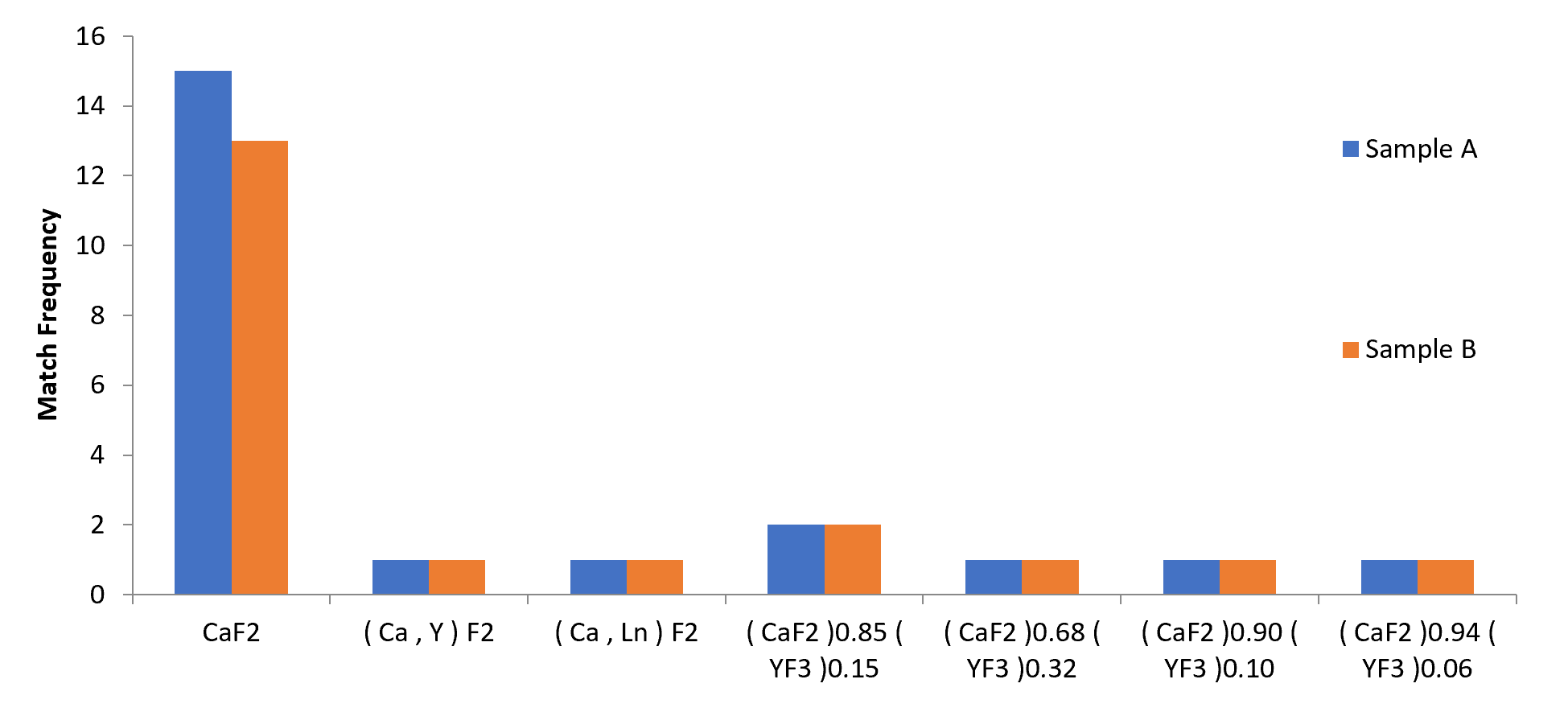
The incorporation of fluorspar also known as Calcium fluorite (CaF2) as a passivation agent for improving photovoltaic performance has become one of the best ways for enhancing the efficiency of solar cells. During the fabrication of titanium dioxide/calcium fluoride (TiO2/CaF2) photoanodes, a dosage of CaF2 is used to optimize the crystal structure and consequently the photovoltaic performance for a better energy harvest. Owing to this remarkable application of CaF2, continuous exploration and intense studies of natural fluorite seem necessary for meeting the demand, ensuring reliability and quality assurance. In this research, the experimental studies on the phases and the crystal parameters of natural fluorite have been reported. Samples of CaF2 were considered for analyses using XRF and XRD techniques. XRF analysis determined the elemental composition of the sample. The obtained X-ray diffraction patterns were used for further analysis. The diffraction angle and intensity data of both samples were used to assess the peak parameters from the X’Pert Highscore plus which determine their phases and lattice parameters. Results confirmed its quality and reliability for use as a good passivation agent.
References
Altay., M., 2020. Thermoluminescence properties of two natural colorful fluorite samples of Anatolian origin for dosimetric applications. Nuclear Inst. and Methods in Physics Research B 467 (2020) 33–39
Derin MT, Vijayagopal P, Venkatraman B, Chaubey RC, Gopinathan A (2012) Radionuclides and radiation indices of high background radiation area in Chavara-Neendakara placer deposits (Kerala, India). PLoS One 7(11):e50468. https://doi.org/10.1371/journal.pone.0050468
Dill, H.G., et al., 2016.Chemical, isotopic and mineralogical characteristics of volcanogenic epithermal fluorite deposits on the Permo-Mesozoic foreland of the Andean volcanic arc in Patagonia (Argentina). ChemiederErde (Geochemistry) 76, 275-297
F. A. Balogun, L A. Tubosun, A. O. Akanle, J. O. Ojo, C. A. Adesanmi, J. A. Ajao, l N. M. Spyrou, INAA in the determination of the elemental constituents of a natural fluorite; Journal of Radioanalytical and Nuclear Chemistry, Vol. 222, Nos 1-2 (1997) 3538
F.A. Balogun, J.O. Ojo, F.O. Ogundare, M.K. Fasasi, L.A. Hussein, TL response of a natural fluorite, Radiat. Meas. (1999), https://doi.org/10.1016/S1350-4487(99)00232-2.
F.A. Ferreira, E.M. Yoshimura, N.K. Umisedo, R.P. do Nascimento, Correlation of optically and thermally stimulated luminescence of natural fluorite pellets, Radiat. Meas. 71 (2014) 254–257, https://doi.org/10.1016/j.radmeas.2014.02.020.
F.O. Ogundare, F.A. Balogun, L.A. Hussain, Heating rate effects on the thermoluminescence of fluorite, Radiat.Meas. (2005), https://doi.org/10.1016/j.radmeas.2005.01.004.
G.S. Polymeris, G. Kitis, N.C. Tsirliganis, Correlation between TL and OSL properties of CaF2:N, Nucl. Instrum.Meth. Phys. Res. Sect. B 251 (2006) 133–142, https://doi.org/10.1016/j.nimb.2006.05.023.
H. Tugay, Z. Yegingil, T. Dogan, N. Nur, N. Yazici, The thermoluminescent properties of natural calcium fluoride for radiation dosimetry, Nucl. Instrum.Meth. Phys. Res. Sect. B 267 (2009) 3640–3651, https://doi.org/10.1016/j.nimb.2009.09.021.
J. R. Deschamps, Judith L. Flippen-Anderson, Encyclopedia of Physical Science and Technology (Third Edition) 2002
M. Topaksu, A.N. Yazici, The thermoluminescence properties of natural CaF2 after β-irradiation, Nucl. Instrum.Meth. Phys. Res. Sect. B 264 (2007) 293–301, https://doi.org/10.1016/j.nimb.2007.09.018.
M. Topaksu, V. Correcher, J. Garcia-Guinea, Luminescence emission of natural fluorite and synthetic CaF2: Mn (TLD-400), Radiat. Phys. Chem. 119 (2016) 151–156, https://doi.org/10.1016/j.radphyschem.2015.10.002.
M. Yüksel, M. Topaksu, A.N. Yazici, Z. Yeǧingil, T. Doǧan, The effects of pre-irradiation heat treatment and heating rate on the thermoluminescence glow peaks of natural CaF2, Radiat Eff. Defects Solids 165 (2010) 396–402, https://doi.org/10.1080/10420150903449696.
M.B. Latif, M.K. Fasasi, F.A. Balogun, Low dose TL characteristics of Nigerian fluorite, Radiat. Meas. (2012), https://doi.org/10.1016/j.radmeas.2011.11.003.
M.H. Kharita, R. Stokes, S.A. Durrani, TL and PTTL in natural fluorite previously irradiated with gamma rays and heavy ions, Radiat. Meas. 24 (1995) 469–472, https://doi.org/10.1016/1350-4487(95)00163-9.
N.O. Dantas, J.F.D. Chubaci, S. Watanabe, Optical absorption bands and thermoluminescence peaks in heavily irradiated fluorites, Radiat. Phys. Chem. (1998), https://doi.org/10.1016/S0969-806X(97)00195-3.
Naturally-Occurring Radioactive Materials (NORM), World Nuclear Association. http://www.worldnuclear.org/info/SafetyandSecurity/Radiation-and-Health/Naturally-Occurring-Radioactive-Materials-NORM/ . Assessed 02 Aug 2014
Noeâlio Oliveira Dantas, Joseâ Fernando DinizChubaci and Shigueo Watanabe 1998, Optical Absorption Bands and Thermoluminescence Peaks in Heavily Irradiated Fluorites; Radiat. Phys. Chem. Vol. 51, no. 4±6, p. 531, 1998
Öztürk, H., 2019. Rare Earth Element-bearing Fluorite Deposits of Turkey: an overview
R Jenkins and Robert L Snyder, “Introduction to X-ray Powder Diffractometry”, (1996) pp. 64 – 75.
Seymen, I., 1984. Kirsehirmetamorfitlerininjeolojikevrimi, KetinSemp.Tu¨rkiyeJeololojiKurumuYayını, 133–148.
Uranium from rare earths deposits, World Nuclear Association. http://www.world-nuclear.org/info/Nuclear-Fuel-Cycle/UraniumResources/Uranium-From-Rare-Earths-Deposits/ . Assessed 16 Oct 2014
Downloads
Published
Issue
Section
License
Copyright (c) 2026 Ibrahim Muhammad Bagudo, Gidado Shehu (Author)

This work is licensed under a Creative Commons Attribution-NonCommercial 4.0 International License.
- Attribution — You must give appropriate credit, provide a link to the license, and indicate if changes were made. You may do so in any reasonable manner, but not in any way that suggests the licensor endorses you or your use.
- NonCommercial — You may not use the material for commercial purposes.
- No additional restrictions — You may not apply legal terms or technological measures that legally restrict others from doing anything the license permits.