
Prevalence, Geographical Distribution and Risk Factors of Urinary Schistosomiasis, Bacteriuria and their Co-Infection among School-Aged Children, Kano, Nigeria
DOI:
https://doi.org/10.70882/josrar.2026.v3i6.348Keywords:
Almajiri, Bacteriuria, Co-infection Kano State, Risk factors, Schistosoma haematobiumAbstract
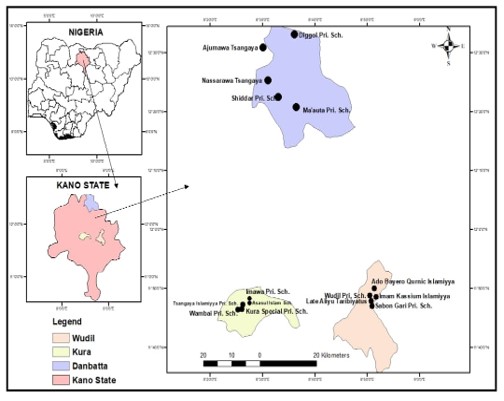
Urinary schistosomiasis and bacterial urinary tract infection frequently coexist in children, yet community-based data from northern Nigeria are scarce. This cross-sectional study determined the prevalence, geographical distribution and risk factors of Schistosoma haematobium infection, bacteriuria and their co-infection among school-aged children in Kura, Dambatta and Wudil Local Government Areas (LGAs) of Kano State. Using multistage sampling, 3,030 pupils (1,010 per LGA) from public primary, Islamiyya and Almajiri schools were enrolled between June 2024 and September 2025—a questionnaire captured socio-demographic, environmental and behavioural data. We examined terminal urine microscopically for S. haematobium eggs and cultured it for bacteria. Associations were tested using Chi-square tests and crude odds ratios. Of the 3,030 pupils, 670 (22.1%) had S. haematobium infection alone, 484 (16.0%) had bacteriuria alone, 183 (6.0%) had both infections and 1,693 (55.9%) had neither. Children from Kura recorded the highest prevalence of S. haematobium (26.3%) and bacteriuria (18.8%), followed by Dambatta and Wudil (both p < 0.001), whereas co-infection did not differ significantly between LGAs (5.2–6.9%; p = 0.243). Use of river or stream water, open defecation, frequent water contact, Almajiri school attendance and inadequate handwashing were all significantly associated with infection (p < 0.001), and frequent water contact showed the steepest gradient (22.1% of uninfected pupils compared with 100% of co-infected pupils). Urinary schistosomiasis and bacteriuria are common among pupils in Kano State with shared environmental and behavioural drivers. Integrated control that combines Praziquantel treatment, improved water, sanitation and hygiene, health education and urine culture-based surveillance is recommended.
References
Ajakaye, O. G., Dagona, A. G., Haladu, A. G., Ombugadu, A., Lapang, M. P., &Enabulele, E. E. (2022). Contrasting epidemiology of urogenital schistosomiasis among pastoral communities surrounding three Ramsar wetland in Nigeria. Journal of Parasitic Diseases, 46(3), 637–642. https://doi.org/10.1007/s12639-022-01478-2
Alabi, E. D., Mzungu, I., & Auta, T. (2023). Bacteriuria co-infection in urinary schistosomiasis among vulnerable children in Safana District of Katsina State, Nigeria. Bacteriology Journal, 13(1), 1–7. https://doi.org/10.3923/bj.2023.1.7
Auta, T., Ezra, J. J., Rufai, H. S., Alabi, E. D., & Anthony, E. (2020). Urinary schistosomiasis among vulnerable children in security challenged District of Safana, Katsina State-Nigeria. International Journal of Tropical Diseases & Health, 41(23), 73–81. https://doi.org/10.9734/IJTDH/2020/v41i2330419
Auta, T., Rufai, H. S., Orpin, J. B., &Alabi, E. D. (2024). Risk factors associated with urinary schistosomiasis and its spatial distribution among Almajirai in selected localities in Katsina State, Nigeria. Asian Science Bulletin, 3(1), 63–71. https://doi.org/10.3923/asb.2025.63.71
Balogun, J. B., Adewale, B., Balogun, S. U., Lawan, A., Haladu, I. S., Dogara, M. M., &Balogun, E. O. (2022). Prevalence and associated risk factors of urinary schistosomiasis among primary school pupils in the Jidawa and Zobiya communities of Jigawa State, Nigeria. Annals of Global Health, 88(1), 71. https://doi.org/10.5334/aogh.3704
Barsoum, R. S. (2013). Urinary schistosomiasis. Journal of Advanced Research, 4(5), 453–459. https://doi.org/10.1016/j.jare.2012.08.004
Bazata, A., Turaki, A., Danlami, M., Aliyu, B., Gulumbe, H., Muhammad, N., &Shamsuddeen, A. (2025). Hidden burden: Schistosomiasis prevalence and risk factors among enrolled and out-of-school children in Kebbi State, Nigeria. Microbiology Research Journal International, 35(11), 118–127. https://doi.org/10.9734/mrji/2025/v35i111658
Carvalho Cabral, P., Olivier, M., &Cermakian, N. (2019). The complex interplay of parasites, their hosts, and circadian clocks. Frontiers in Cellular and Infection Microbiology, 9, 425. https://doi.org/10.3389/fcimb.2019.00425
Centers for Disease Control and Prevention. (2019). Schistosomiasis. https://www.cdc.gov/dpdx/schistosomiasis/index.html
Cheesbrough, M. (2005). District laboratory practice in tropical countries, part 2. Cambridge University Press.
Dada, E. O., &Alagha, B. (2021). Urinary schistosomiasis and asymptomatic bacteriuria among individuals of Ipogun, Nigeria: Detection of predominant microorganisms and antibiotic susceptibility profile. Journal of Medical and Health Studies, 2(2), 70–80. https://doi.org/10.32996/jmhs.2021.2.2.8
Dikwa, K. B., Usman, A., Haroun, A. A., Onusiriuka, B. C., &Inegbenosun, C. U. (2025). Epidemiology of urinary schistosomiasis among primary school children in selected Local Government Areas of Katsina State. Ife Journal of Science, 27(2), 303–319. https://dx.doi.org/10.4314/ijs.v27i2.4
Duwa, M., Oyeyi, T. I., &Bassey, S. E. (2009). Prevalence and intensity of urinary schistosomiasis among primary school pupils in Minjibir Local Government Area of Kano State. Bayero Journal of Pure and Applied Sciences, 2(1), 75–78. https://doi.org/10.4314/bajopas.v2i1.58469
Elkana, D. S., Elkana, O. S., Adle, A. A., Obadiah, S. Y., Babylon, P., Usman, D. D., &Azuchukwuene, G. C. (2024). Occurrence and isolation of urinary tract bacteria associated with urinary schistosomiasis among the school aged children in Sorbai and Murbai area of Kona Ward, Ardo Kola LGA, Taraba State, Nigeria. Galore International Journal of Health Sciences and Research, 9(1), 118–129. https://doi.org/10.52403/gijhsr.20240113
Hotez, P. J., & Kamath, A. (2009). Neglected tropical diseases in sub-Saharan Africa: Review of their prevalence, distribution, and disease burden. PLoS Neglected Tropical Diseases, 3(8), e412. https://doi.org/10.1371/journal.pntd.0000412
Imalele, E. E., Braide, E. I., Emanghe, U. E., &Osondu-Anyanwu, C. (2024). The burden of schistosomiasis among school-aged children in Ogoja, Nigeria: Current level of infection years after mass drug administration with praziquantel. African Health Sciences, 24(4), 65. https://doi.org/10.4314/ahs.v24i4.9
Ishiekwene, U., Kogi, E., Zakari, H., &Mbanu, G. E. (2024). Vectorial infectivity screening and epidemiology of schistosomiasis among inhabitants of ZangoKataf Local Government Area, Southern Kaduna, Nigeria. KIU Journal of Health Science, 4(2), 85–105. https://doi.org/10.59568/KJHS-2024-4-2-07
Jande, H. E., Terwase, A., Amuta, E. U., Okete, J. A., Inalegwu, F., Kposu, J. T., Amana Onekutu, A., &Azua, E. T. (2025). Hyper-endemicity of urinary schistosomiasis in riverine communities: A comparative study of risk factors and water contact patterns in Makurdi. International Journal of Modern Developments in Engineering and Science, 4(12), 16–20. https://doi.org/10.65138/ijmdes.2025.v4i12.290
Jibril, M. S., Aule, D. S., & Idris, A. H. (2022). Assessment of land degradation in Dambatta Local Government Area using remote sensing techniques. Advances in Remote Sensing, 11(4), 167–181. https://doi.org/10.4236/ars.2022.114010
Kone, K. J., Onifade, A. K., & Dada, E. O. (2022). Occurrence of urinary schistosomiasis and associated bacteria in parts of Ondo State, Nigeria. PLOS Global Public Health, 2(10), e0001119. https://doi.org/10.1371/journal.pgph.0001119
LoVerde, P. T. (2024). Schistosomiasis. In R. Toledo & B. Fried (Eds.), Digenetic trematodes (Advances in Experimental Medicine and Biology, Vol. 1454, p. 75). Springer. https://doi.org/10.1007/978-3-031-60121-7_3
Magaji, A., Mahmud, Z., &Gataji, W. (2025). Prevalence of schistosomiasis and associated risks factors among patients with urinary tract infections in Azare Metropolis. Caliphate Journal of Science and Technology, 7(1), 100–107.
Mbanefo, E. C., Le, L., Pennington, L. F., Hsieh, Y. J., Odegaard, J. I., Lapira, K., & Hsieh, M. H. (2020). IPSE, a urogenital parasite-derived immunomodulatory molecule, suppresses bladder pathogenesis and anti-microbial peptide gene expression in bacterial urinary tract infection. Parasites & Vectors, 13(1), 615. https://doi.org/10.1186/s13071-020-04490-8
National Population Commission. (2006). Nigeria national census: Population distribution by sex, state, LGAs and senatorial district: 2006 census priority tables (Vol. 3). http://www.population.gov.ng/index.php/publication/140-popn-distri-by-sex-state-jgas-and-senatorial-distr-2006
O’Ferrall, A. M., Musaya, J., Stothard, J. R., & Roberts, A. P. (2024). Aligning antimicrobial resistance surveillance with schistosomiasis research: An interlinked One Health approach. Transactions of the Royal Society of Tropical Medicine and Hygiene, 118(8), 498–504. https://doi.org/10.1093/trstmh/trae035
Olusi, T. A., Aniaguya, R. N., Dada, E. O., &Olaniran, O. (2024). Water contact! One risk too many: Risk factors associated with Schistosoma haematobium infection in Osun State, Nigeria. Epidemiology International Journal, 8(4), 000284. https://doi.org/10.23880/eij-16000284
Ossai, O. P., Dankoli, R., Nwodo, C., Tukur, D., Nsubuga, P., Ogbuabor, D., &Eze, G. (2014). Bacteriuria and urinary schistosomiasis in primary school children in rural communities in Enugu State, Nigeria, 2012. The Pan African Medical Journal, 18(Suppl 1), 15. https://doi.org/10.11694/pamj.supp.2014.18.1.4169
Owusu, G., Iddrisu, A. K., Antwi-Adjei, M., Asare, T. A., Gyekyebea, P., Opoku-Kusi, R., &Tuekpe, R. M. (2025). Assessment of the prevalence and praziquantel effectiveness and risk factors of urogenital schistosomiasis among school-aged children in Pru East, Ghana. Scientific Reports, 15(1), 19376. https://doi.org/10.1038/s41598-025-96653-9
Perera, D. J., Koger-Pease, C., Paulini, K., Daoudi, M., &Ndao, M. (2024). Beyond schistosomiasis: Unraveling co-infections and altered immunity. Clinical Microbiology Reviews, 37(1), e00098-23. https://doi.org/10.1128/cmr.00098-23
Sambo, K. H., Moi, I. M., Mohammed, A., Yakubu, H., Mohammed, B., &Abdullahi, S. I. (2024). Prevalence of schistosomiasis and associated risks factors among patients with urinary tract infection attending Specialist Hospital Bauchi. IPS Journal of Applied Microbiology and Biotechnology, 3(1), 84–89. https://doi.org/10.54117/ijamb.v3i1.21
Singh, K., Muddasiru, D., & Singh, J. (2016). Current status of schistosomiasis in Sokoto, Nigeria. Parasite Epidemiology and Control, 1(3), 239–244. https://doi.org/10.1016/j.parepi.2016.08.003
Sule, M. N., El Lahham, I., Munkombwe, M. N., Nasike, P., Gouvras, A., Rollinson, D., & De Leo, G. A. (2025). Schistosomiasis and water resources development in Africa: A scoping review and multi-case evaluation of associated snail control. PLOS Neglected Tropical Diseases, 19(6), e0013180. https://doi.org/10.1371/journal.pntd.0013180
Ubi, P. J., Otu, J. U., &Omini, A. U. (2024). Bacteriuria co-infection and impact of urinary schistosomiasis on daily activities of women in Yala Local Government Area, CRS, Nigeria. Science World Journal, 19(3), 900–908. https://doi.org/10.4314/swj.v19i3.39
Uthman, T. O. O., Olufemi, M. A., &Okeowo, M. T. (2024). Urinary schistosomiasis among school-age children in selected local government areas in Ogun State, Nigeria. Basra Journal of Science, 42(1). https://doi.org/10.29072/basjs.20240106
Weerakoon, K. G., Gobert, G. N., Cai, P., & McManus, D. P. (2015). Advances in the diagnosis of human schistosomiasis. Clinical Microbiology Reviews, 28(4), 939–967. https://doi.org/10.1128/CMR.00137-14
Downloads
Published
Issue
Section
Categories
License
Copyright (c) 2026 Solomon K. Gbaden, Timothy Auta, Ignatius Mzungu (Author)

This work is licensed under a Creative Commons Attribution-NonCommercial 4.0 International License.
- Attribution — You must give appropriate credit, provide a link to the license, and indicate if changes were made. You may do so in any reasonable manner, but not in any way that suggests the licensor endorses you or your use.
- NonCommercial — You may not use the material for commercial purposes.
- No additional restrictions — You may not apply legal terms or technological measures that legally restrict others from doing anything the license permits.