
Mathematical Analysis of Gravitational Motion and Orbital Stability in a Two-Body System
DOI:
https://doi.org/10.70882/Keywords:
Keywords: Two-body problem; orbital stability; Newtonian gravitation; Binet’s equation; Keplerian motionAbstract
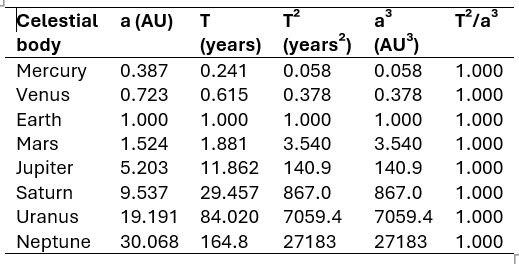
Abstract The Newtonian two-body problem provides an analytical basis for relating gravitational attraction to orbital geometry and stability. This paper presents a unified treatment of relative motion under an inverse-square central force, using the centre of mass transformation and a consistent set of orbital parameters. The Lagrangian formulation separates translational and relative motion, while conservation of angular momentum and mechanical energy reduces the dynamics to an effective radial potential. Circular equilibria are examined through the first and second derivatives of this potential, establishing the condition for local radial stability at fixed angular momentum. Transformation to the reciprocal radial coordinate produces Binet’s equation, whose Newtonian solution yields conic trajectories classified by eccentricity and specific orbital energy. Conservation of areal velocity also leads to the orbital period relation expressed by Kepler’s third law. The planetary quantities reproduced in the accompanying table illustrate this established proportionality and are not independent observations. The analysis shows how the main results of classical orbital mechanics follow from a common mathematical framework, while distinguishing the local stability of the idealized two-body orbit from long-term behaviour under additional gravitational and nonconservative perturbations.References
Adams, F. C., & Bloch, A. M. (2014). On the stability of extrasolar planetary systems and other closely orbiting pairs. arXiv (Cornell University), 446(4), 3676–3686. https://doi.org/10.1093/mnras/stu2397
Agol, E., & Fabrycky, D. C. (2017). Transit Timing and Duration Variations for the Discovery and Characterization of Exoplanets in the TESS era. In arXiv (Cornell University). Cornell University. http://arxiv.org/abs/1706.09849
Baù, G., Bombardelli, C., Peláez, J., & Lorenzini, E. (2015). Non-singular orbital elements for special perturbations in the two-body problem. Monthly Notices of the Royal Astronomical Society, 454(3), 2890–2908. https://doi.org/10.1093/mnras/stv2106
Bini, D., & Damour, T. (2012). Gravitational radiation reaction along general orbits in the effective one-body formalism. arXiv (Cornell University), 86(12). https://doi.org/10.1103/physrevd.86.124012
Bini, D., Damour, T., & Geralico, A. (2020). Sixth post-Newtonian local-in-time dynamics of binary systems. arXiv (Cornell University), 102(2). https://doi.org/10.1103/physrevd.102.024061
Britt, E., Elisabett. (2021). The Syntax and Semantics of Questions in Swedish. In Scholarworks (University of Massachusetts Amherst). University of Massachusetts Amherst. https://doi.org/10.7275/bk1a-ns45
Brzeski, P., & Perlikowski, P. (2018). Sample-Based Methods of Analysis for Multistable Dynamical Systems. Archives of Computational Methods in Engineering, 26(5), 1515–1545. https://doi.org/10.1007/s11831-018-9280-5
Bucci, L., Lavagna, M., Guzzetti, D., & Howell, K. C. (2018). Periodic orbit-attitude solutions along planar orbits in a perturbed circular restricted three-body problem for the Earth-Moon system. Acta Astronautica, 147, 152–162. https://doi.org/10.1016/j.actaastro.2018.03.042
Celletti, A., Blasi, I. D., & Efthymiopoulos, C. (2023). Nekhoroshev estimates for the orbital stability of Earth’s satellites. Research Padua Archive (University of Padua). https://doi.org/10.1007/s10569-023-10124-9
Conway, L., & Will, C. M. (2025). Higher-order effects in the dynamics of hierarchical triple systems. III. Astrophysical implications of second-order and dotriacontapole terms. ArXiv.Org, 111(8). https://doi.org/10.1103/physrevd.111.083052
Correia, A. C. M., Boué, G., Laskar, J., & Rodríguez, A. (2014). Deformation and tidal evolution of close-in planets and satellites using a Maxwell viscoelastic rheology. Astronomy and Astrophysics, 571. https://doi.org/10.1051/0004-6361/201424211
Crespo, F., Espejo, D. E., & Meer, J. C. van der. (2024). (textbf{(}boldsymbol{mathbb{R}}^{textbf{3}} boldsymbol{times } boldsymbol{SO(3)} boldsymbol{times } boldsymbol{mathbb{T}}^{textbf{6}}textbf{)})-Reduction, Relative Equilibria, and Bifurcations for the Full Averaged Model of Two Interacting Rigid Bodies. TU/e Research Portal, 23(1), 668–695. https://doi.org/10.1137/23m158125x
Doumbouya, L. (2026). Structural Selection in Macroscopic Orbital Systems: Admissible Trajectories Under Gravitational Constraint. In Zenodo (CERN European Organization for Nuclear Research). European Organization for Nuclear Research. https://doi.org/10.5281/zenodo.18541018
Galeş, C., Apetrii, M., & Nadabaică, G. (2025). Modeling the resonant dynamics of infinitesimal particles orbiting nonspherical rotating bodies. Celestial Mechanics and Dynamical Astronomy, 137(5). https://doi.org/10.1007/s10569-025-10258-y
Gómez, G., Koon, W. S., Lo, M. W., Marsden, J. E., Masdemont, J. J., & Ross, S. D. (2001). Invariant Manifolds, the Spatial Three-Body Problem and Space Mission Design. In CaltechAUTHORS (California Institute of Technology). California Institute of Technology. https://authors.library.caltech.edu/20327/
Gurfil, P., & Efroimsky, M. (2021). Analysis of the PPN two-Body Problem using non-osculating orbital elements. arXiv (Cornell University), 69(1), 538–553. https://doi.org/10.1016/j.asr.2021.09.009
Jesus, E. D. (2026). Newtonian Two-Body Gravity on the Thales Semicircle: A Geometric Diagnostic for Mass-Partition Structure. Zenodo (CERN European Organization for Nuclear Research). https://doi.org/10.5281/zenodo.18496272
Krishnaswami, G. S., & Senapati, H. (2019). An Introduction to the Classical Three-Body Problem. arXiv (Cornell University), 24(1), 87–114. https://doi.org/10.1007/s12045-019-0760-1
Lee, T. (2008). Computational geometric mechanics and control of rigid bodies [University of Michigan]. In Deep Blue (University of Michigan). https://hdl.handle.net/2027.42/60804
Lei, H. (2019). A semi-analytical model for secular dynamics of test particles in hierarchical triple systems. Monthly Notices of the Royal Astronomical Society, 490(4), 4756–4769. https://doi.org/10.1093/mnras/stz2917
Lei, H., Circi, C., & Ortore, E. (2018). Modified double-averaged Hamiltonian in hierarchical triple systems. IRIS Research Product Catalog (Sapienza University of Rome), 481(4), 4602–4620. https://doi.org/10.1093/mnras/sty2619
Lu, T., Rein, H., Tamayo, D., Hadden, S., Mardling, R. A., Millholland, S., & Laughlin, G. (2023). Self-consistent Spin, Tidal, and Dynamical Equations of Motion in the REBOUNDx Framework. The Astrophysical Journal, 948(1), 41. https://doi.org/10.3847/1538-4357/acc06d
Marsden, J. E., & Ross, S. D. (2005). New methods in celestial mechanics and mission design. Bulletin of the American Mathematical Society, 43(1), 43–73. https://doi.org/10.1090/s0273-0979-05-01085-2
Middleton, C. (2015). The 2D surfaces that generate Newtonian and general relativistic orbits with small eccentricities. In arXiv (Cornell University) (Vol. 83, Issue 7, pp. 608–615). Cornell University. https://doi.org/10.1119/1.4922254
Morey, J. C. (2023). Relative Equilibria of Dumbbells Orbiting in a Planar Newtonian Gravitational System. In arXiv (Cornell University). Cornell University. https://doi.org/10.48550/arxiv.2307.01935
Musielak, Z. E., & Quarles, B. (2014). The three-body problem. arXiv (Cornell University), 77(6), 65901. https://doi.org/10.1088/0034-4885/77/6/065901
Nazari, M., Canales, D., McCann, B., Butcher, E. A., & Howell, K. C. (2023). Framework for the full N-body problem in SE(3) and its reduction to the circular restricted full three-body problem. Celestial Mechanics and Dynamical Astronomy, 135(4). https://doi.org/10.1007/s10569-023-10156-1
Qiao, C., Long, X., Yang, L., Zhu, Y., & Cai, W. (2025). Calculation of a Dynamical Substitute for the Real Earth–Moon System Based on Hamiltonian Analysis. The Astrophysical Journal, 991(1), 46. https://doi.org/10.3847/1538-4357/adf73a
Ramond, P., & Perez, J. (2020). The Geometry of Isochrone Orbits: from Archimedes’ parabolae to Kepler’s third law. In HAL (Le Centre pour la Communication Scientifique Directe). Centre National de la Recherche Scientifique. https://doi.org/10.48550/arxiv.2003.13456
Remus, F., Mathis, S., Zahn, J.-P., & Lainey, V. (2012). Anelastic tidal dissipation in multi-layer planets. Astronomy and Astrophysics, 541. https://doi.org/10.1051/0004-6361/201118595
Saillenfest, M. (2017). Secular theories and orbital dynamics beyond Neptune. http://www.theses.fr/2017PSLEO006/document
Samboy, N., & Gallant, J. (2024). A modern interpretation of Newton’s theorem of revolving orbits. American Journal of Physics, 92(5), 343–348. https://doi.org/10.1119/5.0166698
Scheeres, D. J. (2004). Stability of Relative Equilibria in the Full Two‐Body Problem. Annals of the New York Academy of Sciences, 1017(1), 81–94. https://doi.org/10.1196/annals.1311.006
Schumayer, D., & Hutchinson, D. A. W. (2019). Peculiarities in the gravitational field of a filamentary ring. arXiv (Cornell University), 87(5), 384–394. https://doi.org/10.1119/1.5092450
Tos, D. A. D., & Topputo, F. (2017). On the advantages of exploiting the hierarchical structure of astrodynamical models. Acta Astronautica, 136, 236–247. https://doi.org/10.1016/j.actaastro.2017.02.025
Zhang, C., Topputo, F., Zazzera, F. B., & Zhao, Y. (2015). Low-Thrust Minimum-Fuel Optimization in the Circular Restricted Three-Body Problem. Virtual Community of Pathological Anatomy (University of Castilla La Mancha), 38(8), 1501–1510. https://doi.org/10.2514/1.g001080
Downloads
Published
Issue
Section
Categories
License
Copyright (c) 2026 ALI MUSA (Author)

This work is licensed under a Creative Commons Attribution-NonCommercial 4.0 International License.
- Attribution — You must give appropriate credit, provide a link to the license, and indicate if changes were made. You may do so in any reasonable manner, but not in any way that suggests the licensor endorses you or your use.
- NonCommercial — You may not use the material for commercial purposes.
- No additional restrictions — You may not apply legal terms or technological measures that legally restrict others from doing anything the license permits.