
Blunted Salivary Nitrite Surge as a Predictor of Post-Glucose Microvascular and Vagal Recovery in Habitual Antiseptic-Mouthwash Users
DOI:
https://doi.org/10.70882/Abstract
Background: The enterosalivary nitrate–nitrite–nitric oxide (NO) pathway contributes to systemic NO bioavailability via commensal oral bacteria that reduce dietary nitrate to nitrite. Antiseptic mouthwashes, particularly chlorhexidine, suppress oral nitrate-reducing capacity, but the acute physiological consequences on autonomic and microvascular function following a metabolic challenge remain poorly characterised.
Methods: This was a prospective, randomized, double-blind, placebo-controlled, parallel-group trial. Fifty healthy adults (17–32 years) were randomised (1:1) to receive 0.12% chlorhexidine (CHX, n=25) or placebo mouthwash (PLA, n=25) twice daily for seven days. On day 8, participants underwent a 75 g oral glucose tolerance test with measurements at 0, 30, 60, 90, 120, 180, and 240 minutes post‑glucose.
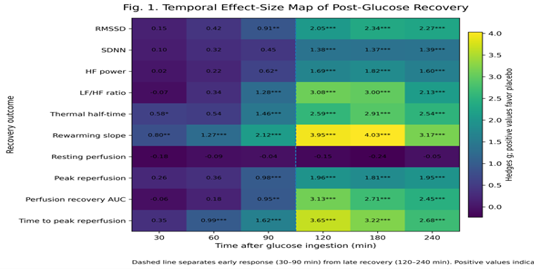
Results: Chlorhexidine reduced oral nitrate‑reducing capacity by 65% compared to placebo (p < 0.001). Salivary nitrite concentrations were significantly lower in the CHX group at all postprandial time points, with a blunted absolute rise (9.4 vs. 32.9 μmol/L; p < 0.001) and reduced AUC₀–₂₄₀ (13,690 vs. 25,246 μmol•min/L; p < 0.001). A group × time interaction was highly significant for salivary nitrite in a mixed model analysis (Wald χ² = 347.9, p < 0.001). CHX exhibited significantly less vagal recovery (i.e., decreased late‑phase RMSSD, g = 0.80; increased LF/HF ratio, g = 3.08). The CHX group had significantly delayed microvascular reperfusion, as evidenced by increased thermal half‐time (g = 2.91), decreased perfusion recovery AUC (g = 3.65), and decreased rewarming slope (g = 3.17, p < 0.001). Salivary nitrite AUC was an independent predictor of late RMSSD (p < 0.05) and rewarming slope (p < 0.01), and oral nitrate‑reducing capacity was an independent predictor of perfusion recovery AUC (p < 0.01). The significant negative coefficients for chlorhexidine allocation remained in all models. The number of mild oral adverse events was higher in the CHX group (40% vs 8%; p = 0.018), but there were no serious adverse events.
Conclusion: Findings raise important questions about the cardiovascular safety of routine antiseptic mouthwash use in healthy individuals, highlighting the need for further research and judicious clinical practice.
Downloads
Published
Issue
Section
Categories
License
Copyright (c) 2026 Zahraa Qasim Mousa (Author)

This work is licensed under a Creative Commons Attribution-NonCommercial 4.0 International License.
- Attribution — You must give appropriate credit, provide a link to the license, and indicate if changes were made. You may do so in any reasonable manner, but not in any way that suggests the licensor endorses you or your use.
- NonCommercial — You may not use the material for commercial purposes.
- No additional restrictions — You may not apply legal terms or technological measures that legally restrict others from doing anything the license permits.