
Extraction and Characterisation of Bio-Oil from Common Selected Biomass in Nigeria
DOI:
https://doi.org/10.70882/josrar.2026.v3i5.317Keywords:
Agricultural residues, Corn-Cob, Rice-Husk, Neem Seed, Bio-productsAbstract
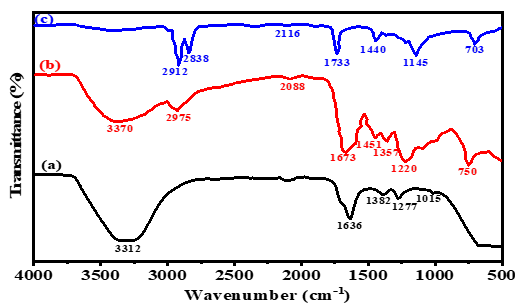
Agricultural residues, and plant oils sourced from various origins, can be used for the production of value-added bio-products and provide alternatives for integrated pest management approaches among other applications. However, there is limited comparative information on physicochemical or functional properties of oils from lignocellulosic and lipid-rich biomass. This study extracted and characterized oils from rice husk, corn cob and neem seed collected in Minna Niger State, Nigeria with focus on physicochemical traits and functional group composition. Rice-husk, corn-cob and neem seed oils had densities of 1.02, 1.16 and 0.91 g mL−1 and pH values of 2.80, 2.24 and 5.87 respectively while moisture contents (MC) were 23.70, 39.70 and 1.10% and acid values (AV) of 118.3, 143.0 and 4.48 mg KOH g−1, respectively. Neem seed oil had the highest yield of 41.25% followed by corn-cob (26%) and rice-husk (20%). Functional group analysis by FTIR showed that lignocellulosic bio-oils had oxygenated and hydroxyl groups while neem oil had more lipid and ester groups. The study established differences in the chemical make-up of the oils based on source material and extraction approach. Neem seed oil has potential as a lipid-rich product while rice-husk and corn-cob oils appear to have more acidic and oxygenated constituents. The findings could help promote the use of local resources for production of bioproducts and bioenergy but requires further chemical characterization and assessment of end-use applications such as biopesticides and biodiesels.
References
Abatyough, M. T, Ajibola O. A, Agbaji E. B, & Yashim, Z. I. (2022a). Optimisation and Modelling of Process Conditions for the Yield of Improved Bio-Oil from Co-Pyrolysis of Corncobs and High-Density Polyethylene Wastes using Central Composite Design (CCD). Chemistry Research Journal 7(3). pp. 23 - 38.
Agu, C. M., Orakwue, C. C., Ani, O. N., & Chinedu, M. P. (2025). Kinetics, Thermodynamics and Characterization of Neem Seeds (Azadirachta indica) Oil Extraction: Extensive Study of the Processes. Green Technologies and Sustainability, 3(1), pp 100-126.
Bello, S. I., & Uthman, T. O. (2025). Urea Enhances the Yield and Quality of Bio-Oil Produced from Corncob through Pyrolysis. Scientific Reports, 15, Article 2990.https://www.nature.com/articles/s41598-025-86800-7
Bisen, D., Lanjewar, R., Alawa, B., Chouhan, A. P. S., & Chakma, S. (2025). Kinetic Analysis and Fuel Characterization with Hydrocarbon Distribution in Pyro-Oil Produced from Co-Pyrolysis of Rice Husk and l] Low-Density Polyethylene. Journal of the Energy Institute, 121, pp 102-175.
Bruce, A., Wilson, A. N., Ranabhat, S., Montgomery, J., Nicholson, S., Harris, K., & Morrison III, W. R. (2022). A Biomass Pyrolysis Oil as a Novel Insect Growth Regulator Mimic for a Variety of Stored Product Beetles Journal of Economic Entomology, 115(3), pp 877-887.
Cai, W., Kang, N., Jang, M. K., Sun, C., Liu, R., & Luo, Z. (2019). Long Term Storage Stability of Bio-Oil from Rice Husk Fast Pyrolysis. Energy, 186, 115882.
Casoni, Andrés. I., Gutierrez, V., García, J. M., Cabada, S., Acevedo, A., & Volpe, M. A. (2022). Pyrolytic Coproduction of Bio-Char and Upgraded Bio-Oils from Abundant Agro-Industrial Wastes. Brazilian Journal of Chemical Engineering, 39(3), pp 561–570. https://doi.org/10.1007/s43153-021-00167-6
Domazetovska, S., Strezov, V., Filkoski, R. V., & Kan, T. (2023). Exploring the Potential of Biomass Pyrolysis for Renewable and Sustainable Energy Production: A Comparative Study of Corn Cob, Vine Rod, and Sunflower. Sustainability, 15(18), 13552. https://doi.org/10.3390/su151813552
Kumar, R., Chandra, S., Kumar, K., Kumar, T., & Kumar, V. (n.d.). Analysis of the Physical and Chemical Characteristics of Edible Vegetable Blended Oil. International Journal of Chemical Studies.
Mabasa, X. E., Mathomu, L. M., Madala, N. E., Musie, E. M., & Sigidi, M. T. (2021). Molecular Spectroscopic (FTIR and UV‐Vis) and Hyphenated Chromatographic (UHPLC‐qTOF‐MS) Analysis and In Vitro Bioactivities of the Momordica balsamina Leaf Extract. Biochemistry Research International, 2021(1), 2854217.
Martins-Vieira, J. C., Lachos-Perez, D., Draszewski, C. P., Celante, D., & Castilhos, F. (2023). Sugar, Hydrochar and Bio-Oil Production by Sequential Hydrothermal Processing of Corn Cob. The Journal of Supercritical Fluids, 194, 105838.
Mishra, J., Dutta, V., and Arora, N. K. (2020). Biopesticides in India: Technology and Sustainability Linkages. 3 Biotech 10, 1–12. https://doi.org/10.1007/s13205-020-02192-7
Novita, S. A., Putera, P., Djinis, M. E., & Ernita, Y. (2025). Analysis of Bio-Oil of Pyrolysis Production Process from Corn Cobs. Journal of Applied Agricultural Science and Technology, 9(3), pp 436–448. https://doi.org/10.55043/jaast.v9i3.463
Nura, I., Jamo, H. U., Getso, I. Y., Tolufase, E., Belo, O. M., Ismail, U. I. and Yusuf, A., 2023. The Effect of Addition of Fly Ash on Physical Properties of Transetererified Calabash Oil as Source of Biodiesel. Science World Journal, 18(1), pp.55-59.
Ojo, A. A., Awogbemi, O., & Oni, T. (2024). Physicochemical Assessment of Vegetable Oil used to Fry some Nigerian Food Items. Science and Technology for Energy Transition, 79, 87. https://doi.org/10.2516/stet/2024086
Okidhika, C. U., & Ekpete, O. A. (2023). Comparative Evaluation of some Physicochemical Characteristics of Selected Brands of Refined Edible Vegetable Oils Marketed in Rivers State, Nigeria. Faculty of Natural and Applied Sciences Journal of Scientific Innovations, 4(1), pp 37-48.
Olaleye, G. O., Odetoye, T. E., Zubairu, A. A., & Olufowora, F. O. (2024). Upgrading and Optimization of Pyrolysis Oil from Corncob (Euphorbia mammillaris) and Peanut (Arachis hypogaea) Shells by Liquid-Liquid Extraction Process. ABUAD Journal of Engineering and Applied Sciences, 2(2), pp 66–76. https://doi.org/10.53982/ajeas.2024.0202.10-j
Padilla, E. R. D., Nakashima, G. T., Hansted, A. L. S., Santos, L. R. O., Barros, J. L. D., De Conti, A. C., & Yamaji, F. M. (2019). Thermogravimetric and FTIR Analyzes of Corn Cob Pyrolysis. Química Nova, 42(5), pp 566-569.
Shayan A and Iqra Z. (2023). Biopesticides: A Green Substitute to Chemical Pesticide. International Journal of Chemical and Biochemical Sciences, IJCBS, 24 (4) (2023): pp 141-156.
Zing, B. Z., Guemfo, W. V. N., Nana, C. T., Halimatou, S., & Ehabe, E. E. (2026). Use of Essential and Vegetable Oil-Impregnated Rice Husk Silica to Control Sitophilus zeamais (Motschulsky) on Stored Maize (Zea Mays L.) Seeds. Bulletin of the National Research Centre, 50(1), 2.
Zuhanee, M.K.A., Rahman, M.M., Hassan, M.M., Hossain, M.I., Ghos, B.C., Rana, G.M., Hossain, M.S., Ahmed, N., Rahman, M.N. and Yeasmin, M.S., 2025. Production, characterization and yield optimization of biodiesel from waste neem Melia azadirachta seeds available in Bangladesh. Scientific Reports, 15(1), p.33913.
Downloads
Published
Issue
Section
Categories
License
Copyright (c) 2026 Alexander Ikechukwu Ajai, Mohammed Mohammed Abdullahi, Simon Olonkwoh Salihu, Saheed Mustapha, Jimoh Oladejo Tijani, Ambali Saka Abdulkareem, Muhammad Muhammad Ndamitso, Labake Ajoke Fadipe, Rasheed Olakitan Oyewale (Author)

This work is licensed under a Creative Commons Attribution-NonCommercial 4.0 International License.
- Attribution — You must give appropriate credit, provide a link to the license, and indicate if changes were made. You may do so in any reasonable manner, but not in any way that suggests the licensor endorses you or your use.
- NonCommercial — You may not use the material for commercial purposes.
- No additional restrictions — You may not apply legal terms or technological measures that legally restrict others from doing anything the license permits.