
Lead and Total Chromium in Street-Vended Soybean Cake (Awara) from Wudil, Nigeria: Concentrations and Estimated Dietary Exposure
DOI:
https://doi.org/10.70882/josrar.2026.v3i5.314Keywords:
Awara, Soybean cake, Lead, Chromium, Potentially toxic elements, Dietary exposure, Food safety, Wudil, NigeriaAbstract
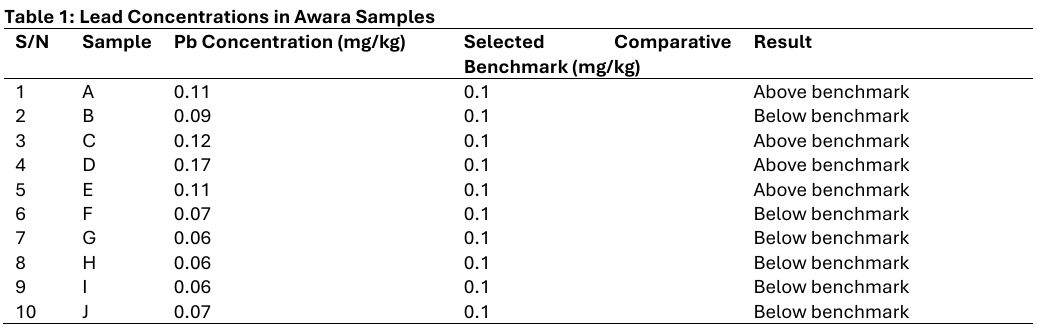
Potentially toxic element contamination of ready-to-eat foods is an important food-safety concern because dietary exposure may contribute to cumulative human exposure to environmental contaminants. This study investigated lead (Pb) and chromium (Cr) concentrations in soybean cake (awara) obtained from selected vending locations in Wudil Local Government Area, Kano State, Nigeria, and characterized consumer exposure under defined dietary parameters. Ten awara samples were collected and analyzed using Microwave Plasma Atomic Emission Spectrometry (MP-AES) following acid digestion. Lead was detected in all samples at concentrations of 0.06–0.17 mg/kg, with four samples (40%) exceeding 0.1 mg/kg, which was used as a comparative food-safety benchmark rather than an awara-specific legal limit. Chromium concentrations ranged from 0.06 to 0.14 mg/kg. Estimated daily intake (EDI) was calculated for adults and children using an awara consumption rate of 50 g/day and body weights of 60 and 24 kg, respectively. Lead exposure was characterized using dietary EDI because a health-protective oral reference dose is not currently established for inorganic lead. Chromium exposure was additionally assessed using a Cr(III)-based screening reference dose; however, total chromium was measured and Cr(III) and Cr(VI) were not differentiated, making this assessment conditional on an unverified Cr(III) assumption. Estimated exposures were consistently higher in children due to their lower body weight. The findings demonstrate detectable Pb and Cr contamination in awara and support continued surveillance, investigation of contamination pathways, chromium speciation, and locally derived consumption patterns.
References
Abdullahi, N., Dandago, M., Gambo, M., Abubakar, S., Tsoho, A., & Idah, P. (2026). Soil-plant transfer, bio-accumulation and health risks of potentially toxic elements in vegetables from Wudil, Northern Nigeria. European PMC. https://doi.org/10.21203/rs.3.rs-8779751/v1
Adeniyi, A. G., Iwuozor, K. O., Ogbureke, N., Erojikwe, O., Ajala, M. A., Ezenduka, J., Emenike, E. C., Akinsola, S. I., & Ikhenebome, D. (2026). Lead pollution in Nigeria: Recent trends, distribution, and remediation strategies. Next Research, 10, 101895. https://doi.org/10.1016/j.nexres.2026.101895
Adesida, S. O., & Alimba, C. G. (2025). Systematic literature review of radionuclides, heavy metals, and organochlorine pesticides in Nigerian food crops: Assessment of carcinogenic and non-carcinogenic health risk. Environmental Analysis, Health and Toxicology, 40(2), e2025012. https://doi.org/10.5620/eaht.2025012
Akamo, A. J., Olagunju, B. A., Kehinde, I. A., Akamo, N. M., & Akinloye, O. A. (2025). Evaluation and health risk analysis of potential toxic elements in select foods vended within a university campus in southeastern Nigeria. Journal of Trace Elements and Minerals, 12, 100248. https://doi.org/10.1016/j.jtemin.2025.100248
Alhassan, A. J., Muhammad, I. U., Sule, M. S., Dangambo, M. A., Gadanya, A. M., Umar, Y., Dangambo, M. A., Mohammed, A., & Syed, M. (2019). Correlation analysis of toxic metals distribution and pollution indices in soil, beans and maize samples of Kano State, Nigeria. Annual Research & Review in Biology, 32(3), 1–13.
CDC. (2023). Lead in blood: 2023 case definition. Centers for Disease Control and Prevention. https://ndc.services.cdc.gov/case-definitions/lead-in-blood-2023/
Chung, S. W. C. (2024). Update on chromium speciation analysis in foods: A review of advances in analytical methods and dietary exposure assessment. Food Additives & Contaminants: Part A, 41(7), 782–789. https://doi.org/10.1080/19440049.2024.2352858
Ertani, A., Mietto, A., Borin, M., & Nardi, S. (2019). Chromium in agricultural soils and crops: A review. Water, Air, & Soil Pollution, 230(2), 47. https://doi.org/10.1007/s11270-019-4085-1
Firdous, S. M., Maity, D., & Marick, S. (2026). Molecular and cellular mechanisms of lead-induced neurotoxicity: Comparative insights from rodent and zebrafish models. BioMetals, 39(5), 1467. https://doi.org/10.1007/s10534-026-00857-z
Flora, J., Arumugam, K., Kowsalya, S., Firdous, S., Theivasigamani, P., Viteri, J. S. H., & Uddin, I. (2026). A comprehensive review of chromium contamination in agricultural systems: Unraveling its journey from soil to food chain and strategies for safe remediation. Environmental Sciences Europe, 38, Article 144. https://doi.org/10.1186/s12302-026-01445-1
Joint FAO/WHO Expert Committee on Food Additives. (2011). Safety evaluation of certain food additives and contaminants: Seventy-third report of the Joint FAO/WHO Expert Committee on Food Additives. World Health Organization.
Jomova, K., Alomar, S. Y., Nepovimova, E., Kuca, K., & Valko, M. (2025). Heavy metals: Toxicity and human health effects. Archives of Toxicology, 99, 153–209. https://doi.org/10.1007/s00204-024-03903-2
Mustatea, G., & Ungureanu, E. L. (2024). Assessing the presence and health risks of potentially toxic metals in food: A comprehensive overview. Exploratory Foods and Foodomics, 2, 471–496. https://doi.org/10.37349/eff.2024.00047
Nag, R., & Cummins, E. (2022). Human health risk assessment of lead (Pb) through the environmental-food pathway. Science of the Total Environment, 810, 151168. https://doi.org/10.1016/j.scitotenv.2021.151168
Odubo, T. C., & Izah, S. C. (2025). Safety considerations of trace metals in locally produced nutritive food-drinks consumed in Yenagoa metropolis, Nigeria. Biological Trace Element Research, 203(8), 4408–4419. https://doi.org/10.1007/s12011-024-04488-8
Ogidi, O. I., & Tawariowei, A. M. (2023). Multi-elemental analysis and potential human health risk assessment of selected canned foods sold in Nigeria. FAO AGRIS.
Onoyima, C. C., Okibe, F. G., Ibrahim, A. Y., & Nwoye, E. E. (2023). Non-carcinogenic and carcinogenic risk assessment of some heavy metals in carrots selected from Wudil, Kano, Nigeria. Science World Journal, 18(1).
Orisakwe, O. E., Mbagwu, H. O. C., Ajaezi, G. C., Edet, U. W., & Uwana, P. U. (2015). Heavy metals in seafood and farm produce from Uyo, Nigeria: Levels and health implications. Sultan Qaboos University Medical Journal, 15(2), e275–e282. https://doi.org/10.18295/2075-0528.1691
Taiwo, A. M., Olukayode, S., Ojekunle, O. Z., Oyedepo, J. A., Awomeso, J. A., & Gbadebo, A. M. (2022). The content and toxicological risk assessment of trace elemental impurities (Pb and Cr) in snacks from Ogun State, Southwestern Nigeria. Biological Trace Element Research, 200(5), 2519–2527. https://doi.org/10.1007/s12011-021-02839-3
UNICEF. (2022). Contaminants reference table: Codex maximum permitted limit for contaminants in food and feed. UNICEF Supply Division.
US EPA. (1998). Chromium(III), insoluble salts (CASRN 16065-83-1). Integrated Risk Information System. https://iris.epa.gov/ChemicalLanding/&substance_nmbr=28
WHO. (2011). Lead in food: JECFA evaluation. World Health Organization. https://apps.who.int/food-additives-contaminants-jecfa-database/Home/Chemical/3511
WHO. (2024). Lead poisoning: Fact sheet. World Health Organization. https://www.who.int/news-room/fact-sheets/detail/lead-poisoning-and-health
Yaradua, A. I., Bungudu, J. I., Shuaibu, L., Alhassan, A. J., Nasir, A., Bello, U. A., Usman, A., Suleiman, Z. A., Abdullahi, A., Muhammad, M. M., & Yaradua, I. A. (2022). Heavy metals and health risk burden, how safe is the consumer population?: A study on the heavy metal content of soybeans cultivated in Katsina State, North West Nigeria. Asian Journal of Applied Chemistry Research, 11(4), 30–38.
Zhao, D., Wang, P., & Zhao, F.-J. (2024). Toxic metals and metalloids in food: Current status, health risks, and mitigation strategies. Current Environmental Health Reports, 11, 468–483. https://doi.org/10.1007/s40572-024-00462-7
Downloads
Published
Issue
Section
Categories
License
Copyright (c) 2026 Judith Ebunoluwa Olanrewaju (Author)

This work is licensed under a Creative Commons Attribution-NonCommercial 4.0 International License.
- Attribution — You must give appropriate credit, provide a link to the license, and indicate if changes were made. You may do so in any reasonable manner, but not in any way that suggests the licensor endorses you or your use.
- NonCommercial — You may not use the material for commercial purposes.
- No additional restrictions — You may not apply legal terms or technological measures that legally restrict others from doing anything the license permits.