
Renewable Energy-Based Smart Waste Management System for a Circular Economy
DOI:
https://doi.org/10.70882/josrar.2026.v3i5.311Keywords:
Waste Management (WM), Solar Energy, Internet of Things (IoT), Circular Economy, Sustainability, Renewable EnergyAbstract
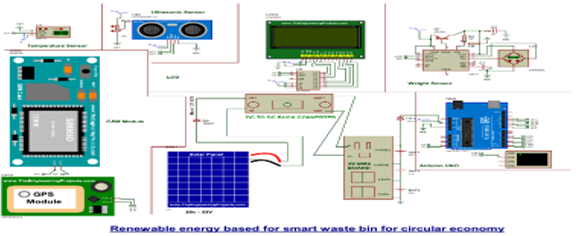
The urbanization of cities and the growing population have led to an increase in municipal solid waste generation, which has become an environmental and public health issue in urban areas. Traditional waste collection systems are characterized by overflowing garbage bins, unnecessary pickup operations, high cost of operation, and associated environmental impact. This paper presents the design and development of the Solar-Powered Smart Waste Management System (SWMS), which uses renewable energy and IoT technology to monitor and manage waste. SWMS consists of a smart waste bin that is managed by the ARDUINO UNO microcontroller and ultrasonic, temperature, humidity, and load cell sensors that monitor waste level, environment, and weight of the waste. Communication is established by the GSM and GPS modules, and a solar panel along with a rechargeable battery serves as a power source for SWMS. The ultrasonic sensor was able to detect the changes in the level of waste, the load cell sensor detected the changes in the weight of the waste, and the temperature and humidity sensors gave environmental readings. The GSM module was able to send notifications, whereas the solar panel was able to charge the battery, and the charged battery supplied power to the prototype. Simulation was also performed on the system using Proteus software to validate the operation of the electronic control and monitoring process. It should be noted that Proteus was not able to simulate the operation of the solar panel, battery management system (BMS), buck converter, and the entire battery subsystem. Thus, the results of the study prove the operation of the prototype, but not the full quantification of the accuracy of sensors or renewable energy.
References
Addas, A., Khan, M. N., & Naseer, F. (2024). Waste management 2.0 leveraging internet of things for an efficient and eco-friendly smart city solution. PLOS ONE, 19(7), e0307608. https://doi.org/10.1371/journal.pone.0307608
Ajibola, O. A., & Ogbolumani, O. (2024). Smart battery storage integration in an IoT-based solar-powered waste management system. Journal of Digital Food, Energy & Water Systems, 5(2), 17–42. https://doi.org/10.36615/hrewq861
Atofarati, E. O., Adogbeji, V. O., & Enweremadu, C. C. (2025). Sustainable smart waste management solutions for rapidly urbanizing African cities. Utilities Policy, 95, 101961. https://doi.org/10.1016/j.jup.2025.101961
Dehshiri, S. J. H., Amiri, M., Mostafaeipour, A., & Le, T. (2025). Improving sustainability in waste management based on the Internet of Things: A robust hybrid decision-making framework. Environmental Development, 56, 101292. https://doi.org/10.1016/j.envdev.2025.101292
Gubbi, J., Buyya, R., Marusic, S., & Palaniswami, M. (2013). Internet of Things (IoT): A vision, architectural elements, and future directions. Future Generation Computer Systems, 29(7), 1645–1660. https://doi.org/10.1016/j.future.2013.01.010
Guman, O., & Wegner-Kozlova, E. (2020). Waste management based on circular economy principles. E3S Web of Conferences, 177, 04014. https://doi.org/10.1051/e3sconf/202017704014
Henaien, A., Ben Elhadj, H., & Chaari Fourati, L. (2024). A sustainable smart IoT-based solid waste management system. Future Generation Computer Systems, 157, 587–602. https://doi.org/10.1016/j.future.2024.03.056
Hussain, I., Elomri, A., Kerbache, L., & Omri, A. E. (2024). Smart city solutions: Comparative analysis of waste management models in IoT-enabled environments using multiagent simulation. Sustainable Cities and Society, 103, 105247. https://doi.org/10.1016/j.scs.2024.105247
Iacovidou, E., Hahladakis, J. N., & Purnell, P. (2021). A systems thinking approach to understanding the challenges of achieving the circular economy. Environmental Science and Pollution Research, 28(19), 24785–24806. https://doi.org/10.1007/s11356-020-11725-9
Kabir, M. H., Roy, S., Ahmed, M. T., & Alam, M. (2020). IoT based solar powered smart waste management system with real time monitoring—An advancement for smart city planning. Global Journal of Computer Science and Technology: G Interdisciplinary, 20(5), 11–20. https://doi.org/10.34257/GJCSTGVOL20IS5PG11
Kannan, D., Khademolqorani, S., Janatyan, N., & Alavi, S. (2024). Smart waste management 4.0: The transition from a systematic review to an integrated framework. Waste Management, 174, 1–14. https://doi.org/10.1016/j.wasman.2023.08.041
Khan, S., Ali, B., Alharbi, A. A. K., Alotaibi, S., & Alkhathami, M. (2024). Efficient IoT-assisted waste collection for urban smart cities. Sensors, 24(10), 3167. https://doi.org/10.3390/s24103167
Kumaravel, G., & Ilankumaran, V. (2022). IoT based smart battery power and wastage level tracking system for solar powered waste bin by GSM technology. IOP Conference Series: Earth and Environmental Science, 1055(1), 012014. https://doi.org/10.1088/1755-1315/1055/1/012014
Lakhouit, A. (2025). Revolutionizing urban solid waste management with AI and IoT: A review of smart solutions for waste collection, sorting, and recycling. Results in Engineering, 25, 104018. https://doi.org/10.1016/j.rineng.2025.104018
Mohd Yusof, N., Faizal Zulkifli, M., Yusma Amira Mohd Yusof, N., & Azman, A. A. (2018). Smart waste bin with real-time monitoring system. International Journal of Engineering and Technology, 7(2.29), 725–729. https://doi.org/10.14419/ijet.v7i2.29.14006
Murugaanandam, S., Ganapathy, V., & Balaji, R. (2018). Efficient IoT based smart bin for clean environment. In 2018 International Conference on Communication and Signal Processing (ICCSP) (pp. 715–720). IEEE. https://doi.org/10.1109/ICCSP.2018.8524230
Nižetić, S., Djilali, N., Papadopoulos, A., & Rodrigues, J. J. P. C. (2019). Smart technologies for promotion of energy efficiency, utilization of sustainable resources and waste management. Journal of Cleaner Production, 231, 565–591. https://doi.org/10.1016/j.jclepro.2019.04.397
Ogbolumani, O. A., & Adekoya, M. (2025). Intelligent waste management optimization through machine learning analytics. Journal of Science Research and Reviews, 2(1), 7–26. https://doi.org/10.70882/josrar.2025.v2i1.25
Ogbolumani, O. A., & Godfrey, D. (2024). Nexus of wireframes, 3D model, and simulation for the development of an intelligent waste management system. FUDMA Journal of Sciences, 8(6), 328–342. https://doi.org/10.33003/fjs-2024-0806-3020
Ogbolumani, O., & Mabaso, B. (2023). An IoT-based hydroponic monitoring and control system for sustainable food production. Journal of Digital Food, Energy & Water Systems, 4(2), 106–140. https://doi.org/10.36615/digital_food_energy_water_systems.v4i2.2873
Okubanjo, A., Bashir Olufemi, O., Okandeji, A., & Daniel, E. (2024). Smart bin and IoT: A sustainable future for waste management system in Nigeria. Gazi University Journal of Science, 37(1), 222–235. https://doi.org/10.35378/gujs.1254271
Olawade, D. B., Fapohunda, O., Wada, O. Z., Usman, S. O., Ige, A. O., Ajisafe, O., & Oladapo, B. I. (2024). Smart waste management: A paradigm shift enabled by artificial intelligence. Waste Management Bulletin, 2(2), 244–263. https://doi.org/10.1016/j.wmb.2024.05.001
Pardini, K., Rodrigues, J. J. P. C., Diallo, O., Das, A. K., de Albuquerque, V. H. C., & Kozlov, S. A. (2020). A smart waste management solution geared towards citizens. Sensors, 20(8), 2380. https://doi.org/10.3390/s20082380
Ramson, S. R. J., Moni, D. J., Vishnu, S., Anagnostopoulos, T., Kirubaraj, A. A., & Fan, X. (2021). An IoT-based bin level monitoring system for solid waste management. Journal of Material Cycles and Waste Management, 23(2), 516–525. https://doi.org/10.1007/s10163-020-01137-9
SparkFun Electronics. (2015, June 11). Getting started with load cells. SparkFun Learn. SparkFun Learn – Getting Started with Load Cells
Suárez-Eiroa, B., Fernández, E., Méndez-Martínez, G., & Soto-Oñate, D. (2019). Operational principles of circular economy for sustainable development: Linking theory and practice. Journal of Cleaner Production, 214, 952–961. https://doi.org/10.1016/j.jclepro.2018.12.271
Ukala, U. D. C., Ifeanyi, A., & Owamah, H. I. (2020). A review of solid waste management practice in Nigeria. NIPES Journal of Science and Technology Research, 2(3), 169–174. https://doi.org/10.37933/nipes/2.3.2020.17
World Bank. (2023). Nigeria-Solar irradiation and PV power potential maps. World Bank Data Catalog. https://datacatalog.worldbank.org/search/dataset/0042025/nigeria-solar-irradiation-and-pv-power-potential-maps
Xiao, H., Li, Z., Jia, X., & Ren, J. (2020). Waste to energy in a circular economy approach for better sustainability: A comprehensive review and SWOT analysis. In Waste-to-energy: Multi-criteria decision analysis for sustainability assessment and ranking (pp. 23–43). Elsevier. https://doi.org/10.1016/B978-0-12-816394-8.00002-1
Zubairu, S. M. (2026). Barriers and enablers to renewable energy adoption in rural Northern Nigeria: A systematic review (2018–2025). Journal of Science Research and Reviews, 3(3), 107–111. https://doi.org/10.70882/josrar.2026.v3i3.218
Downloads
Published
Issue
Section
Categories
License
Copyright (c) 2026 Abubakar O. Jimoh, Omolola A. Ogbolumani (Author)

This work is licensed under a Creative Commons Attribution-NonCommercial 4.0 International License.
- Attribution — You must give appropriate credit, provide a link to the license, and indicate if changes were made. You may do so in any reasonable manner, but not in any way that suggests the licensor endorses you or your use.
- NonCommercial — You may not use the material for commercial purposes.
- No additional restrictions — You may not apply legal terms or technological measures that legally restrict others from doing anything the license permits.