Remifentanil versus Nitroglycerin for Inducing Controlled Hypotension During Primary Open Rhinoplasty: A Randomized Controlled Trial
DOI:
https://doi.org/10.70882/josrar.2026.v3i6.310Abstract
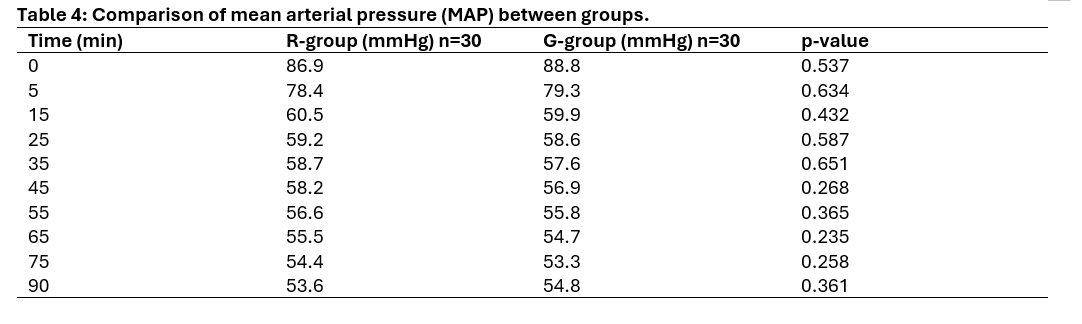
Lowering blood pressure during surgery is a widespread technique aimed at minimizing bleeding and improving visibility for the surgeon, especially when doing facial and aesthetic procedures. The aim of this investigation was to evaluate the efficacy of nitroglycerin and remifentanil on reducing blood pressure during rhino plastic surgery. This study done Al-Shaab teaching hospital in Baghdad, between October 2023 and December 2024. A total of 60 patients were distributed randomly into two groups, first one receiving remifentanil and the other one receiving nitroglycerin to achieve acceptable controlled hypotension, keeping mean arterial pressure within 60 mmHg. Intraoperative hemodynamic variables, including heart rate and systolic and diastolic blood pressures, were continuously monitored. The two groups were further evaluated and compared regarding intraoperative blood loss, duration of surgery, and the quality of the operative field. Both nitroglycerin and remifentanil groups attained similar targets for systolic, diastolic, and mean arterial pressures. Nevertheless, the group receiving remifentanil had a shorter operative time of 135.3 minutes than the one receiving nitroglycerin of 145.3 minutes. The heart rate was very different in both cases, with remifentanil having a better cardiovascular regulation. In addition, there were lower levels of bleeding during operation, improved visualization in the operating field, and increased surgeon satisfaction for remifentanil. The continuous infusion of nitroglycerin and remifentanil effectively achieves hypotension control by achieving the required mean arterial pressure. Remifentanil proves to be better than nitroglycerin because it effectively restricts blood loss and operative time while maintaining hemodynamic stability.
References
Beikaei, M., Ghazipour, A., Derakhshande, V., Saki, N., & Nikakhlagh, S. (2015). Evaluating the effect of intravenous tranexamic acid on intraoperative bleeding during elective rhinoplasty surgery. Biomedical & Pharmacology Journal, 8(Special Edition), 753–759. https://doi.org/10.13005/bpj/779
Butterworth, J. F., IV, Mackey, D. C., & Wasnick, J. D. (2013). Morgan & Mikhail’s clinical anesthesiology (5th ed.). McGraw-Hill Medical.
Degoute, C.-S. (2007). Controlled hypotension: A guide to drug choice. Drugs, 67(7), 1053–1076. https://doi.org/10.2165/00003495-200767070-00007
Degoute, C.-S., Ray, M. J., Manchon, M., Dubreuil, C., & Banssillon, V. (2001). Remifentanil and controlled hypotension; comparison with nitroprusside or esmolol during tympanoplasty. Canadian Journal of Anesthesia, 48(1), 20–27. https://doi.org/10.1007/BF03019809
Dolman, R. M., Bentley, K. C., Head, T. W., & English, M. (2000). The effect of hypotensive anesthesia on blood loss and operative time during Le Fort I osteotomies. Journal of Oral and Maxillofacial Surgery, 58(8), 834–839. https://doi.org/10.1053/joms.2000.8194
Dongre, H., Sharma, V., Premendran, B., Dongre, A., & Tidke, S. (2012). The efficacy of esmolol and nitroglycerine in creating dry operative field by producing controlled hypotension in spinal surgeries. IOSR Journal of Pharmacy, 2(4), 26–33. https://doi.org/10.9790/3013-24102633
Flood, P., Rathmell, J. P., & Shafer, S. (Eds.). (2015). Stoelting’s pharmacology and physiology in anesthetic practice (5th ed.). Wolters Kluwer.
Ghodraty, M., Khatibi, A., Rokhtabnak, F., Maleki, M., & Parsa, F. (2017). Comparing labetalol and nitroglycerine on inducing controlled hypotension and intraoperative blood loss in rhinoplasty: A single-blinded clinical trial. Anesthesiology and Pain Medicine, 7(5), Article e13677. https://doi.org/10.5812/aapm.13677
Guney, A., Kaya, F. N., Yavascaoglu, B., Gurbet, A., Selmi, N. H., Kaya, S., & Kutlay, O. (2012). Comparison of esmolol to nitroglycerine in controlling hypotension during nasal surgery. The Eurasian Journal of Medicine, 44(2), 99–105. https://doi.org/10.5152/eajm.2012.23
Keech, B. M., & Laterza, R. D. (Eds.). (2021). Anesthesia secrets (6th ed.). Elsevier.
Koşucu, M., Ömür, S., Beşir, A., Uraloğlu, M., Topbaş, M., & Livaoğlu, M. (2014). Effects of perioperative remifentanil with controlled hypotension on intraoperative bleeding and postoperative edema and ecchymosis in open rhinoplasty. Journal of Craniofacial Surgery, 25(2), 471–475. https://doi.org/10.1097/SCS.0000000000000603
Modir, H., Modir, A., Rezaei, O., & Mohammadbeigi, A. (2018). Comparing remifentanil, magnesium sulfate, and dexmedetomidine for intraoperative hypotension and bleeding and postoperative recovery in endoscopic sinus surgery and tympanomastoidectomy. Medical Gas Research, 8(2), 42–47. https://doi.org/10.4103/2045-9912.235124
Simpson, P. (1992). Perioperative blood loss and its reduction: The role of the anaesthetist. British Journal of Anaesthesia, 69(5), 498–507. https://doi.org/10.1093/bja/69.5.498
Tinker, J. H., & Michenfelder, J. D. (1976). Sodium nitroprusside: Pharmacology, toxicology and therapeutics. Anesthesiology, 45(3), 340–354. https://doi.org/10.1097/00000542-197609000-00016
Tobias, J. D. (2002). Controlled hypotension in children: A critical review of available agents. Paediatric Drugs, 4(7), 439–453. https://doi.org/10.2165/00128072-200204070-00003
Tuncel, U., Turan, A., Bayraktar, M. A., Erkorkmaz, U., & Kostakoglu, N. (2013). Efficacy of dexamethasone with controlled hypotension on intraoperative bleeding, postoperative oedema and ecchymosis in rhinoplasty. Journal of Cranio-Maxillofacial Surgery, 41(2), 124–128. https://doi.org/10.1016/j.jcms.2012.06.003
Downloads
Published
Issue
Section
Categories
License
Copyright (c) 2026 Halah M.J. Alkhattab, Haitham Hassan Abbas (Author)

This work is licensed under a Creative Commons Attribution-NonCommercial 4.0 International License.
- Attribution — You must give appropriate credit, provide a link to the license, and indicate if changes were made. You may do so in any reasonable manner, but not in any way that suggests the licensor endorses you or your use.
- NonCommercial — You may not use the material for commercial purposes.
- No additional restrictions — You may not apply legal terms or technological measures that legally restrict others from doing anything the license permits.