
A Computational and Statistical Analysis of the Relationship Between Euler’s Totient Function and the Sum-of-Divisors Function
DOI:
https://doi.org/10.70882/josrar.2026.v3i5.309Keywords:
Euler’s Totient Function, Sum-of-Divisors Function, Number Theory, Statistical Analysis, Pearson Correlation, Linear Regression, MATLAB, Arithmetic Functions, Prime FactorizationAbstract
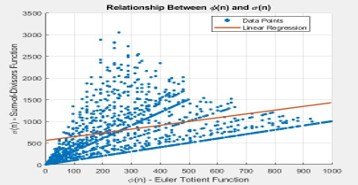
This study examines the statistical relationship between Euler’s Totient Function, ϕ(n), and the Sum-of-Divisors Function, σ(n), using computational and statistical methods implemented in MATLAB. The analysis was conducted on the first 1,000 positive integers, for which both arithmetic functions were computed. Descriptive statistics, covariance, Pearson’s correlation coefficient, statistical significance testing, linear regression, and graphical analysis were employed to investigate the relationship between the two functions. The results showed that the mean value of ϕ(n) was 304.1920 whereas the mean value of σ(n) was 823.0810. The Pearson's correlation coefficient was calculated and there was a positive but relatively weak-to-moderate linear association, r=0.3443. There was a significant relation between the two (p < 0.001). A simple linear regression was used to get the model as σ(n)=0.8737+ϕ(n)=557.3142 and the coefficient of determination R 2 = 0.1185. This means that there is about 11.85% of the variance in the Sum-of-Divisors Function accounted for by the simple linear relationship with Euler's Totient Function. The results demonstrate that there is a positive and statistically significant relationship between ϕ(n) and σ(n); however, the relationship is not strongly linear. This may be attributed to the distinct arithmetic properties measured by the two functions and their different dependencies on the prime factorization and divisor structure of integers. Overall, the study highlights the value of computational and statistical methods implemented in MATLAB for exploring relationships between classical arithmetic functions.
References
Amdeberhan, T., Andrews, G. E., & Tauraso, R. (2024). Extensions of MacMahon’s sums of divisors. Research in the Mathematical Sciences, 11(1), https://doi.org/10.1007/s40687-024-00421-6
Baker, A. (2022). Transcendental number theory. Cambridge University Press.
Cox, D., Ghosh, S., & Sultanow, E. (2022). A generalization of the sum of divisors function [Preprint]. (Note: Entries 5 and 10 from your original list were duplicates of this paper)
Hasse, H. (2022). Number theory. Walter de Gruyter.
Jakimczuk, R. (2026). A theorem on the sum of divisors function [Preprint]. ResearchGate.
Johnson, P. L. (2026). On equal values of the sum-of-divisors function and related natural density [Master’s thesis, Tennessee Technological University].
Kaliski, B. (2025). Euler’s totient function. In Encyclopedia of cryptography, security and privacy (pp. 834–835). Springer Nature Switzerland.
Oliver, R. J. L., Shrestha, S. T., & Thorne, F. (2023). Asymptotic identities for additive convolutions of sums of divisors. Mathematical Proceedings of the Cambridge Philosophical Society, 174(1), 59–78. https://doi.org/10.1017/S0305004122000135
Zwain, H. M. (2026). Computational and statistical study of the relationship between σ (n) and φ (n) in natural numbers. Journal of Pure and Applied Sciences (Science Forum), 26(4).
Downloads
Published
Issue
Section
Categories
License
Copyright (c) 2026 Hind Mahdi Zwain (Author)

This work is licensed under a Creative Commons Attribution-NonCommercial 4.0 International License.
- Attribution — You must give appropriate credit, provide a link to the license, and indicate if changes were made. You may do so in any reasonable manner, but not in any way that suggests the licensor endorses you or your use.
- NonCommercial — You may not use the material for commercial purposes.
- No additional restrictions — You may not apply legal terms or technological measures that legally restrict others from doing anything the license permits.