
Production Risk and Productivity of Smallholder Onion Farmers in Taraba State, Nigeria
DOI:
https://doi.org/10.70882/josrar.2026.v3i5.307Keywords:
Cobb-Douglas Production Function, Onion Production, Productivity, Returns to Scale, Risk, Smallholder FarmersAbstract
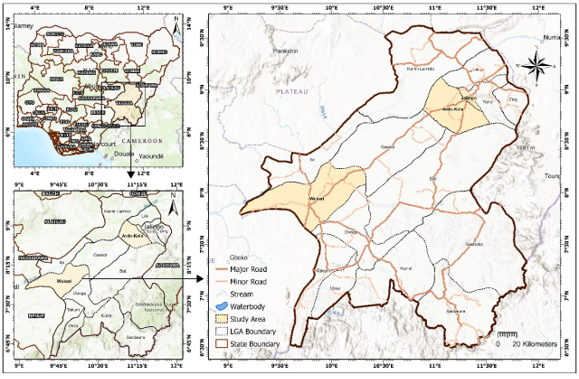
This study examined the production risks and productivity of smallholder onion farmers in Taraba State, Nigeria. The study specifically analyzed the production risk associated with onion production for each input, assessed the contribution of major production inputs to onion output, and estimated the returns to scale in onion production. A multistage sampling procedure was used to select 254 onion farmers from Jalingo, Ardo-Kola, and Wukari Local Government Areas of Taraba State. Primary data were collected during the 2025 cropping season using semi-structured questionnaires. The collected data were analyzed usingCobb-Douglas production function model.The results revealed that Fertilizer, seed, and agro-chemicals played a significant role in increasing output and reducing production risk, while labour remains a major source of yield variability. The findings also revealed that seed (β = 0.424, p˂0.01), fertilizer (β = 0.475, p˂0.01), and labour (β = 0.096, p˂0.01) had positive and statistically significant relationship with onion output, while agro-chemical use had a positive but statistically insignificant relationship (β = 0.004, p = 0.485); with seed and fertilizer exercise the strongest relationship on productivity. The estimated return to scale indicated increasing returns to scale, implying that farmers were still operating below the optimum production level and could increase output by more efficiently utilizing available resources. The study concluded that onion production in Taraba State has considerable potential for improved productivity if farmers are supported with quality inputs, extension services, and improved production practices. The study recommended that farmers should be encouraged to use improved onion seed and fertilizer appropriately. Although seed and fertilizer contributed positively to onion output, their risk-reducing relationship was not statistically significant. Therefore, farmers should focus on using good-quality seed and applying fertilizer at recommended rates rather than simply increasing the quantities used.
References
Ambali, O.I., Adegbite, D.A., Ayinde, I.A., &Awotide, D.O. (2012). Analysis of Production Efficiency of Food Crop Farmers in Ogun State, Nigeria. Journal of Agricultural and Biological Science, 7(9), pp 680–688.
Danji, M.B., Kara, H.A., Luqman, M.M., David, F.A., Adamu, M.M.,& Muhammad, B. (2025). Technical Efficiency of Onion Production: The Case of Smallholder Farmers in Wukari Local Government Area of Taraba State, Nigeria. J. Glob. Innov. Agric. Sci. 13(4): pp 1-6. ISSN (Online):2788–4546; ISSN (Print):2788–4538. http://www.jgiass.com
Food and Agriculture Organization of the United Nations (FAO, 2024). FAOSTAT Statistical Database: Crops and Livestock Products. Retrieved from https://www.fao.org/faostat.
Food and Agriculture Organization of the United Nations (FAO), (2020), Crops, Accessed 29 July 2020, 10 September 2020, 14 and 16 January 2021, http://www.fao.org/faostat/en/#data/QC.
Kara, A.H., Shamsudin, M.N., Mohamed, Z., Latiff, I.B., & Seng, K.W.K. (2019). Technical Efficiency and Production Risk of Rice Farms under the Ancho Borrowers Programme in Kebbi State, Nigeria. Asian Journal of Agricultural Extension, Economics and Sociology, 31(4), pp 1–12.
Khai, H.V., & Yabe, M. (2011). Technical Efficiency Analysis of Rice Production in Vietnam. Journal of ISSAAS, 17(1), pp 135–146.
Koye, T. D., Koye, A. D., & Mekie, T. M. (2022). Analysis of Technical Efficiency of Irrigated Tomato Production in North Gondar Zone of Amhara Regional State, Ethiopia. Letters in Spatial and Resource Sciences, 15(3), pp 599-620.
Kumbhakar, S.C. (2002). Specification and Estimation of Production Risk, Risk Preferences and Technical Efficiency. American Journal of Agricultural Economics, 84(1), pp 8-22.
Ogundari, K. &Akinbogun, O.O. (2010). Modelling Technical Efficiency with Production Risk. A Study of Fish Farms in Nigeria. Marine Resource Economics, vol 25.
Olanrewaju, K. O., Akintunde, O. K., Adeoye, I. B., & Bamiwuye, O. A. (2021). Gender Differential in Leafy Vegetable Production in Lagelu Local Government Area of Oyo State, Nigeria. Journal of Agriculture and Food Sciences, 19(1), pp 120–133.
Oruonye, E.D., & Abbas, B. (2011). The Geography of Taraba State, Nigeria. LAP LAMBERT Academic Publishing GnBH& Co. KG and Licensors.
Osei, S.K., Folitse, B.Y., Dzandu, L.P. & Obeng-Koranteng, G. (2017). Sources of Information for Urban Vegetable farmers in Accra, Ghana. Information Development, 33(1):pp72–79.
Rahman, K.M.M., Mia, M.I.A. &Bhuiyan, M.K.J. (2012).A Stochastic Frontier Approach to Model Technical Efficiency of Rice Farmers in Bangladesh: An Empirical Analysis. The Agriculturists 10(2): pp 9-19 ISSN.1729-5211.
Robert, K., Kara, H.A., Adamu, M.M. & Muhammad, B. (2021). Analysis of Dry Season Vegetable Production Among Kiri Dam Users in Adamawa State, Nigeria. Journal of Agripreneurship and Sustainable Development. 4(4): pp 2651–6365.
TADP (2021). Taraba State Agricultural Development Programme.
Yamane, T. (1967). Statistics, an Introductory Analysis, 2nd Ed., New York: Harper and Row.
Yahaya, K., Gindi, A.A., Buhari, A.K.& Umar, H.S. (2019). Profit and Technical Efficiency Estimation of Onion Farms in Aliero Local Government Area of Kebbi State, Nigeria. Direct Research Journal of Agriculture and Food Science.7(2): Pp. 30-35.
Downloads
Published
Issue
Section
Categories
License
Copyright (c) 2026 Magaji Bitrus Danji, Edinya Jatau Garba, Justice Inyanda Onu, Abdu Akaliyus Tashkalma (Author)

This work is licensed under a Creative Commons Attribution-NonCommercial 4.0 International License.
- Attribution — You must give appropriate credit, provide a link to the license, and indicate if changes were made. You may do so in any reasonable manner, but not in any way that suggests the licensor endorses you or your use.
- NonCommercial — You may not use the material for commercial purposes.
- No additional restrictions — You may not apply legal terms or technological measures that legally restrict others from doing anything the license permits.