Household Water Sources, Accessibility and Consumption Patterns in Selected Rural Communities of Taraba State, Nigeria
DOI:
https://doi.org/10.70882/josrar.2026.v3i5.298Keywords:
Rural water insecurity, Household water consumption, Water accessibility, Rural livelihoods, Water infrastructure, Sustainable Development Goal 6Abstract
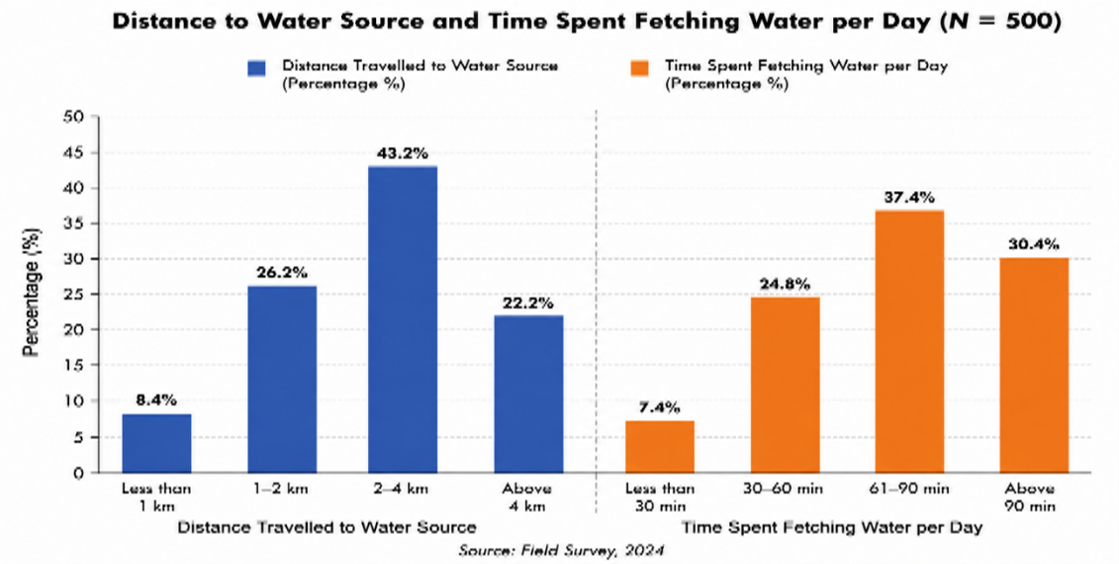
Rural water insecurity remains a persistent development challenge in Nigeria, particularly in communities with limited access to reliable water infrastructure. This study assessed water supply, household water consumption patterns, and factors influencing water use in ten rural communities of Taraba State, northeastern Nigeria. The communities were purposively selected based on their rural characteristics and varying access to functional water infrastructure, after which households were sampled systematically. A cross-sectional household survey was conducted among 500 respondents, producing allocations ranging from 40 to 62 respondents in each community. Data were collected using structured questionnaires and analysed using descriptive statistics, Pearson correlation, and multiple linear regression. Results showed that rivers and streams were the principal sources of domestic water (39.0%), followed by rainwater harvesting (34.0%) and hand-dug wells (23.4%), while only 3.6% of households used private or public boreholes. Distance to water source, collection time, and water cost were negatively associated with household water consumption, whereas household income and household size showed positive associations. The regression model explained 53.4% of the variation in household water consumption (adjusted R² = 0.529; p < 0.001). Distance to the water source had the largest absolute standardised regression coefficient in the reported model (β = −0.396). However, distance, collection time, income and other categorical or range-based variables were represented using numerical codes for ordered categories; therefore, coefficients should be interpreted as associations with coded categories rather than necessarily as effects per continuous unit. The findings highlight physical accessibility, affordability and socioeconomic conditions as important dimensions of rural water insecurity and underscore the need for improved water infrastructure and maintenance.
References
Adeyeye, K., Gibberd, J., & Chakwizira, J. (2020). Water marginality in rural and peri-urban communities. Journal of Cleaner Production, 273, 122594. https://doi.org/10.1016/j.jclepro.2020.122594
Amankwaa, G., Abrefa Busia, K., Agbadi, P., Duah, H. O., & Arthur-Holmes, F. (2024). Access heterogeneities and collection time inequalities of drinking water sources in Ghana: Implications for water and development policy. Local Environment, 29(3), 263–278.
Bain, R., Cronk, R., Hossain, R., Bonjour, S., Onda, K., Wright, J., Yang, H., Slaymaker, T., Hunter, P., Prüss-Ustün, A., & Bartram, J. (2014). Global assessment of exposure to faecal contamination through drinking water based on a systematic review. Tropical Medicine & International Health, 19(8), 917–927. https://doi.org/10.1111/tmi.12334
Bartram, J., & Howard, G. (2003). Drinking-water standards for the developing world. In Handbook of water and wastewater microbiology (pp. 221–240).
Bazaanah, P., & Mothapo, R. A. (2024). Sustainability of drinking water and sanitation delivery systems in rural communities of the Lepelle-Nkumpi Local Municipality, South Africa. Environment, Development and Sustainability, 26(6), 14223–14255.
Cominola, A., Preiss, L., Thyer, M., Maier, H. R., Prevos, P., Stewart, R. A., & Castelletti, A. (2023). The determinants of household water consumption: A review and assessment framework for research and practice. npj Clean Water, 6, Article 11. https://doi.org/10.1038/s41545-022-00208-8
Cook, J., Kabubo-Mariara, J., & Kimuyu, P. (2024). Short-run impacts of reducing water collection times on time use, well-being, and education in rural Kenya. Economic Development and Cultural Change, 73(1), 273–306. https://doi.org/10.1086/727342
Damania, R., Desbureaux, S., Hyland, M., Islam, A., Moore, S., Rodella, A. S., Russ, J., & Zaveri, E. (2017). Uncharted waters: The new economics of water scarcity and variability. World Bank.
Efe, S. I. (2006). Quality of rainwater harvesting for rural communities of Delta State, Nigeria. Environmentalist, 26(3), 175–181.
Efe, S. I., Ogban, F. E., Horsfall, M., Jr., & Akporhonor, E. E. (2005). Seasonal variations of physico-chemical characteristics in water resources quality in western Niger Delta region, Nigeria. Journal of Applied Sciences and Environmental Management, 9(1), 191–195. https://doi.org/10.4314/jasem.v9i1.17282
Egwom, O. J., Godwin, A. I., Ogar, M. O., & John, G. (2025). Digital solution for seamless water supply management in Wukari metropolis. Journal of Science Research and Reviews, 2(1), 62-75.
Israilova, E., Voronina, A., & Shatila, K. (2023). Impact of water scarcity on socio-economic development. E3S Web of Conferences, 458, 08027.
Miller, J. D., Young, S. L., Bryan, E., & Ringler, C. (2024). Water insecurity is associated with greater food insecurity and lower dietary diversity: Panel data from sub-Saharan Africa during the COVID-19 pandemic. Food Security, 16(1), 149–160.
Ngayaga, M. (2025). Socioeconomic determinants of household access to clean water: A case study of a selected peri-urban ward in northern Tanzania [Doctoral dissertation, Nelson Mandela African Institution of Science and Technology].
Ovrawah, L., & Hymore, F. K. (2001). Quality of water from hand-dug wells in the Warri environs of Niger Delta region. African Journal of Environmental Studies, 2(2), 169–173.
Oyerinde, A. O., & Jacobs, H. E. (2022). Determinants of household water demand: A cross-sectional study in South West Nigeria. Journal of Water, Sanitation and Hygiene for Development, 12(2), 200–207.
Pacheco-Treviño, S., & Manzano-Camarillo, M. G. F. (2024). Review of water scarcity assessments: Highlights of Mexico's water situation. WIREs Water, 11(4), e1721.
Sani, Y., & Tukur, A. (2026). Rural water supply management and sustainability: A case study of Katsina State, Nigeria. ISA Journal of Multidisciplinary, 3(4). https://doi.org/10.5281/zenodo.21109173
Srinivasan, V., Lambin, E. F., Gorelick, S. M., Thompson, B. H., & Rozelle, S. (2012). The nature and causes of the global water crisis: Syndromes from a meta-analysis of coupled human-water studies. Water Resources Research, 48(10), Article W10516.
Streeten, P., & Burki, S. J. (1978). Basic needs: Some issues. World Development, 6(3), 411–421. https://doi.org/10.1016/0305-750X(78)90116-X
Streeten, P., Burki, S. J., Haq, M. ul, Hicks, N., & Stewart, F. (1981). First things first: Meeting basic human needs in the developing countries. Oxford University Press.
Van den Broeck, A., Vansteenkiste, M., De Witte, H., & Lens, W. (2008). Explaining the relationships between job characteristics, burnout, and engagement: The role of basic psychological need satisfaction. Work & Stress, 22(3), 277–294.
Vansteenkiste, M., Soenens, B., & Ryan, R. M. (2023). Basic psychological needs theory: A conceptual and empirical review of key criteria. In The Oxford handbook of self-determination theory (pp. 84–123).
World Health Organization & United Nations Children’s Fund. (2025). Progress on household drinking water, sanitation and hygiene 2000–2024: Special focus on inequalities. World Health Organization. https://www.who.int/publications/i/item/9789240115149
Yusuf, W. O., Jidauna, G. G., & Ndabula, C. (2026). Domestic water supply sources and household utilization of rainwater harvesting in Dutsin-Ma Town, Katsina State, Nigeria. FUDMA Journal of Earth and Environmental Sciences, 3(1), 176–190.
Downloads
Published
Issue
Section
Categories
License
Copyright (c) 2026 Joseph Oghenero Mogborukor, Tega Emmanuel Eyetan, Shedrach Terlumun Semaka (Author)

This work is licensed under a Creative Commons Attribution-NonCommercial 4.0 International License.
- Attribution — You must give appropriate credit, provide a link to the license, and indicate if changes were made. You may do so in any reasonable manner, but not in any way that suggests the licensor endorses you or your use.
- NonCommercial — You may not use the material for commercial purposes.
- No additional restrictions — You may not apply legal terms or technological measures that legally restrict others from doing anything the license permits.