
Association of Anthropometric Adiposity Indices with Anxiety Symptoms in Type 2 Diabetes Mellitus at Ahmadu Bello University Teaching Hospital Zaria, Kaduna State
DOI:
https://doi.org/10.70882/josrar.2026.v3i3.296Keywords:
Type 2 Diabetes Mellitus, Anxiety Symptoms, Anthropometric Adiposity Indices, Waist–Hip Ratio, Triceps Skinfold ThicknessAbstract
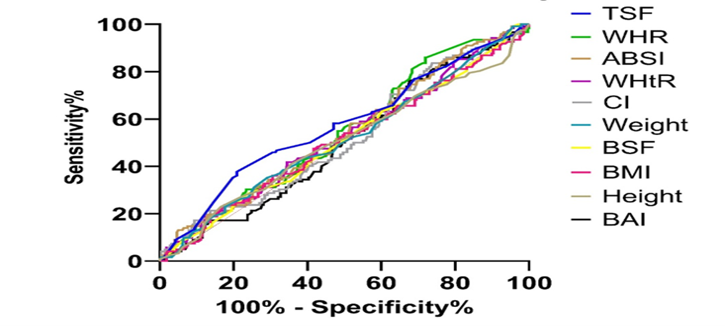
Anxiety symptoms are common psychological complications among individuals with Type 2 Diabetes Mellitus (T2DM) and may contribute to poor disease outcomes. Anthropometric adiposity indices reflect metabolic alterations associated with diabetes; however, their relationship with anxiety symptoms remains insufficiently explored, particularly in African clinical populations. This study evaluated the association between anthropometric adiposity indices and anxiety symptoms among patients with T2DM attending Ahmadu Bello University Teaching Hospital, Zaria. A cross-sectional analytical study was conducted among 400 patients with T2DM. Anxiety symptoms were assessed using the Generalized Anxiety Disorder-7 questionnaire. Anthropometric indices, including body mass index (BMI), waist-to-hip ratio (WHR), waist-to-height ratio (WHtR), body adiposity index (BAI), conicity index (CI), a body shape index (ABSI), biceps skinfold thickness (BSF), and triceps skinfold thickness (TSF), were evaluated. Binary logistic regression was used to assess associations, while receiver operating characteristic (ROC) curve analysis evaluated discriminatory performance. The overall logistic regression model was not significantly associated with anxiety symptom status (Omnibus test: χ² = 11.294, df = 7, p = 0.126). TSF showed a significant association with anxiety symptoms (OR = 1.076, 95% CI: 1.009–1.148, p = 0.026), while BSF demonstrated a borderline association. ROC analysis revealed limited discriminatory ability across all indices, with TSF showing the highest area under the curve (AUC = 0.5737, 95% CI: 0.5112–0.6362). Anthropometric adiposity indices alone have limited ability to identify anxiety symptoms among patients with T2DM. Although TSF showed a weak association, psychological, metabolic, and socioeconomic factors should be considered when assessing anxiety risk in this population.
References
Abdullahi, I., Tanko, M., Umana, U. E., Mustapha, M., Sabo, H. L., Aliyu, A. I., Babankanwa, A. H., Sulaiman, Y. I., Umar, A. S., Umoh, E. C., Abdulmalik, M., Nasidi, A., Bello, S. A., & Oyewo, R. A. (2024). Prevalence of cognitive impairment and its associated risk factors among subjects with type-2 diabetes mellitus attending referral hospitals in Katsina state. Nigerian Journal of Neuroscience, 15(3), 87-96.
Agbir, T. M., Audu, M. D., Adebowale, T. O., & Goar, S. G. (2010). Depression among medical outpatients with diabetes: A cross-sectional study at Jos University Teaching Hospital, Jos, Nigeria. Annals of African Medicine, 9(1).
Azudialu, B. C., Timothy, N., Emmanuel, O., Frances, O., Obi-Nwosu, A., & Nkem, B. I. (2024). Prevalence and predictors of depression among adult male patients with type 2 diabetes mellitus attending general outpatient clinic in a tertiary hospital in Northern Nigeria. Journal of Advances in Medicine and Medical Research, 36(7), 132-141.
Abu Bonsra, E., Mbiba, F., Kyeremeh, E. A., Kyere, G. A., & Kwame Ananga, M. (2025). Depression, anxiety, and stress among diabetic patients in Ghana: a health facility–based mixed-method cross-sectional study at Volta Regional Hospital. BMC Public Health, 25(1), 2369.
Abdulmalik, N. A., Akpor, O. A., Bamidele, F. I., Adeoluwa, O. A., & Olaniyi, K. S. (2025). The New Type 3 Diabetes Mellitus: A Growing Concern. Medical Journal of Dr. DY Patil Vidyapeeth, 18(5), 757-763.
Agyemang, C., Tetteh, J., Mbaye, M. N., Lamptey, R., Seidu, S., Khunti, K., & Kengne, A. P. (2026). Burden and determinants of diabetes in sub-Saharan Africa. The Lancet Diabetes & Endocrinology, 14(6), 498-511.
Ahmad, E., Lim, S., Lamptey, R., Webb, D. R., & Davies, M. J. (2022). Type 2 diabetes. The Lancet, 400(10365), 1803-1820.
Basiri, R., Seidu, B., & Rudich, M. (2023). Exploring the interrelationships between diabetes, nutrition, anxiety, and depression: implications for treatment and prevention strategies. Nutrients, 15(19), 4226.
Boakye, M. D. S., Osei, E. P., Akyirem, S., Dare, S., Omololu, S. O., Ekpor, E., ... & Suglo, J. N. (2026). Psychosocial burden of diabetes in Africa: a systematic review and meta-analysis. Journal of Health Psychology, 31(3), 948-982.
Bakhtiani, P., & Geffner, M. E. (2022). Early anthropometric indicators of type 2 diabetes mellitus. Current Opinion in Endocrinology, Diabetes and Obesity, 29(1), 52-56.
Bennasar-Veny, M., Lopez-Gonzalez, A. A., Tauler, P., Cespedes, M. L., Vicente-Herrero, T., Yañez, A., Tomas-Salva, M., & Aguilo, A. (2013). Body adiposity index and cardiovascular health risk factors in Caucasians: A comparison with the body mass index and others. PloS One, 8(5), e63999.
Bhardwaj, R., Agrawal, U., Vashist, P., & Manna, S. (2024). Determination of sample size for various study designs in medical research: A practical primer. Journal of Family Medicine and Primary Care, 13(7), 2555-2561.
Bielka, W., Przezak, A., Molęda, P., Pius-Sadowska, E., & Machaliński, B. (2024). Double diabetes—when type 1 diabetes meets type 2 diabetes: Definition, pathogenesis and recognition. Cardiovascular Diabetology, 23(1), 62.
Calderón-García, J. F., Roncero-Martín, R., Rico-Martín, S., De Nicolás-Jiménez, J. M., López-Espuela, F., Santano-Mogena, E., Alfageme-García, P., & Sanchez Munoz-Torrero, J. F. (2021). Effectiveness of body roundness index (BRI) and a body shape index (ABSI) in predicting hypertension: A systematic review and meta-analysis of observational studies. International Journal of Environmental Research and Public Health, 18(21), 11607.
Christakoudi, S., Tsilidis, K. K., Muller, D. C., Freisling, H., Weiderpass, E., Overvad, K., Söderberg, S., Häggström, C., Pischon, T., Dahm, C. C., & Zhang, J. A. (2020). Body Shape Index (ABSI) achieves better mortality risk stratification than alternative indices of abdominal obesity: Results from a large European cohort. Scientific Reports, 10(1), 14541.
Chen, P., Zhang, P., Lin, Z., Qiu, J., Zou, M., Liu, R., ... & Sun, W. (2025). Association between changes in obesity status and neuropsychiatric health and brain structure in different glucose status. Frontiers in Nutrition, 12, 1676168.
Damayantie, N., Ernawati, E., Dewi, M., & Fahmi, I. (2025). Nursing education on diabetes through smartphone therapeutic applications. Health Education and Health Promotion, 12(1), 9-15.
Erhunmwunse, R., Ogbodo, E., & Muoneke, G. (2025). Complications associated with type 2 diabetes mellitus, pathophysiology, diagnosis and management: A concise review of current literature. Saudi J Biomed Res, 10(7), 201-244.
Edah, J. O., Goar, S. G., Odoh, G., Lawal, B., Dayom, P. S., Sunday, Z. F., Sawa, I. F., Obi, C. V., Ochigbo, E. E., & Puepet, F. H. (2020). Undiagnosed depression among adults with diabetes mellitus in Jos. Nigerian Journal of Clinical Practice, 23(10), 1431-1436.
Fu, X., Zhao, Y., Wu, Y., Wen, L., Huo, W., Zhang, D., Zhang, Y., Li, J., Lu, X., Hu, F., & Zhang, M. (2025). Relationship between the trajectory of Chinese visceral adiposity index and risk of type 2 diabetes mellitus: Evidence from the China-PAR project. Diabetes, Obesity and Metabolism, 27(2), 785-794.
Gowda, V., & Philip, K. M. (2016). Abdominal volume index and conicity index in predicting metabolic abnormalities in young women of different socioeconomic classes. International Journal of Medical Sciences and Public Health, 5(7), 1452-1456.
Gonzalez, J. S., Tanenbaum, M. L., & Commissariat, P. V. (2016). Psychosocial factors in medication adherence and diabetes self-management: Implications for research and practice. American Psychologist, 71(7), 539.
Gulzar, M., Saboor, S., Abbas, S. H., & Anser, A. (2025). Prevalence of Depression and Anxiety in Patients with Type 2 Diabetes Mellitus and Their Association with Glycemic Control: A Cross-Sectional Study: Depression, Anxiety, and Glycemic Control in Type 2 Diabetes. DEVELOPMENTAL MEDICO-LIFE-SCIENCES, 2(8), 34-40.
Geraci, C., Geraci, G., Buonauro, A., Morello, V., La Rocca, F., & Esposito, R. (2026). Gaps in current cardiometabolic risk assessment: a review supporting the development of the CORE indicator model. Journal of Clinical Medicine, 15(2), 617.
Hasan, S. S., Clavarino, A. M., Dingle, K., Mamun, A. A., & Kairuz, T. (2015). Diabetes mellitus and the risk of depressive and anxiety disorders in Australian women: a longitudinal study. Journal of Women's Health, 24(11), 889-898.
Harisu, Z., Mustapha, M., Umana, U. E., Agbon, A. N., Sabo, H. L., Adamu, A., ... & Bello, S. A. (2025). Adiposity Indices and Depression Risk in Type 2 Diabetes: Evaluating Predictive Utility beyond Body Mass Index. Journal of Experimental and Clinical Anatomy, 22(3), 493-501.
Huang, C. J., Hsieh, H. M., Tu, H. P., Jiang, H. J., Wang, P. W., & Lin, C. H. (2020). Generalized anxiety disorder in type 2 diabetes mellitus: prevalence and clinical characteristics. Brazilian Journal of Psychiatry, 42(6), 621-629.
Huet, L., Delgado, I., Dexpert, S., Sauvant, J., Aouizerate, B., Beau, C., Forestier, D., Ledaguenel, P., Magne, E., Capuron, L. (2021). Relationship between body mass index and neuropsychiatric symptoms: Evidence and inflammatory correlates. Brain, Behavior, and Immunity, 94, 104-110.
Ibigbami, O. I., Oginni, O. A., Bradley, C., Lusher, J., Sam-Agudu, N. A., & Folayan, M. O. (2023). A cross-sectional study on resilience, anxiety, depression, and psychoactive substance use among heterosexual and sexual minority adolescents in Nigeria. BMC public health, 23(1), 1759.
Jayedi, A., Soltani, S., Motlagh, S. Z., Emadi, A., Shahinfar, H., Moosavi, H., & Shab-Bidar, S. (2023). Anthropometric and adiposity indicators and risk of type 2 diabetes: Systematic review and dose-response meta-analysis of cohort studies. BMJ, 376.
Kalra, A. (2016). The odds ratio: Principles and applications. Journal of the Practice of Cardiovascular Sciences, 2(1), 49–51.
Kelechi Wisdom, E., Soyemi, T., Mayowa, S., Ede, N. S., Ubalaeze Solomon, E., Iloanusi, C. A., ... & Olabisi Promise, L. (2025). Building healthcare capacity for neurodegenerative disease management in Nigeria: Challenges and opportunities. Journal of Public Health Research, 14(2), 22799036251350957.
Kumar, R., & Indrayan, A. (2011). Receiver operating characteristic (ROC) curve for medical researchers. Indian Paediatrics, 48, 277-287.
Luo, C., Yu, X. M., Zeng, M. Q., Duan, C. Z., Xu, S. Y., Zhu, C. Y., ... & He, D. J. (2025). Breaking the diabetes-depression cycle: Exploring shared mechanisms, neuroinflammation, and emerging interventions for metabolic-mood comorbidities. World Journal of Diabetes, 16(7), 107406.
Liu, X., Haagsma, J., Sijbrands, E., Buijks, H., Boogaard, L., Mackenbach, J. P., ... & Polinder, S. (2020). Anxiety and depression in diabetes care: longitudinal associations with health-related quality of life. Scientific reports, 10(1), 8307.
Lear, S. A., James, P. T., Ko, G. T., & Kumanyika, S. (2010). Appropriateness of waist circumference and waist-to-hip ratio cutoffs for different ethnic groups. European Journal of Clinical Nutrition, 64(1), 42-61.
Li, S., Wang, Y., Ying, Y., Gong, Q., Lou, G., Liu, Y., Liu, S., & Li, H. (2023). Independent and joint associations of BMI and waist circumference with the onset of type 2 diabetes mellitus in Chinese adults: Prospective data linkage study. JMIR Public Health and Surveillance, 9(1), e39459.
Mehta, R., & Naveed, M. (2025). Cross-sectional studies: Design, measures, classic example. In Translational Gastroenterology (pp. 175-177). Academic Press.
Mosaku, K., Kolawole, B., Mume, C., & Ikem, R. (2008). Depression, anxiety and quality of life among diabetic patients: A comparative study. Journal of the National Medical Association, 100(1), 73-78.
Nameni, G., Jazayeri, S., Salehi, M., Esrafili, A., Hajebi, A., & Motevalian, S. A. (2024). Association between visceral adiposity and generalized anxiety disorder (GAD). BMC psychology, 12(1), 49.
Nagayama, D., Fujishiro, K., Watanabe, Y., Yamaguchi, T., Suzuki, K., Saiki, A., & Shirai, K. (2022). A body shape index (ABSI) as a variant of the conicity index, not affected by the obesity paradox: A cross-sectional study using arterial stiffness parameter. Journal of Personalized Medicine, 12(12), 2014.
Nakanishi, S., Shimoda, M., Kimura, T., Katakura, Y., Sanada, J., Fushimi, Y., Iwamoto, Y., Iwamoto, H., Mune, T., Kaku, K., Kaneto, H. (2024). The impact of grip strength, waist circumference, and body mass index on Hemoglobin A1c value: Cross-sectional study using outpatient clinical data in Japanese elderly patients with type 2 diabetes mellitus. Geriatrics & Gerontology International, 24(4), 410-414.
Nihiser, A. J., Lee, S. M., Wechsler, H., McKenna, M., Odom, E., Reinold, C., Thompson, D., Grummer‐Strawn, L. (2007). Body mass index measurement in schools. Journal of School Health, 77(10), 651-671.
Nwakobi, M. E. (2014). Diabetes mellitus (Type 2) associated psychological stress of patients in Nigeria. Walden University.
Olamoyegun, M. A., Alare, K., Afolabi, S. A., Aderinto, N., & Adeyemi, T. (2024). A systematic review and meta-analysis of the prevalence and risk factors of type 2 diabetes mellitus in Nigeria. Clinical diabetes and endocrinology, 10(1), 43.
Ouakinin, S. R., Barreira, D. P., & Gois, C. J. (2018). Depression and obesity: Integrating the role of stress, neuroendocrine dysfunction and inflammatory pathways. Frontiers in endocrinology, 9, 431.
Okeafor, C. U. (2023). Depression and associated factors among in-school adolescents in Nigeria. Asian Journal of Social Health and Behaviour, 6(1), 14-20.
Pan, R., Zhang, Y., Wang, R., Xu, Y., Ji, H., & Zhao, Y. (2022). Effect of SGLT-2 inhibitors on body composition in patients with type 2 diabetes mellitus: A meta-analysis of randomized controlled trials. PloS One, 17(12), e0279889.
Possidente, C., Fanelli, G., Serretti, A., & Fabbri, C. (2023). Clinical insights into the cross-link between mood disorders and type 2 diabetes: A review of longitudinal studies and Mendelian randomization analyses. Neuroscience & Biobehavioral Reviews, 152, 105298.
Prodaniuc, A., Amalinei, C., Caruntu, I. D., Riscanu, A. L., & Grigoraș, A. (2025). Parallel pathways, divergent outcomes: adipose tissue–neural crosstalk in depression and obesity. Journal of Clinical Medicine, 14(23), 8307.
Rindler, G. A., Gries, A., & Freidl, W. (2023). Associations between overweight, obesity, and mental health: a retrospective study among European adults aged 50+. Frontiers in Public Health, 11, 1206283.
Rufino, J. V., Rodrigues, R., Birolim, M. M., Girotto, E., Mesas, A. E., Martínez-Vizcaíno, V., & Guidoni, C. M. (2024). Analysis of the dimensional structure of the Patient Health Questionnaire-9 (PHQ-9) in undergraduate students at a public university in Brazil. Journal of Affective Disorders, 349, 158-164.
Sabo, H. L., Mustapha, M., Hamman, W. O., Adamu, S. A., Bello, F. S., Adamu, A., Abdullahi, I., Aliyu, A. I., Dahiru, A. U. (2023). Somatotype components as valuable predictors of Type 2 diabetes mellitus. Nigerian Journal of Basic and Applied Sciences, 31(2), 48-56.
Savva, S. C., Lamnisos, D., & Kafatos, A. G. (2013). Predicting cardiometabolic risk: Waist-to-height ratio or BMI. A meta-analysis. Diabetes, Metabolic Syndrome and Obesity: Targets and Therapy, 24, 403-419.
Sayed Ahmed, H. A., Fouad, A. M., Elotla, S. F., Joudeh, A. I., Mostafa, M., Shah, A., Shah, J., & Mohamed, S. F. (2022). Prevalence and associated factors of diabetes distress, depression and anxiety among primary care patients with type 2 diabetes during the COVID-19 pandemic in Egypt: A cross-sectional study. Frontiers in Psychiatry, 13, 937973.
Scheen, A. J., & Van Gaal, L. F. (2014). Combating the dual burden: Therapeutic targeting of common pathways in obesity and type 2 diabetes. The Lancet Diabetes & Endocrinology, 2(11), 911-922.
Shafran, I., Krakauer, N. Y., Krakauer, J. C., Goshen, A., & Gerber, Y. (2024). The predictive ability of ABSI compared to BMI for mortality and frailty among older adults. Frontiers in Nutrition, 12, 1305330.
Silva, V. S., & Vieira, M. F. (2020). International Society for the Advancement of Kinanthropometry (ISAK) Global: International accreditation scheme of the competent anthropometrist. Revista Brasileira de Cineantropometria & Desempenho Humano, 22, e70517.
Stefanaki, C., Pervanidou, P., Boschiero, D., & Chrousos, G. P. (2018). Chronic stress and body composition disorders: implications for health and disease. Hormones, 17(1), 33-43.
Sulaiman, N., Hamdan, A., Tamim, H., Mahmood, D. A., & Young, D. (2010). The prevalence and correlates of depression and anxiety in a sample of diabetic patients in Sharjah, United Arab Emirates. BMC Family Practice, 11(1), 80.
Sibal, R., Balamurugan, G., Graham, Y., & Mahawar, K. (2025). Moving away from BMI: a new era of diagnostic criteria in obesity. Expert Review of Endocrinology & Metabolism, 20(5), 403-413.
Sun, Y., Kong, Z., Song, Y., Liu, J., & Wang, X. (2022). The validity and reliability of the PHQ-9 on screening of depression in neurology: A cross-sectional study. BMC Psychiatry, 22(1), 98.
Szuhany, K. L., & Simon, N. M. (2022). Anxiety disorders: a review. Jama, 328(24), 2431-2445.
Taylor, K. D., Adedokun, A., Awobusuyi, O., Adeniran, P., Onyia, E., & Ogedegbe, G. (2012). Explanatory models of hypertension among Nigerian patients at a University Teaching Hospital. Ethnicity & health, 17(6), 615-629.
Tanasescu, M. D., Rosu, A. M., Minca, A., Rosu, A. L., Grigorie, M. M., Timofte, D., & Ionescu, D. (2025). Beyond BMI: rethinking obesity metrics and cardiovascular risk in the era of precision medicine. Diagnostics, 15(23), 3025.
Taboada-Iglesias, Y., Vernetta-Santana, M., Alonso-Fernández, D., & Gutiérrez-Sánchez, Á. (2023). Body composition profiles of female acrobatic gymnasts of different age categories. South African Journal for Research in Sport, Physical Education and Recreation, 45(1), 75-91.
Wang, W., Bian, Q., Zhao, Y., Li, X., Wang, W., Du, J., Zhang, G., Zhou, Q., & Zhao, M. (2014). Reliability and validity of the Chinese version of the Patient Health Questionnaire (PHQ-9) in the general population. General Hospital Psychiatry, 36(5), 539-544.
Wei, J., Liu, X., Xue, H., Wang, Y., & Shi, Z. (2019). Comparisons of visceral adiposity index, body shape index, body mass index and waist circumference and their associations with diabetes mellitus in adults. Nutrients, 11(7), 1580.
Zhu, L., Chandran, S. R., Tan, W. B., Xin, X., Goh, S. Y., & Gardner, D. S. L. (2020). Persistent anxiety is associated with higher glycemia post-transition to adult services in Asian young adults with diabetes. Diabetes & Metabolism Journal, 45(1), 67-76.
Zierfuss, B., Hoebaus, C., Herz, C. T., Koppensteiner, R., & Schernthaner, G. H. (2019). 464-P: Visceral Adiposity Index Identifies Both Type 2 Diabetes Mellitus and Prediabetes Better than Established Indices of Visceral Obesity in a PAD Cohort. Diabetes, 68(Supplement_1).
Downloads
Published
Issue
Section
Categories
License
Copyright (c) 2026 Y. I. Sulaiman, Musa Mustapha, H. L. Sabo, A. Adamu, I. Abdullahi, A. I. Aliyu, A. U. Dahiru, A. H. Babankanwa, A. U. Shehu, Jirbin Danladi, T. I. Daniel, J. E. Eronmosole, R. A. Oyewo, S. A. Bello, S. M. Maidawa (Author)

This work is licensed under a Creative Commons Attribution-NonCommercial 4.0 International License.
- Attribution — You must give appropriate credit, provide a link to the license, and indicate if changes were made. You may do so in any reasonable manner, but not in any way that suggests the licensor endorses you or your use.
- NonCommercial — You may not use the material for commercial purposes.
- No additional restrictions — You may not apply legal terms or technological measures that legally restrict others from doing anything the license permits.