
Ionospheric and Atmospheric Precursors to Earthquakes: A Critical Review of Multi-Parametric Observations, Coupling Mechanisms, and Machine Learning Applications
DOI:
https://doi.org/10.70882/josrar.2026.v3i5.290Keywords:
Lithosphere-Atmosphere-Ionosphere Coupling, Earthquake Precursors, Ionospheric Anomalies, Total Electron Content, Machine LearningAbstract
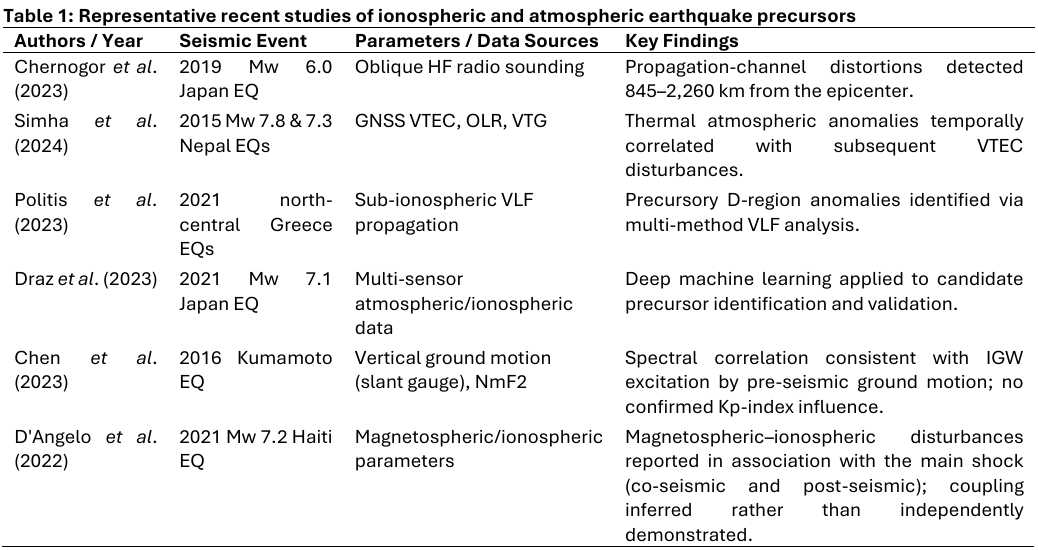
The search for reliable pre-earthquake signals in the upper atmosphere has produced a large and heterogeneous body of literature over the past two decades, much of it organized around the Lithosphere-Atmosphere-Ionosphere Coupling (LAIC) hypothesis. This narrative-critical review synthesizes studies published between 2020 and 2026, identified through Scopus, Web of Science, Google Scholar and journal-archive searches and screened against stated eligibility and evidence-appraisal criteria, on ionospheric and atmospheric precursors to large earthquakes, covering Global Navigation Satellite System (GNSS)-derived Total Electron Content (TEC) anomalies, sub-ionospheric Very Low Frequency (VLF) and High Frequency (HF) radio propagation disturbances, and thermal atmospheric signatures. It further examines the proposed mechanical (acoustic-gravity wave), geochemical (radon-driven), and electromagnetic channels invoked to explain lithosphere-to-ionosphere energy transfer, and considers how solar and geomagnetic activity confound or mimic seismogenic signals. Beyond summarizing individual case studies, this review evaluates the field's methodological foundations: the near-universal reliance on retrospective, single-event case studies; the absence of standardized anomaly definitions and false-positive/false-negative statistics; and the growing but still under-validated use of deep machine learning for anomaly discrimination. We find that pre-seismic ionospheric perturbations are reported using several independent techniques, but the evidence is heterogeneous and rarely controlled, and causal attribution to seismogenic processes rather than coincidental space weather variability remains unresolved for the majority of reported cases. The present evidence does not support operational earthquake forecasting; we recommend prospective, statistically rigorous, and physically constrained research designs.
References
Alam, A., Nikolopoulos, D., & Wang, N. (2023). Fractal patterns in groundwater radon disturbances prior to the great 7.9 Mw Wenchuan earthquake, China. Geosciences, 13(9), 268. https://doi.org/10.3390/geosciences13090268
Boudjada, M. Y., Biagi, P. F., Eichelberger, H. U., Nico, G., Galopeau, P. H. M., Ermini, A., Solovieva, M., Hayakawa, M., Lammer, H., Voller, W., & Pitterle, M. (2024). Analysis of pre-seismic ionospheric disturbances prior to 2020 Croatian earthquakes. Remote Sensing, 16(3), 529. https://doi.org/10.3390/rs16030529
Cano-Domingo, C., Stoean, R., Joya, G., Novas, N., Fernandez-Ros, M., & Gazquez, J. A. (2023). A machine learning hourly analysis on the relation between the ionosphere and Schumann Resonance frequency. Measurement, 208, 112426. https://doi.org/10.1016/j.measurement.2023.112426
Chen, C. H., Oyama, K., Jhuang, H. K., & Das, U. (2023). Driving source of change for ionosphere before large earthquake vertical ground motion. Remote Sensing, 15(18), 4556. https://doi.org/10.3390/rs15184556
Chernogor, L. F., Garmash, K. P., Guo, Q., Rozumenko, V. T., & Zheng, Y. (2023). Perturbations in the characteristics of ionospheric HF radio waves during the April 11, 2019, earthquake in Japan: Results from oblique sounding. Advances in Space Research, 72(5), 1688–1702. https://doi.org/10.1016/j.asr.2023.04.053
Colonna, R., Nayak, K., Sharma, G., & Romero-Andrade, R. (2026). Evaluation of seismo-ionospheric and seismological parameters within the lithosphere–atmosphere–ionosphere coupling framework for the 2025 Mw 7.7 Myanmar earthquake. Remote Sensing, 18(7), 1016. https://doi.org/10.3390/rs18071016
D'Angelo, G., Piersanti, M., Battiston, R., Bertello, I., Carbone, V., Cicone, A., Diego, P., Papini, E., Parmentier, A., Picozza, P., Recchiuti, D., Sparvoli, R., & Ubertini, P. (2022). Haiti earthquake (Mw 7.2): Magnetospheric–ionospheric–lithospheric coupling during and after the main shock on 14 August 2021. Remote Sensing, 14(21), 5340. https://doi.org/10.3390/rs14215340
Draz, M. U., Shah, M., Jamjareegulgarn, P., Shahzad, R., Hasan, A. M., & Ghamry, N. A. (2023). Deep machine learning based possible atmospheric and ionospheric precursors of the 2021 Mw 7.1 Japan earthquake. Remote Sensing, 15(7), 1904. https://doi.org/10.3390/rs15071904
Endeshaw, L. (2024). Investigation of atmospheric anomalies due to the great Tohoku earthquake disturbance using NRLMSISE-00 atmospheric model measurement. Pure and Applied Geophysics, 181(5), 1455–1478. https://doi.org/10.1007/s00024-024-03476-2
Girona, T., & Drymoni, K. (2024). Abnormal low-magnitude seismicity preceding large-magnitude earthquakes. Nature Communications, 15(1), 7429. https://doi.org/10.1038/s41467-024-51596-z
Gulyaeva, T. L. (2023). Decline of geomagnetic and ionospheric activity at earthquake during spotless Sun. Advances in Space Research, 71(1), 306–315. https://doi.org/10.1016/j.asr.2022.10.069
Li, W., Yang, F., Li, L., Zhao, D., Zhang, K., Zuo, X., & Pan, X. (2026). Lithosphere–atmosphere–ionosphere coupling: Opportunities and challenges from phenomenon observation to physical prediction. IEEE Geoscience and Remote Sensing Magazine. https://doi.org/10.1109/MGRS.2026.3714896
Ouzounov, D., & Khachikyan, G. (2024). Study the global earthquake patterns that follow the St. Patrick's Day geomagnetic storms of 2013 and 2015. Remote Sensing, 16(14), 2544. https://doi.org/10.3390/rs16142544
Pilipenko, V. A., & Surkov, V. V. (2025). Seismoelectromagnetic and seismoionospheric phenomena: From the pioneering works of G. A. Sobolev to present. Izvestiya, Physics of the Solid Earth, 61(4), 609–625. https://doi.org/10.1134/S1069351325700557
Politis, D. Z., Potirakis, S. M., Contoyiannis, Y., Potamitis, I., Sasmal, S., Yang, S. S., & Hayakawa, M. (2023). Lower-ionosphere anomalies prior to strong earthquakes that occurred in north-central mainland Greece on March 2021 as revealed by multi-method analysis of VLF sub-ionospheric propagation data. Annals of Geophysics, 66(6), SE645. https://doi.org/10.4401/ag-8986
Pulinets, S., Ouzounov, D., Karelin, A., & Boyarchuk, K. (2022). Earthquake precursors in the atmosphere and ionosphere: New concepts. Springer Nature.
Sasmal, S., Nanda, K., Hayakawa, M., Solovieva, M., Kopylova, G., & Potirakis, S. M. (2025). Towards understanding earthquake preparatory dynamics: A multi-parametric investigation of the 2025 Kamchatka Mw 8.8 event. Atmosphere, 16(12), 1328. https://doi.org/10.3390/atmos16121328
Simha, C. P., Rao, K. M., & Dumka, R. K. (2024). Observation of atmospheric and ionospheric anomalies before the Nepal earthquakes on 25th April and 12th May 2015. Geotectonics, 58(2), 234–249. https://doi.org/10.1134/S0016852124700158
Tan, Q., Shen, C., Wang, J., Yang, X., Jin, W., Zhang, M., & Yang, G. (2025). Dynamic changes of gravity field before the Luding MS6.8 earthquake and its crustal material migration characteristics. Geodesy and Geodynamics, 16(2), 214–222. https://doi.org/10.1016/j.geog.2024.09.006
Zhang, R., Li, H., Shen, Y., Yang, J., Li, W., Zhao, D., & Hu, A. (2025). Deep learning applications in ionospheric modeling: Progress, challenges, and opportunities. Remote Sensing, 17(1), 124. https://doi.org/10.3390/rs17010124
Zhu, F., Yang, J., Qing, Y., & Li, X. (2023). Assessment and analysis of the global ionosphere maps over China based on CMONOC GNSS data. Frontiers in Earth Science, 11, 1095754. https://doi.org/10.3389/feart.2023.1095754
Downloads
Published
Issue
Section
Categories
License
Copyright (c) 2026 Racheal Foluke Oloruntola, Oludare Olukayode Babalola, Ganiyu Akanji Olaniyi, George Atilade Àlàgbé, Hameed Olalekan Bakare, Adedamola Julius Agbelemoge (Author)

This work is licensed under a Creative Commons Attribution-NonCommercial 4.0 International License.
- Attribution — You must give appropriate credit, provide a link to the license, and indicate if changes were made. You may do so in any reasonable manner, but not in any way that suggests the licensor endorses you or your use.
- NonCommercial — You may not use the material for commercial purposes.
- No additional restrictions — You may not apply legal terms or technological measures that legally restrict others from doing anything the license permits.