
Environmental and Health Implications of Heavy Metal Exposure in Oreochromis niloticus from Sabke Reservoir Katsina State, Nigeria
DOI:
https://doi.org/10.70882/josrar.2026.v3i5.286Keywords:
Bioaccumulation, Heavy metals, Histopathology, Oreochromis niloticus, Sabke ReservoirAbstract
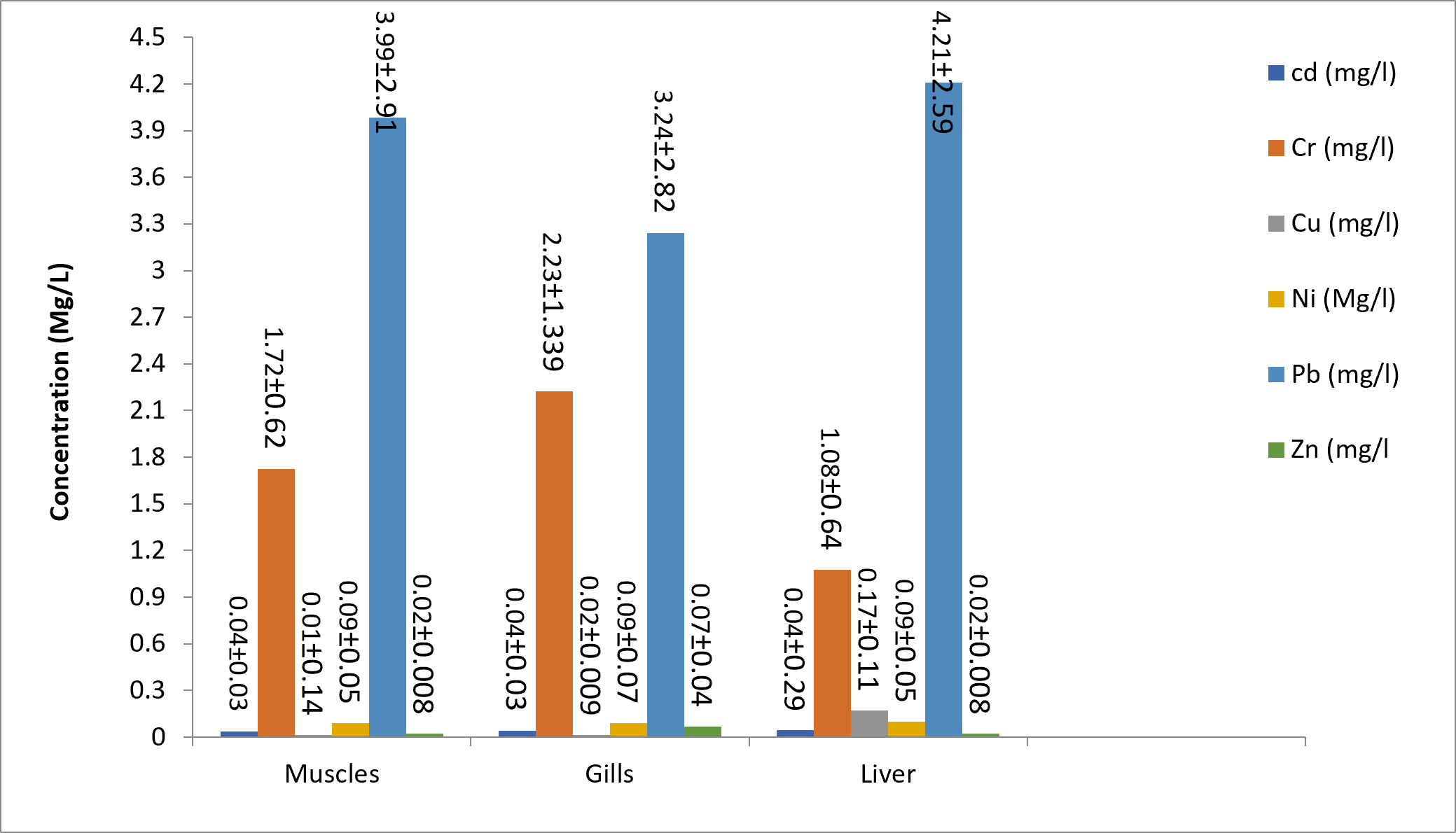
This study assessed heavy metal contamination (Cd, Cr, Cu, Ni, Pb, and Zn) in water, sediment, and Oreochromis niloticus tissues from Sabke Reservoir, Katsina State, Nigeria, over six months (June–November 2024) at three stations. Water and sediment samples were analysed using APHA protocols, while fish gills, liver, and muscle were analysed by Atomic Absorption Spectrophotometry (AAS). The liver accumulated the highest concentrations, particularly Cr (1.08 ± 0.64 mg/kg) and Pb (4.21 ± 2.59 mg/kg), while gills recorded the highest Zn (0.068 ± 0.035 mg/kg) and positive correlations with sediment-derived Cr (r = 0.623, p < 0.05) and Ni (r = 0.789, p < 0.01). Muscle recorded the lowest concentrations. Health risk assessment indicated significant non-carcinogenic risks from Cr (HQ = 4.79) and Pb (HQ = 9.49), exceeding the safe threshold of 1.0. Carcinogenic risks for Cr (CR = 7.18 × 10⁻³) and Cd (CR = 1.14 × 10⁻⁴) exceeded the acceptable level of 1 × 10⁻⁴. Bioaccumulation Factor analysis confirmed accumulation of Cd (BAF = 1.51) and Ni (BAF = 1.06). Histopathology revealed epithelial loss and lamellar detachment in gills, hepatic congestion and hepatocellular necrosis, and slight muscle fibre fragmentation, indicating chronic tissue stress. The findings demonstrate significant heavy metal pollution with ecological and human health implications through fish consumption, attributed to agricultural runoff, improper waste disposal, and illegal mining. Continuous monitoring, public awareness, stringent regulation, and sustainable agricultural and industrial practices are recommended.
References
Abdel-Moneim, A. M., Al-Kahtani, M. A., and Elmenshawy, O. M. (2012). Histopathological biomarkers in gills and liver of Oreochromis niloticus from polluted wetland environments, Saudi Arabia. Chemosphere, 88(8), 1028–1035. https://doi.org/10.1016/j.chemosphere.2012.03.006
Adenuga, R. A., Adeyemi, A. A., & Adenuga, A. A. (2022). Assessment of heavy metal concentration in sediment and fish (Oreochromis niloticus and Clarias gariepinus) in Bonny Estuary, Niger Delta, Nigeria, and their human health implications. Journal of Global Ecology and Environment, 16(4), 58–67. https://doi.org/10.56557/JOGEE/2022/v16i47822
Aldoghachi, M. A. J., Abdullah, A. H. J., & Hussein, D. A. (2025). Bioaccumulation, histological and structural changes in the gills of the Nile tilapia (Oreochromis niloticus) exposed to heavy metals. Egyptian Journal of Aquatic Biology & Fisheries, 29(2), 2333–2345. https://doi.org/10.21608/ejabf.2025.422694
Al-Ghanim, K. A., Ahmad, Z., Alkahem Al-Balawi, H., Al-Misned, F., El-Serehy, H. A., and Al-Mulhim, N. (2019). Accumulation and histological transformation in the gills, liver, muscles, and skin in Oreochromis niloticus induced by mercury. Turkish Journal of Veterinary and Animal Sciences, 43(2), 276–284.
Bala, U., and Abdullahi, S. (2011). Aspects of reproductive biology of fish of commercial importance in Sabke Reservoir, Katsina State. Bayero Journal of Pure and Applied Sciences, 4(2), 178–181. https://doi.org/10.4314/bajopas.v4i2.36
Bwala, A. U., Mohammed, S., and Lawan, A. (2023). Heavy metal concentrations in fish and sediments of selected reservoirs in northeastern Nigeria. Nigerian Journal of Environmental Sciences, 17(1), 66–78.
Dane, H. (2025). Histopathological effects of anthropogenic toxic element pollution in freshwater fishes in their natural environments: A global review. Journal of Applied Toxicology, 45(12), 2480–2497. https://doi.org/10.1002/jat.4881
Ehiemere, V. C., Ihedioha, J. N., Ekere, N. R., et al. (2022). Pollution and risk assessment of heavy metals in water, sediment and fish (Clarias gariepinus) in a fish farm cluster in Niger Delta region, Nigeria. Journal of Water and Health, 20(6), 927–945.
Emon, F. J., Rohani, M. F., Sumaiya, N., Jannat, M. F. T., Akter, Y., Shahjahan, M., Kari, Z. A., Tahiluddin, A. B., and Goh, K. W. (2023). Bioaccumulation and bioremediation of heavy metals in fishes—A review. Toxics, 11(6), 510. https://doi.org/10.3390/toxics11060510
Hamouda, A. H., & Abd Alkareem, O. M. (2021). Insight into the correlation between parasitic infestation and heavy metal concentrations in tilapia species inhabiting Lake Nasser, Egypt. Aquaculture Research, 52, 3425–3437. https://doi.org/10.1111/are.15187
Ibrahim, Y., Auta, T., and Orpin, J. B. (2024). Health risk assessment associated with consumption of Oreochromis niloticus from Ajiwa Reservoir, Katsina State, Nigeria. Sahel Journal of Life Sciences FUDMA, 2(2), 162–166. https://doi.org/10.33003/sajols-2024-0202-22
Mustapha, A. M., Ugya, A. Y., & Mustapha, Z. (2022). Assessment of heavy metal levels in fish tissues, water and sediment from Epe Lagoon, Lagos, Nigeria. Science World Journal.
Ogan, A. C. (2023). Environmental impact of human activities on water and sediment composition in Oginigba/Woji Creek, Port Harcourt, Nigeria.
Suleiman, I. L., and Rabi’u, T. (2024). Completion of Sabke Dam water supply and irrigation project as a boost to water resource management in Katsina State, Nigeria. Direct Research Journal of Agriculture and Food Science, 12(2), 160–172.
Yacoub, A. M., Mahmoud, S. A., and Abdel-Satar, A. M. (2021). Accumulation of heavy metals in tilapia fish species and related histopathological changes in muscles, gills and liver of Oreochromis niloticus occurring in the area of Qahr El-Bahr, Lake Al-Manzalah, Egypt. Oceanological and Hydrobiological Studies, 50(1), 1–15. https://doi.org/10.2478/oandhs-2021-0001
Yi, Y., Yang, Z., and Zhang, S. (2011). Ecological risk assessment of heavy metals in sediment and human health risk assessment of heavy metals in fishes in the middle and lower reaches of the Yangtze River basin. Environmental Pollution, 159(10), 2575–2585. https://doi.org/10.1016/j.envpol.2011.06.011
Zango, B. M., and Rafindadi, I. A. (2015). List of dams in Katsina State, their condition and potentials. Document submitted for Governor Masari’s Agricultural Restoration Agenda
Downloads
Published
Issue
Section
Categories
License
Copyright (c) 2026 Timothy Auta, Ismail Nasir, Muhammad A. Yahaya, Umaru Musa Kankara, Mustapha A. Sadauki, Auwalu Jalo (Author)

This work is licensed under a Creative Commons Attribution-NonCommercial 4.0 International License.
- Attribution — You must give appropriate credit, provide a link to the license, and indicate if changes were made. You may do so in any reasonable manner, but not in any way that suggests the licensor endorses you or your use.
- NonCommercial — You may not use the material for commercial purposes.
- No additional restrictions — You may not apply legal terms or technological measures that legally restrict others from doing anything the license permits.