
Adsorption Properties of CO2 on both Pristine and B-doped Coronene Quantum Dots: A Density Functional Theory Study
DOI:
https://doi.org/10.70882/josrar.2026.v3i5.284Keywords:
Coronene quantum dots (CQDs), Boron-doped Coronene quantum dots (B-CQDs), Density functional theory, CO2 molecule, Electronic propertiesAbstract
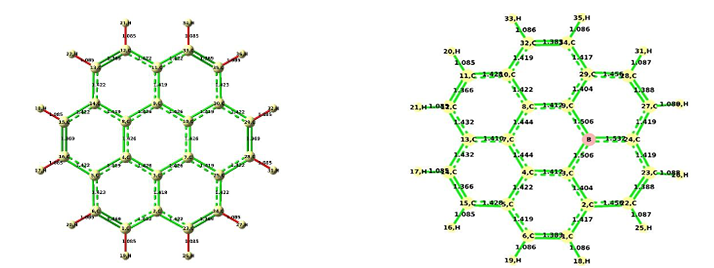
The study of the interactions between nanomaterials and target molecules at the molecular level is a key factor in the design of new materials for high-performance applications of nanosensors. In this study, the adsorption properties of CO2 molecules on the surface of pristine Coronene quantum dots (pCQDs) and Boron-doped Coronene (B-CQDs) clusters were estimated using density functional theory (DFT) calculations. The results show that CO2 molecules are weakly adsorbed (physisorption) on the pristine Coronene surface, while they are strongly chemisorbed on the B-Coronene surface with a large adsorption energy. The recovery time for CO2 on the pristine Coronene is very short, which makes the practical detection of this molecule almost impossible, regardless of any intrinsic electronic sensitivity. The substitution of a carbon atom in the Coronene framework with a Boron atom greatly enhances the adsorption properties. This change increases the chemical reactivity of the system favoring stronger interactions. The electrical conductivity of the B-Coronene cluster is greatly enhanced after the interaction with the CO2 molecule, and the energy gap exhibits a drastic change. Therefore, the B-Coronene cluster is a very promising nanosensor candidate for CO2 detection based on its high electrical sensitivity. Therefore, Boron dopants greatly promote the chemisorption of CO2 and enhance the overall sensing performance of Coronene. Overall, boron-doped coronene clusters demonstrate significant potential for application in the design and development of highly sensitive and efficient CO₂ gas detection systems.
References
Abdelati, M. A., et al. (2021). Pristine and holey graphene quantum dots: Optical properties using time independent and dependent density functional theory. Physica E: Low-dimensional Systems and Nanostructures, 128, 114602.
Ajeel, F. N., & Ben Ahmed, A. (2023). Influence of the boron doping and Stone–Wales defects on the thermoelectric performance of graphene nanoribbons. The European Physical Journal B, 96, 127.
Ajeel, F. N., Mohsin, K. H., Shakier, H. G., Khamees, S. K., & Mutier, M. N. (2023). Theoretical insights into tunable electronic properties of graphene quantum dots through ZnO doping. Chemical Physics Impact, 7, 100305.
Ajeel, F. N., Mutier, M. N., Mohsin, K. H., Khamees, S. K., Khudhair, A. M., & Ben Ahmed, A. (2024). Theoretical study on electronic properties of BN dimers doped graphene quantum dots. BioNanoScience, 14(2), 1110–1118. https://doi.org/10.1007/s12668-024-01422-z
Ajeel, F. N., Ouda, Y. W., & Abdullah, S. A. (2019). Graphene nanoflakes as a nanobiosensor for amino acid profiles of fish products: Density functional theory investigations. Drug Invention Today, 12(12).
Almansour, K., Alsaab, H. O., & Pishnamazi, M. (2026). Computational study of metal doped coronene quantum dots for formaldehyde sensing and adsorption in medical and environmental applications. Scientific Reports, 16, 2761.
Bhattacharjee, R., et al. (2026). Chemical oxidation of coronene: A crystallographic and computational study of charge-regulated π-stacking. ACS Physical Chemistry Au.
Ejuh, G. W., et al. (2020). Theoretical study on the electronic, optoelectronic, linear and nonlinear optical properties and UV–Vis spectrum of coronene and coronene substituted with chlorine. SN Applied Sciences, 2, 1247.
Fedorov, I. A. (2017). Structure and electronic properties of perylene and coronene under pressure: First-principles calculations. Computational Materials Science, 139, 252–259.
Feng, J., Dong, H., Pang, B., Shao, F., Zhang, C., Yu, L., & Dong, L. (2018). Theoretical study on the optical and electronic properties of graphene quantum dots doped with heteroatoms. Physical Chemistry Chemical Physics, 20(22), 15244–15252. https://doi.org/10.1039/C8CP01403E
Feng, J., et al. (2021). Density functional theory study on optical and electronic properties of co-doped graphene quantum dots based on different nitrogen doping patterns. Diamond and Related Materials, 113, 108264.
Feng, J., et al. (2024). Density functional theory study of the relationship between N-dopants and vacancy defects on graphene quantum dots for oxygen reduction electrocatalysis. ACS Applied Nano Materials, 7(18), 21578–21589.
Glasser, L., & Sheppard, D. A. (2016). Cohesive energies and enthalpies: Complexities, confusions, and corrections. Inorganic Chemistry, 55(14), 7103–7110.
Hadi, M. A., & Hussein, M. T. (2023). Study the effect of oxygen on coronene electronic and spectroscopic properties via the density functional theory (DFT). Iraqi Journal of Science, 157–165.
Khamees, S. K., Ajeel, F. N., Mohsin, K. H., & Mutier, M. N. (2024). Influence of B, Si, Ge, and As impurities on the electronic properties of graphene quantum dot: A density functional theory study. Nano Trends, 7, 100049. https://doi.org/10.1016/j.nwnano.2024.100049
Khudhair, A. M., et al. (2023). Enhancement the electronic and optical properties of the graphene nanoflakes in the present S impurities. Chemical Physics Impact, 6, 100154.
Khalaf, T. T., & Hussein, M. T. (2024). Thermodynamic and spectroscopic properties investigation of coronene as a function of the number of oxygen atoms and temperature via density functional theory. Iraqi Journal of Physics, 22(2), 81–89.
Khalaf, T. T., & Hussein, M. T. (2025). A study on physical properties of coronene oxide as a function of number of oxygen atoms and temperature by density functional theory. International Journal of Nanoelectronics and Materials, 18(1), 15–21.
Kh, S., & Abbas, S. (2019). Theoretical study for coronene and coronene-Al, B, C, Ga, In and coronene-O interactions by using density functional theory. University of Thi-Qar Journal, 14(4), 80–94.
Martin, J. M. L. (1996). The vibrational spectra of corannulene and coronene. A density functional study. Chemical Physics Letters, 262(1–2), 97–104.
Milon, et al. (2022). A first principle study to investigate structural, electronic and optical properties of pristine and valency comparable Co, P decorated graphene-like boron nitride (BN) nanosheets. Phase Transitions, 95(12), 837–850.
Nair, R. G. S., Nair, A. K. N., & Sun, S. (2024). Density functional theory study of doped coronene and circumcoronene as anode materials in lithium-ion batteries. Scientific Reports, 14, 15220.
Pechnikova, N. A., Domvri, K., Porpodis, K., Istomina, M. S., Iaremenko, A. V., & Yaremenko, A. V. (2025). Carbon quantum dots in biomedical applications: Advances, challenges, and future prospects. Aggregate, 6(3), e707.
Prodhan, S., & Ramasesha, S. (2025). Strongly correlated electronic structure of some graphene nano ribbons and nano flakes. Journal of Computational Chemistry, 46(23), e70216.
Qian, J., et al. (2018). Tailoring the electronic properties of graphene quantum dots by P doping and their enhanced performance in metal-free composite photocatalyst. The Journal of Physical Chemistry C, 122(1), 349–358.
Rabeya, R., Mahalingam, S., Manap, A., Satgunam, M., Akhtaruzzaman, M., & Chia, C. H. (2022). Structural defects in graphene quantum dots: A review. International Journal of Quantum Chemistry, 122(12), e26900.
Schulman, J. M., & Disch, R. L. (1997). Thermal and magnetic properties of coronene and related molecules. The Journal of Physical Chemistry A, 101(48), 9176–9179.
Shtepliuk, I., & Yakimova, R. (2023). Nature of photoexcited states in ZnO-embedded graphene quantum dots. Physical Chemistry Chemical Physics, 25(15), 10525–10535.
Talha, A., et al. (2024). To examine the adsorption behavior and dissociation of hydrogen selenide (H₂Se) gas on pristine and transition-metal (Fe, Mn)-doped boron nitride nanosheets: A DFT study. ChemistrySelect, 9(43), e202401651.
Tachikawa, H., & Lund, A. (2022). Structures and electronic states of trimer radical cations of coronene: DFT–ESR simulation study. Physical Chemistry Chemical Physics, 24(17), 10318–10324.
Ullah, Z., et al. (2022). DFT study of 6-amino-3-(1-hydroxyethyl) pyridine-2,4-diol (AHP) adsorption on coronene. Journal of Molecular Liquids, 360, 119436.
Vig, A., Doan, E., & Yang, K. (2023). First-principles investigation of size effects on cohesive energies of transition-metal nanoclusters. Nanomaterials, 13(16), 2356.
Wang, Q., et al. (2023). Pyridine derivatives as hydrogen bond acceptors to prepare deep eutectic solvents for ammonia storage. International Journal of Hydrogen Energy.
Xiong, S., et al. (2022). Surface oxygen vacancy and graphene quantum dots co-modified Bi₂WO₆ toward highly efficient photocatalytic reduction of CO₂. Applied Catalysis B: Environmental, 305, 121026.
Yeh, C.-N., et al. (2018). Electronic properties of the coronene series from thermally-assisted-occupation density functional theory. RSC Advances, 8(60), 34350–34358.
Yoosefian, M., Fouladi, M., & Atanase, L. I. (2022). Molecular dynamics simulations of docetaxel adsorption on graphene quantum dots surface modified by PEG-b-PLA copolymers. Nanomaterials, 12(6), 926.
Zeng, S., Sun, S., Liu, S., Liang, T., Lu, B., Guo, Y., Zhang, W., & Xie, J. (2025). Influence of edge functionalization on the structural and photophysical properties of graphene quantum dots. Journal of Molecular Structure, 1335, 141956. https://doi.org/10.1016/j.molstruc.2025.141956
Zhang, Q., et al. (2021). Investigation of edge states in artificial graphene nano-flakes. Journal of Physics: Condensed Matter, 33(22), 225003.
Downloads
Published
Issue
Section
Categories
License
Copyright (c) 2026 Mohammed K. Kzar (Author)

This work is licensed under a Creative Commons Attribution-NonCommercial 4.0 International License.
- Attribution — You must give appropriate credit, provide a link to the license, and indicate if changes were made. You may do so in any reasonable manner, but not in any way that suggests the licensor endorses you or your use.
- NonCommercial — You may not use the material for commercial purposes.
- No additional restrictions — You may not apply legal terms or technological measures that legally restrict others from doing anything the license permits.