
Interactions of Some Physicochemical Parameters and Sediment Heavy Metals with Snails Species in Ajiwa Reservoir
DOI:
https://doi.org/10.70882/josrar.2026.v3i5.283Keywords:
Snail, Heavy metal, Sediment, Abundance, Physicochemical parametersAbstract
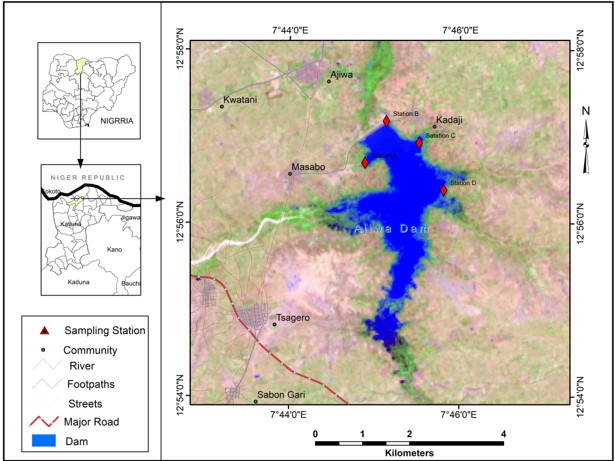
The aim of this study is to examine some physicochemical parameters, sediment heavy metals concentrations and their interaction with Snails Species in Ajiwa Reservoir, Katsina State. The study was carried out from September to December, 2023. The water and sediment samples were collected twice a month from four (4) sampling stations (A, B, C and D) and analysed for physicochemical parameters such as (pH, temperature, transparency, conductivity, DO and BOD) and heavy metals (Co, Cu, Ni, Mn and Pb) using standard procedures. Snail samples were collected with the aid of D-frame sweep sampler net and identified using standard keys. The physicochemical parameters were found to be within the WHO/NESREA standard limits. The mean of physicochemical parameters of Ajiwa reservoir were pH (7.1031±0.4849), Temperature (22.9281±4.0192), Transparency (12.6093±2.4654), Conductivity (113.9700±10.6330), DO (6.7812±1.0908), and BOD (3.5225±0.8854). The concentration of heavy metals was found in ascending order of Co>Pb>Ni>Mn>Cu. A total of 427 snails from seven (7) different species were observed. There was less abundance of snail species in the month of September (76) and high in October (123). Sampling station C has less abundance of snail species (13) while sampling station B has high abundance (174). The Pearson correlation analysis revealed some snails’ species to have positive and negative correlation with Cu, pH and conductivity. The study concludes that there is high abundance of snail species in Ajiwa reservoir particularly in the month of October while less in September. It is recommended that regular assessments of snail species and physicochemical parameters should be conducted to understand ecosystem dynamics.
References
Abubakar, A., Musa, I. B. and Ibrahim, I. M. (2024). Impact of Heavy Metals and Organophosphates on Freshwater Ecosystems. Journal of Aquatic Pollution, 15(3), 205-217.
Adeboye, I. A. (2017). Determination of Heavy Metals in Water, Fish and Sediment from Ujere Water Reservoir. Journal of Environmental Analytical Toxicology. 7:486.
Ahmad, AA; Usman, H (2020). Determination of Heavy Metal Accumulation in Tilapia Fish (Oreochromis niloticus) Tissues harvested from Ajiwa Dam, Batagarawa, Katsina State. FUDMA Journal of Sciences 7(1), 219-223.
Alani, R., Alo, B., and Ukoakonam, F. (2014). Preliminary investigation of the state of pollution of Ogun River at Kara Abattoir, near Berger, Lagos. International Journal of Environmental Science and Toxicology, 2(2), 11-23.
Auta, J., Ibrahim, Y. K. and Dahiru, A. A. (2024). The Role of Freshwater Snails in Ecosystem Function and Biodiversity. Aquatic Science and Technology, 9(4), 333-347.
Auta, T; Agnes, A; Bichi, AH (2023). Wet season water quality and zooplanktons community of Jibia lake, Katsina Katsina State, Asian Journal of Biological Science. 16(2): 175-187. ISSN : 19996- 3351.
Auta, T; Alkal, E; Michael, EA (2018). Population dynamics, diversity and distribution of freshwater snails in Zobe Dam, Dutsin-Ma, North-Western Nigeria. Asian J. Environ. Ecol., Vol. 8. https://doi.org/10.9734/ajee/2018/v8i430078
Auta, T; Rabiu, MD; Sadauki, MA (2024). Interactions of Physicochemical Parameters with Snails in Dutsin-Ma Reservoir. Asian Sci. Bull., 2 (4): 401-408, 2024.
Authman, M. M. N. (2008). Use of Fish as Bio-indicators of the Effects of Heavy Metals Pollution. Journal of Aquatic Biology and Fisheries, 12(1), 24-35.
Ewutanure, JS (2018). Phd Thesis, Fisheries Department, UNIBEN. p. 38
Garg, RK; Rao, R.J; Saksena, DN (2009) Correlation of molluscan diversity with physicochemical characteristics of water of Ramsagar reservoir, India. International Journal of Biodiversity and Conservation. 1(6) pp. 202-207. ISSN: 1813-0070. https://doi.org/10.3923/asb.2024.401.408
Gupta, V. K., Gupta, M., & Sharma, S. (2001). Process development for removal of lead and chromium from aqueous solution using red mud-an aluminium industry waste. Water Research, 35(5), 1125-1134
NESREA. (2011). National Environmental (Surface and Ground Water Quality) Regulations. National Environmental Standards and Regulations Enforcement Agency.
Olaifa, F. E. (2004). Heavy Metals in Aquatic Environments and Their Effects on Fish Health. Fish Pathology Journal, 11(2), 76-85.
Pissia, T., Katsara, K. and Kanelis, D. (2021). Freshwater Snails: Ecology, Diversity, and Significance in Aquatic Habitats. Journal of Molluscan Studies, 87(1), 65-79.
Sadauki, H. M., Abubakar, A., & Musa, I. B. (2024). Anthropogenic Activities and Their Impact on Aquatic Ecosystems. Journal of Environmental Pollution and Control, 22(1), 98-110.
Sadauki, MA; Auta, T; Umaru, J (2024). AN APPRAISAL OF AQUATIC POLLUTION: A REVIEW. Agricultural Science: An International journal (AGRIJ), Vol.1, No.2, 2024
Sadauki, MA; Bichi, AH; Dauda, AB; Geidam, MB (2022). Assessment of Water Quality Parameters of Zobe and Ajiwa Reservoirs, Katsina State, Nigeria, African Scientist 23 (1): 9-18, http://www.niseb.org/afs
Sani, A. R., Zayyad, B. and Patricia, A. E. (2016). Trace Metals Distribution in Water and Sediment from Selected Water Bodies in Kano State, Nigeria. 8th International Conference on Latest Trends in Engineering and Technology. (8): 56-60.
Tukur, SA; Auta, T; Atalabi, ET (2023). Ecological Observations of Freshwater Snails in the Vicinity of an Artificial Lake. Science World Journal. Vol. 19 (1).
Uba, S; Ajibola VO; Adeosun, OS; Ikeh, DC; Mikal, A; John, AK; Rumah, MM (2021). Assessment of physicochemical parameters, Geo-accumulation Indices and contamination factor of sediment from Mairua Dam, Faskari LGA, Katsina state North-western Nigeria, Communication in physical sciences, 7(4): 454-462
USEPA. (2010). List of Contaminants and their Maximum Contaminants Levels (MCLs). http://water.epa.gov/drink/contaminant/index.cfm#List. Accessed on 13/2/2016.
USEPA. (2016). Habitat Assessment and Physicochemical Parameters
Usman, LU (2016). Effects of Anthropogenic Activities on the seasonal variation of some physicochemical parameters in Ajiwa Reservoir, Katsina State, Nigeria. Annals of Experimental Biology, 4 (4): 146-151.
Usman, LU; Adakole, JA (2017). Biodiversity Assessment of some Benthic Macro Invertebrates in Ajiwa Reservoir, Katsina State Nigeria. UMYU Journal of Microbiology UJMR, 2(1): 1-10
Yar’adua A. I, Alhassan A. J, Nasir A, Matazu K. I, Muhammad I, Idi A, Muhammad I. U and Aliyu S. M (2018) Evaluation of Heavy Metals in Sediment of Some Selected Dams from Katsina State Nigeria. International Journal of Scientific and Technical Research in Engineering (IJSTRE) 3(2)
Zaharaddeen, HY; Rafindadi, NK. (2018). Impacts of human activities on the limnology and water quality index of Ajiwa Dam, Katsina, International journal of fisheries and Aquatic studies, 6(6):341-347.
Downloads
Published
Issue
Section
License
Copyright (c) 2026 Muhammad Idris, Timothy Auta, Armayau Hamisu Bichi (Author)

This work is licensed under a Creative Commons Attribution-NonCommercial 4.0 International License.
- Attribution — You must give appropriate credit, provide a link to the license, and indicate if changes were made. You may do so in any reasonable manner, but not in any way that suggests the licensor endorses you or your use.
- NonCommercial — You may not use the material for commercial purposes.
- No additional restrictions — You may not apply legal terms or technological measures that legally restrict others from doing anything the license permits.