
A Performance-Based Hybrid RT–HT Model-Switching Mechanism in 5G Handover Optimization
DOI:
https://doi.org/10.70882/josrar.2026.v3i5.282Keywords:
Concept Drift, Hybrid technique, Error-Based Switching, 5G Networks, Handover OptimizationAbstract
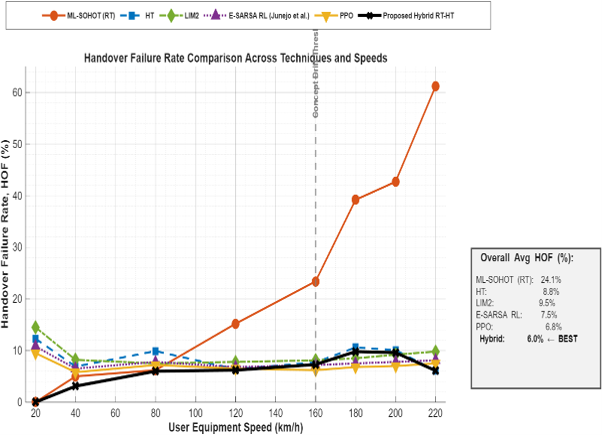
The problem of concept drift poses a critical challenge in dynamic 5G networks, causing static machine learning models to fail when data distributions change. While online learning techniques can adapt, but suffer from cold start problems. This paper presents a performance-based Hybrid Regression Tree (RT) - Hoeffding Tree (HT) technique for concept drift detection in 5G handover optimization. The technique dynamically selects between a pre-trained Regression Tree (RT) and an incrementally trained Hoeffding Tree (HT) using a mobility-domain indicator and a sliding window of recent prediction errors. The study conducted an extensive simulation using the 3GPP TR 38.901 urban-microcell channel model and compared the proposed hybrid technique against five baseline techniques: ML-SOHOT (Alraih et al., 2025), Hoeffding Tree, LIM2 (Karmakar et al., 2022), E-SARSA Reinforcement Learning (Junejo et al., 2025), and PPO (Voigt et al., 2024). The results show that the proposed Hybrid technique reduces handover failure by 82.2% under drift conditions, achieves 44% reduction in handover latency, and 66% reduction in ping-pong rate compared to MLSOHOT (RT). The technique maintains consistent handover interruption time (1.8 ms) and achieves the best balance across all the KPIs among the compared baseline studies, confirming its effectiveness for real-time 5G deployment.
References
3GPP. (2020). Study on Channel Technique for Frequencies From 0.5 to 100 GHz (TR 38.901). 3rd Generation Partnership Project.
Alraih, S., Nordin, R., Abu-Samah, A., Shayea, I., & Abdullah, N. F. (2023). A survey on handover optimization in beyond 5G mobile networks: Challenges and solutions. IEEE Access, 11, 59317-59345. https://doi.org/10.1109/ACCESS.2023.3284905
Alraih, S., Nordin, R., Abu-Samah, A., Shayea, I., Abdullah, N. F., & Alhammadi, A. (2025). ML-Based self-optimization handover technique for beyond 5G mobile network. IEEE Access, 13, 8568-8584. https://doi.org/10.1109/ACCESS.2025.3528357
Asif, H. M., Alhammadi, A., Tarhuni, N., & Bait-Suwailam, M. M. (2026). AI-Driven Mobility Management in 5G and 6G Wireless Networks: A Survey. Future Internet, 18(8), 425. https://doi.org/10.3390/fi18080425.
Baier, L., Hofmann, M., Kühl, N., Mohr, M., & Satzger, G. (2020). Handling concept drifts in regression problems – the error intersection approach. arXiv preprint arXiv:2004.00438.
Casado, F. E., Lema, D., Iglesias, R., Regueiro, C. V., & Barro, S. (2023). Ensemble and continual federated learning for classification tasks. Machine Learning, 112(9), 3413– 3453. https://doi.org/10.1007/s10994-023-06330-z.
Chien, W.-C., Huang, Y., Chang, B.-Y., & Hwang, W.-Y. (2024). Privacy-Preserving Handover Optimization Using Federated Learning and LSTM Networks. Sensors, 24(20), 6685. https://doi.org/10.3390/s24206685.
Ghasemkhani, B., Kut, R. A., Birant, D., & Yilmaz, R. (2025). Balanced Hoeffding Tree Forest (BHTF): A Novel Multi-Label Classification with Oversampling and Undersampling Techniques for Failure Mode Diagnosis in Predictive Maintenance. Mathematics, 13(18), 3019. https://doi.org/10.3390/math13183019
Haghrah, A., Abdollahi, M. P., Azarhava, H., & Niya, J. M. (2023). A survey on the handover management in 5G-NR cellular networks: aspects, approaches and challenges. EURASIP Journal on Wireless Communications and Networking, 2023(1),52. https://doi.org/10.1186/s13638-023-02261-4
Junejo, Y.S.; Shaikh, F.K.; Chowdhry, B.S.; Ejaz, W. (2025). Adaptive Handover Management in High-Mobility Networks for Smart Cities. Computers, 14(1), 23. https://doi.org/10.3390/computers14010023
Karmakar, R., Kaddoum, G., & Chattopadhyay, S. (2022). Mobility Management in 5G and Beyond: A Novel Smart Handover with Adaptive Time-to-Trigger and Hysteresis Margin. ArXiv. https://arxiv.org/abs/2207.01706.
Lu, J., Li, W., Guo, J., Ding, X., Tang, Z., & Wang, T. (2024). Container scheduling with dynamic computing resource for microservice deployment in edge computing. In Proceedings of the 20th International Conference on Mobility, Sensing and Networking (MSN 2024) (pp. 40-47). IEEE
Mahdi, O. A., Pardede, E., Bevinakoppa, S., & Ali, N. (2025). Federated Learning Under Concept Drift: A Systematic Survey of Foundations, Innovations, and Future Research Directions. Electronics, 14(22), 4480. https://doi.org/10.3390/electronics14224480.
Mollel, M. S., Abubakar, A. I., Ozturk, M., Kaijage, S. F., Kisangiri, M., Hussain, S., ... & Abbasi, Q. H. (2021). A survey of machine learning applications to handover management in 5G and beyond. IEEE Access, 9, 45770- 45802. https://doi.org/10.1109/ACCESS.2021.3068752
Pham, T. M. T., Premkumar, K., Naili, M., & Yang, J. (2024). Time to retrain? Detecting concept drifts in machine learning systems. arXiv preprint arXiv:2410.09190.
Tashan, W., Shayea, I. ve Aldırmaz Çolak, S. (2024). Analysis of mobility robustness optimization in ultra-dense heterogeneous networks. Computer Communications, 222, 241-255. http://dx.doi.org/10.1016/j.comcom.2024.04.033.
Ullah, Y., Roslee, M. B., Mitani, S. M., Khan, S. A., & Jusoh, M. H. (2023). A survey on handover and mobility management in 5G HetNets: Current state, challenges, and future directions. Sensors, 23(11), 5081. https://doi.org/10.3390/s23115081
Voigt, J., Gu, P. J., & Rost, P. M. (2024). A deep reinforcement learning-based approach for adaptive handover protocols in mobile networks. arXiv preprint arXiv:2401.14823.
Xu, Y., Xu, R., Yan, W., & Ardis, P. (2017). Concept drift learning with alternating learners. In 2017 International Joint Conference on Neural Networks (IJCNN) (pp. 2104-2111). IEEE. https://doi.org/10.1109/IJCNN.2017.7966095
Downloads
Published
Issue
Section
Categories
License
Copyright (c) 2026 Abdullahi Musa Mahuta, Abubakar Aminu Muazu, Aliyu Danjuma BakinKasuwa, Halima Shehu Salihu, Fatima Musa Mahuta, Aliyu Tanimu (Author)

This work is licensed under a Creative Commons Attribution-NonCommercial 4.0 International License.
- Attribution — You must give appropriate credit, provide a link to the license, and indicate if changes were made. You may do so in any reasonable manner, but not in any way that suggests the licensor endorses you or your use.
- NonCommercial — You may not use the material for commercial purposes.
- No additional restrictions — You may not apply legal terms or technological measures that legally restrict others from doing anything the license permits.