
Comparative Antioxidant Properties of Crude Leaf and Stalk Extracts of Ocimum Gratissimum L. (Scent Leaf) Cultivated in Jos, Nigeria
DOI:
https://doi.org/10.70882/josrar.2026.v3i4.279Keywords:
Ocimum gratissimum, Antioxidant property, FRAP assay, Leaf extracts, Stalk extract, DPPH assayAbstract
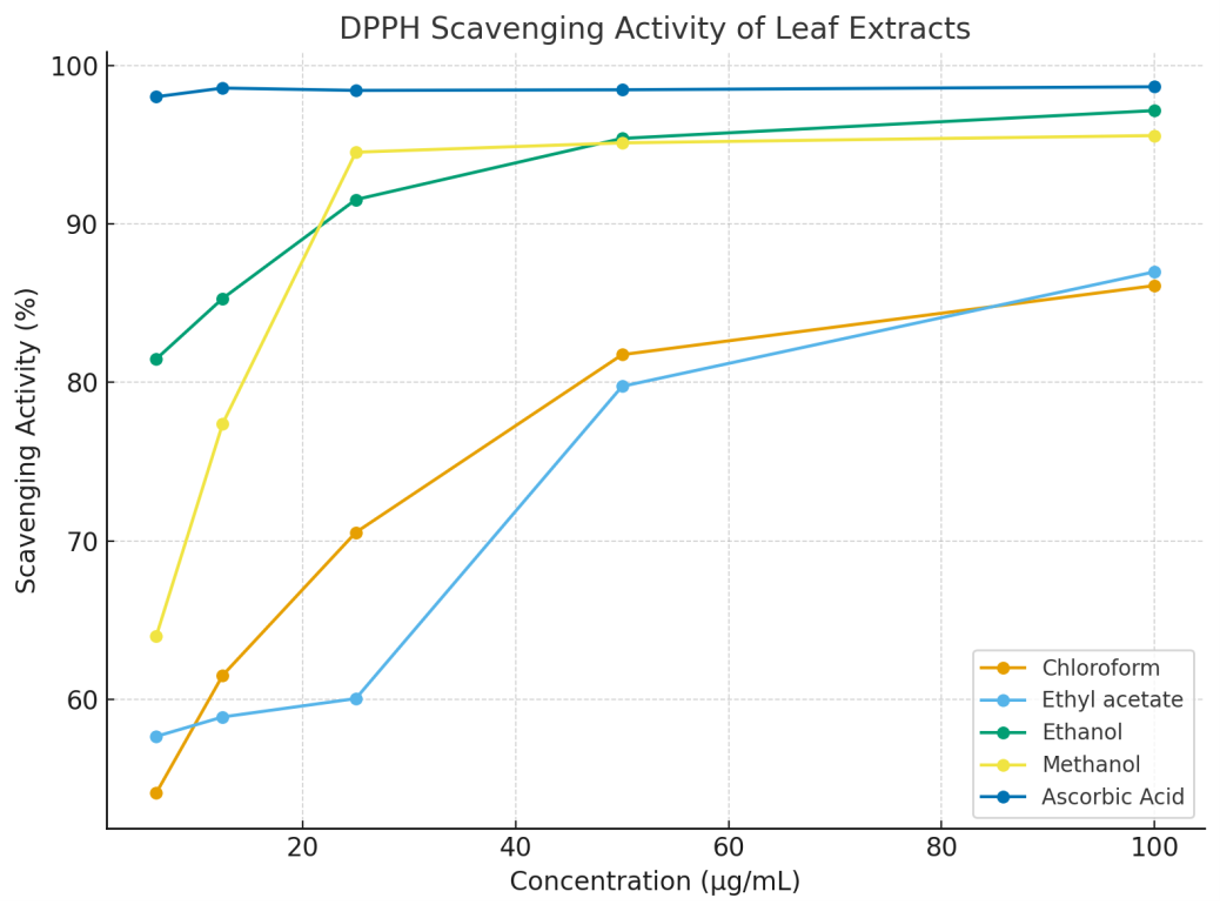
Ocimum gratissimum is commonly found in different communities across Africa and Asia. In Nigeria, the plant is usually incorporated into menus in different cultures. Studies have shown that the plant possesses high antioxidant properties. However, both researchers and consumers have paid little attention to the stalk, with more focuses targeting the leaf. This study investigated the comparative antioxidant properties of crude extracts of the leaf and stalk of O. gratissimum cultivated in Jos, Nigeria. The leaves and stalks were separately extracted with various solvents using maceration. The antioxidant activities of the extracts were evaluated using 2,2-diphenyl-1-picrylhydrazyl (DPPH) radical-scavenging and ferric reducing antioxidant power (FRAP) assays in different concentrations (6.25–100 µg/mL). The results showed that antioxidant activities were concentration-dependent with various extracts of both plant parts. The DPPH activity demonstrated significantly high percentage inhibitions with the various extracts explored. The ethanol extract (up to 97.16 %) and ethanol extract (95.58 %) of the leaf provided remarkable antioxidant properties in analogy to the ascorbic acid(standard). Similarly, the stalk ethanol extract (up to 97.02 %) and methanol extract (96.91 %) exhibited very significant inhibition. The results of the FRAP assay for the leaf and stalk extracts are consistent with those of the DPPH assay as evidenced by the high percentage reducing power obtained from the various extracts. The FRAP results of leaf showed that the ethanol extract gave the highest reducing activity across all concentrations (up to 92.30 %). From the stalk’s FRAP results, ethanol extract (up to 92.17 %) and methanol extract (up to 92.07 %), exhibited the highest reducing powers. Although leaf extracts demonstrated the highest antioxidant properties in all cases, the study suggests that the stalk possesses remarkable antioxidant properties as well. Further study is required to comparatively explore the toxicology of both plant’s parts.
References
Achuenu, C., Tanko, S., Nworie, M. O., Edah, A. O., & Adelakun, E. A. (2026). ANALGESIC ACTIVITY, PHYTOCHEMICAL PROFILING AND TOXICITY ASSESSMENT OF ETHANOL EXTRACT FROM OCIMUM GRATISSIMUM LEAVES CULTIVATED IN JOS, NIGERIA. FUDMA Journal of Sciences, 10(5), 249-255. https://doi.org/10.33003/fjs-2026-1005-4327
Akintunde, A. O., Ogah, A. M., Ndubuisi-Ogbonna, L. C., Olumide, M. D., & Banjoko, O. J. (2025). Antimicrobial and Antioxidant Potentials of Aqueous Extracts of Ocimum gratissimum Leaves. Journal of Applied Animal Science, 18(1), 9.
Benzie, I. F., & Strain, J. J. (1996). The ferric reducing ability of plasma (FRAP) as a measure of “antioxidant power”: the FRAP assay. Analytical biochemistry, 239(1), 70-76.
Chatepa, L. E. C., Mwamatope, B., Chikowe, I., & Masamba, K. G. (2024). Effects of solvent extraction on the phytoconstituents and in vitro antioxidant activity properties of leaf extracts of the two selected medicinal plants from Malawi. BMC complementary medicine and therapies, 24(1), 317. https://doi.org/10.1186/s12906-024-04619-7
Ibeabuchi, C. G., Oyeike, E. N., Patrick-Iwuanyanwu, K. C., & Akaninwor, J. O. (2023). Qualitative and quantitative phytochemical screening and antioxidant capacity of Zingiber officinale, Ocimum gratissimum and their Mixture. Journal of Public Health and Toxicological Research, 1(1), 11-18. https://jphtr.com/index.php/journal
Ike, E. C., Wokota, P. N., & Nnenna Gabez, L. (2024). Comparative antioxidant activity of Ocimum gratissimum and Jatropha tanjorensis 2024. bioRxiv, 2024-10. https://doi.org/10.1101/2024.10.30.620967
Ikokide, J. E., Jaja, F. I., Ajibade, T. O., Oyagbemi, A. A., & Oyeyemi, M. O. (2025). Phytochemical analysis of polyphenol-rich extract of Ocimum gratissimum leaves by GC–MS, TFC, TPC, TTC, and in vitro antioxidant properties. Discover Molecules, 2(1), 24. https://doi.org/10.1007/s44345-025-00030-y
Jomova, K., Raptova, R., Alomar, S. Y., Alwasel, S. H., Nepovimova, E., Kuca, K., & Valko, M. (2023). Reactive oxygen species, toxicity, oxidative stress, and antioxidants: chronic diseases and aging. Archives of toxicology, 97(10), 2499-2574. https://doi.org/10.1007/s00204-023-03562-9
Kabubii, Z. N., Mbaria, J. M., Mathiu, M. P., Wanjohi, J. M., & Nyaboga, E. N. (2023). Evaluation of seasonal variation, effect of extraction solvent on phytochemicals and antioxidant activity on Rosmarinus officinalis grown in different agro-ecological zones of Kiambu County, Kenya. CABI Agriculture and Bioscience, 4(1), 1. https://doi.org/10.1186/s43170-023-00141-x
Kıran, T. R., Otlu, O., & Karabulut, A. B. (2023). Oxidative stress and antioxidants in health and disease. Journal of Laboratory Medicine, 47(1), 1-11. https://doi.org/10.1515/labmed-2022-0108
Liyana-Pathiranan, S., & Shahidi, F. (2005). Antibacterial and antioxidant activities of Adiantum pedatium L. Journal of Phytology, 31, 26-32.
Maphetu, N., Unuofin, J. O., Oladipo, A. O., & Lebelo, S. L. (2026). Ocimum gratissimum: Chemical Composition, Phytochemical Properties, Antioxidants, and Pharmacological Activities: A Review. Plants, 15(11), 1662. https://doi.org/10.3390/plants15111662
Nganteng, D. N. D., Melong, R., Mbiekop, E. P., Maffo, T., Allémann, É., Delie, F., ... & Dzoyem, J. P. (2022). Chemical constituents and cytotoxic activity of Ocimum gratissimum L. South African Journal of Botany, 150, 330-333. https://doi.org/10.1016/j.sajb.2022.07.029
Olaniyi-Olushola, T., & Udourioh, G. A. (2026). Isolation and Identification of Active Phytochemical Profiling and Larvicidal Efficacy of Ocimum gratissimum Extracts against Anopheles gambiae ss Larvae. Journal of Applied Sciences & Environmental Management, 30(1), 364. https://doi.org/10.4314/jasem.v30i1.40
Poulios, E., Papadopoulou, S. K., Psara, E., & Giaginis, C. (2025). Antioxidant, antimicrobial, and anticancer activity of Basil (Ocimum basilicum). Antioxidants, 14(12), 1469. https://doi.org/10.3390/antiox14121469
Sharifi-Rad, M., Anil Kumar, N. V., Zucca, P., Varoni, E. M., Dini, L., Panzarini, E., ... & Sharifi-Rad, J. (2020). Lifestyle, oxidative stress, and antioxidants: back and forth in the pathophysiology of chronic diseases. Frontiers in Physiology, 11, 552535. https://doi.org/10.3389/fphys.2020.00694
Downloads
Published
Issue
Section
License
Copyright (c) 2026 Chukuka Achuenu, Simon Tanko, Susona Joshua Ngullah, Silas Johnson Ngandi, Rowland Tuamyen Hoomkwap (Author)

This work is licensed under a Creative Commons Attribution-NonCommercial 4.0 International License.
- Attribution — You must give appropriate credit, provide a link to the license, and indicate if changes were made. You may do so in any reasonable manner, but not in any way that suggests the licensor endorses you or your use.
- NonCommercial — You may not use the material for commercial purposes.
- No additional restrictions — You may not apply legal terms or technological measures that legally restrict others from doing anything the license permits.