
Assessing Forest Resource Depletion and Rural Livelihood Sustainability in Ovia Southwest, Nigeria using Remote Sensing, GIS, and Qualitative Socio-Economic Data
DOI:
https://doi.org/10.70882/josrar.2026.v3i5.278Keywords:
Forest Cover Change, Livelihoods, Non-Timber Forest Products, Rural Development, Socio-Economic Factors, Sustainable Forest ManagementAbstract
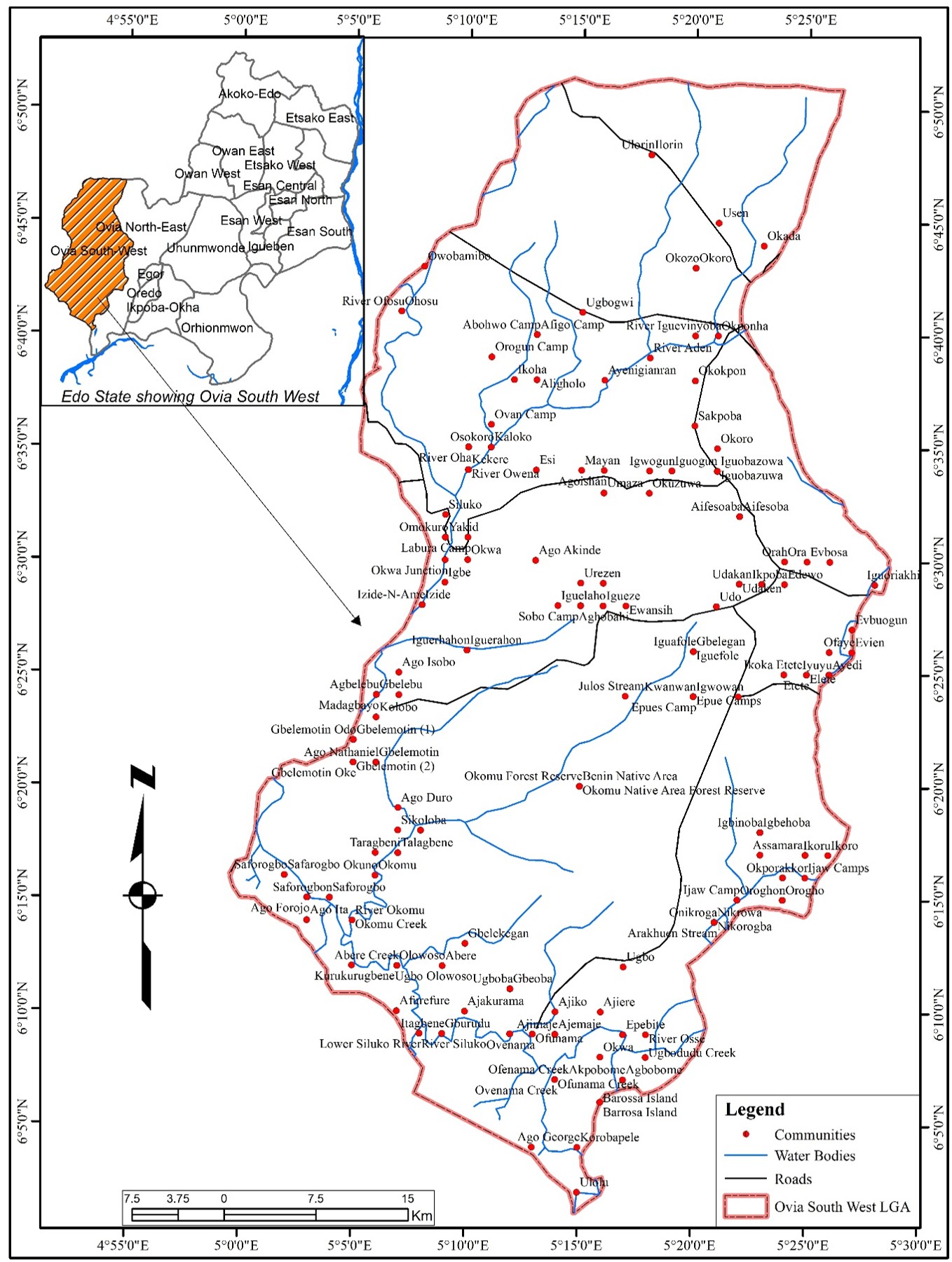
Forest resources are fundamental to rural livelihoods in sub-Saharan Africa, yet rapid land-use change threatens their sustainability. This study assessed forest cover change, available forest resources, socio-economic drivers of household dependence, and community perceptions of forest contributions to socio-economic development in Ovia Southwest LGA., Edo State, Nigeria. A mixed-methods approach was used to integrate remote sensing and GIS analysis of Landsat imagery (1987–2024), a household survey (n = 390), factor analysis, multiple regression, and chi-square tests. Land use land cover classification revealed that natural environment (forest cover) declined from 76.95% (202,031.28ha) in 1987 to 42.07% (110,449.55ha) in 2024, representing a 50% loss. Disturbed forest increased from 13.48% to 27.80%, while farmland expanded from 6.90% to 26.08%. Factor analysis identified four dominant forest resource categories: timber/charcoal/fibres (35.4% variance), medicinal plants/roots/forest soil (14.8%), fruits/animal fodder (9.9%), and meat/honey (7.0%). Multiple regression showed socio-economic factors significantly influenced household forest dependence (R² = 0.279, F = 29.779, p < 0.001), with education, age, and occupation as the strongest predictors. Chi-square analysis confirmed that communities perceive a significant contribution of forest resources to socio-economic development (χ² = 221.718, df = 32, p < 0.001). The study concludes that agricultural expansion and timber extraction are primary drivers of forest degradation, and livelihood diversification interventions are urgently needed to reduce forest dependence while sustaining rural well-being. And recommended implementation of community-participatory forest conservation programmes; investment in rural education/expanded vocational training to provide alternative income sources; and regular monitoring using remote sensing should continue to track forest cover trends and inform adaptive management.
References
Ali, A., & Rahut, D. (2018). Forest-based Livelihoods, Income, and Poverty: Empirical Evidence from the Himalayan Region of Rural Pakistan. Journal of Rural Studies, 57, pp 44-54.
Akan, A. T. and Marcus, M. E. (2026). Drivers and Socio-economic Repercussions of Urban Expansion in a Rapidly Growing Secondary City: Evidence from Uyo Capital City, Nigeria. Global Academic International Journal of Art and Social Sciences (GAIJASS), 1(1): pp 1 -11.
Akan, A. T. and Eighemhenrio, D. E. (2026). Geospatial Investigation of Shoreline and Land Cover Changes in Ilaje LGA Coastal Stretch, Nigeria (1987-2024. Global Academic International Journal of Multidisciplinary (GAIJM), 1(1): pp 1 -13.
Angelsen, A., Jagger, P., Babigumira, R. (2014). Environmental Income and Rural Livelihoods: A Global-Comparative Analysis. World Development, 64(1), pp 12-28.
Awe, F. (2011). Forest Resources and Food Security in Nigeria. Journal of Sustainable Agriculture, 35(3), pp 234-249.
Babulo, B., Muys, B., Nega, F. (2008). Household Livelihood Strategies and Forest Dependence in the Highlands of Tigray, Northern Ethiopia. Agricultural Systems, 98, pp 147-155.
Bore, N. (2014). A Struggle between Livelihood and Forest Conservation. Institute of Development Studies, University of Nairobi.
Chazdon, R. L. (2014). Second Growth: The Promise of Tropical Forest Regeneration in an Age of Deforestation. University of Chicago Press.
Cheng, S. H., MacLeod, K. & Ahlroth, S. (2019). A Systematic Map of Evidence on the Contribution of Forests to Poverty Alleviation. Environmental Evidence, 8, p 3.
Dalu, M. T., Gunter, A. W., Makatu, M. (2021). Contribution of Natural Forest Products to Rural Livelihoods at Mavunde and Sambandou Villages, South Africa. Sustainability, 13: p 4252.
DFID. (2000). Sustainable Livelihoods Guidance Sheets. Department for International Development.
Eighemhenrio, D. E. and Tom, A. A. (2026). Spatio-Temporal Analysis of Forest Cover Dynamics (1987-2024) and its Implications for Conservation in Ovia South-West, Edo State, Nigeria. Alvan Journal of Social Sciences (AJSS), 3(1): pp 897 – 906.
Ekong, E. (2003). Gender Dimensions in Forest Resource Use in Rural Nigeria. African Journal of Environmental Studies, 4(2), pp 45-56.
Ema, E., Etim, E., Tom, A., Ansa, I., Ituen, U., Ekpenyong, R., Inyanam, M. & Akpan, U. (2025). Remote Sensing Based-Assessment of Land Use and Land Cover Dynamics in Mangrove Vegetation, Akwa Ibom State, Nigeria (1986-2024). Global Journal of Environmental Science and Sustainability (GJESS), 2(2): pp 92-103.
FAO. (2016). State of the World's Forests: Forests and Agriculture – Land-Use Challenges and Opportunities. Food and Agriculture Organisation.
Fikir, D., Tadesse, W., & Gure, A. (2016). Economic Contribution to Local Livelihoods and Households' Dependency on Dryland Forest Products in Hammar District, Ethiopia. International Journal of Forestry Research, 1, pp 1-11.
Fokeng, R. M., et al. (2020). Forest Cover Change Dynamics in Cameroon. Journal of Land Use Science, 15(4), pp 456-472.
Fonta, W. M., & Ayuk, E. T. (2013). Measuring the Role of Forest Income in Mitigating Poverty in Rural Nigeria. Forest Policy and Economics, 34, pp 19-27.
Garekae, H., Thakadu, O., & Lepetu, J. (2017). Socio-Economic Factors Influencing Household Forest Dependency in Chobe Enclave, Botswana. Ecological Processes, 6, p 40.
Goselle, N. T. and Tom, A. A. (2026). Application of Geospatial Technology in Assessing Urban Expansion in Benin and Environs – Implications on Climate Change. Int. J. Renew. Energy & Environ, 4(1): pp 104-116.
Hedges, S., & Enters, T. (2000). Forest Products and Household Economies. FAO Regional Office.
Hosonuma, N., Herold, M. and De Sy, V. (2012). An Assessment of Deforestation and Forest Degradation Drivers in Developing Countries. Environmental Research Letters, 7(4), 044009.
Inoni, O. E. (2009). Forest Resource Exploitation and Rural Livelihoods in Delta State, Nigeria. Journal of Environmental Management, 90(2), pp 1120-1128.
Jacob, D. E., Nelson, I. U., Okoh, K. S. & Tom, A. A. (2015). Trend in Land Use/Cover Changes in Stubbs Creek Forest, Akwa Ibom State, Nigeria. International Journal for Research in Business, Management and Accounting, 1(1), pp 123 - 130.
Kissinger, G., Herold, M., & De Sy, V. (2012). Drivers of Deforestation and Forest Degradation. Lexeme Consulting.
Kohlin, G., & Parks, P. J. (2001). Spatial Variability and Disincentives to Harvest: Deforestation and Fuelwood Collection in South Asia. Land Economics, 77(2), pp 206-218.
Langat, D. K. (2016). Valuation of Forest Resources in Developing Countries. Forest Policy and Economics, 72, pp 103-112.
Marcus, M. E., Tom, A. A. & Ituen, U. J. (2026). Spatio-Temporal Dynamics of Urban Expansion and Land Use/Land Cover Change in Uyo Capital City, Nigeria (1986 2024): A Remote Sensing and GIS-Based Analysis. Global Academic International Journal of Information Sciences and Technology (GAIJIST), 1(1), pp 1 -13.
Mbani, A. O. (2015). Contributions of Forest Resources to Rural Household Income in Enugu State, Nigeria. Journal of Forestry Research, 26(3), pp 721-730.
Mwampamba, T. H. (2013). Charcoal and forest degradation in Sub-Saharan Africa. Energy for Sustainable Development, 17(6), pp 577-588.
Newton, P., Miller, D., Byenkya, M., & Agrawal, A. (2016). Who are forest-dependent people? A Taxonomy to Aid Livelihood and Land Use Decision-Making. Land Use Policy, 57, pp 388-395.
Olujobi, O. (2015). Evaluation of the Contributions of Ikere Forest Reserve to Sustainable Livelihood of Adjoining Communities in Ekiti State. Journal of Research in Forestry, Wildlife and Environment, 7, pp 103-114.
Olujobi, O., & Olajuyigbe, B. (2020). Socio-economic Contributions of Forest Products to Rural Livelihood: A Case Study of Aramoko Forest Reserve, Ekiti State. Journal of Agriculture and Crops, 6(8), pp 105-112.
Onuche, O. (2011). Forest v Vegetables and Household Food Security in Nigeria. African Journal of Food Science, 5(8), pp 472-479.
Saifullah, M., Kari, F. & Othman, A. (2018). Income Dependency on Non-Timber Forest Products: Empirical Evidence of Indigenous People in Peninsular Malaysia. Social Indicators Research, 135, pp 215-231.
Shackleton, C. M. & Shackleton, S. E. (2004). The Importance of Non-Timber Forest Products in Rural Livelihoods Security. International Forestry Review, 6(1), pp 15-26.
Suleiman, M. S. (2017). Spatial and Temporal Analysis of Forest Cover Change in Falgore Game Reserve, Kano, Nigeria. FUDMA Journal of Sciences, 1(2), pp 45-58.
Sunderland, T. & Ndoye, O. (Eds.). (2014). Forest Products, Livelihoods and Conservation: Case Studies of Non-timber Forest Product Systems (Vol. 2 – Africa). CIFOR.
Ullah, S. (2021a). Socioeconomic Impacts of Livelihood from Fuelwood and Timber Consumption on Forest Environment: Evidence from Basho Valley, Pakistan. Forests, 12, p 245.
Wale, E., Nkoana, M. A., & Mkuna, E. (2022). Determinants of Rural Household Livelihood Dependence on Non-Timber Forest Products: A Case Study from Inanda Community, South Africa. Frontiers in Forests and Global Change, 5, pp 788-815.
Downloads
Published
Issue
Section
Categories
License
Copyright (c) 2026 David E. Eighemhenrio, Akan A. Tom (Author)

This work is licensed under a Creative Commons Attribution-NonCommercial 4.0 International License.
- Attribution — You must give appropriate credit, provide a link to the license, and indicate if changes were made. You may do so in any reasonable manner, but not in any way that suggests the licensor endorses you or your use.
- NonCommercial — You may not use the material for commercial purposes.
- No additional restrictions — You may not apply legal terms or technological measures that legally restrict others from doing anything the license permits.