
Soil-Transmitted Helminths and Their Impact on Nutritional and Anaemia Status Among School-Aged Children in Some Schools in Dutsin-Ma, Katsina State Nigeria
DOI:
https://doi.org/10.70882/josrar.2026.v3i5.273Keywords:
Prevalence, School-age-children, Soil-transmitted helminthiases, Thinness, Underweight, WASHAbstract
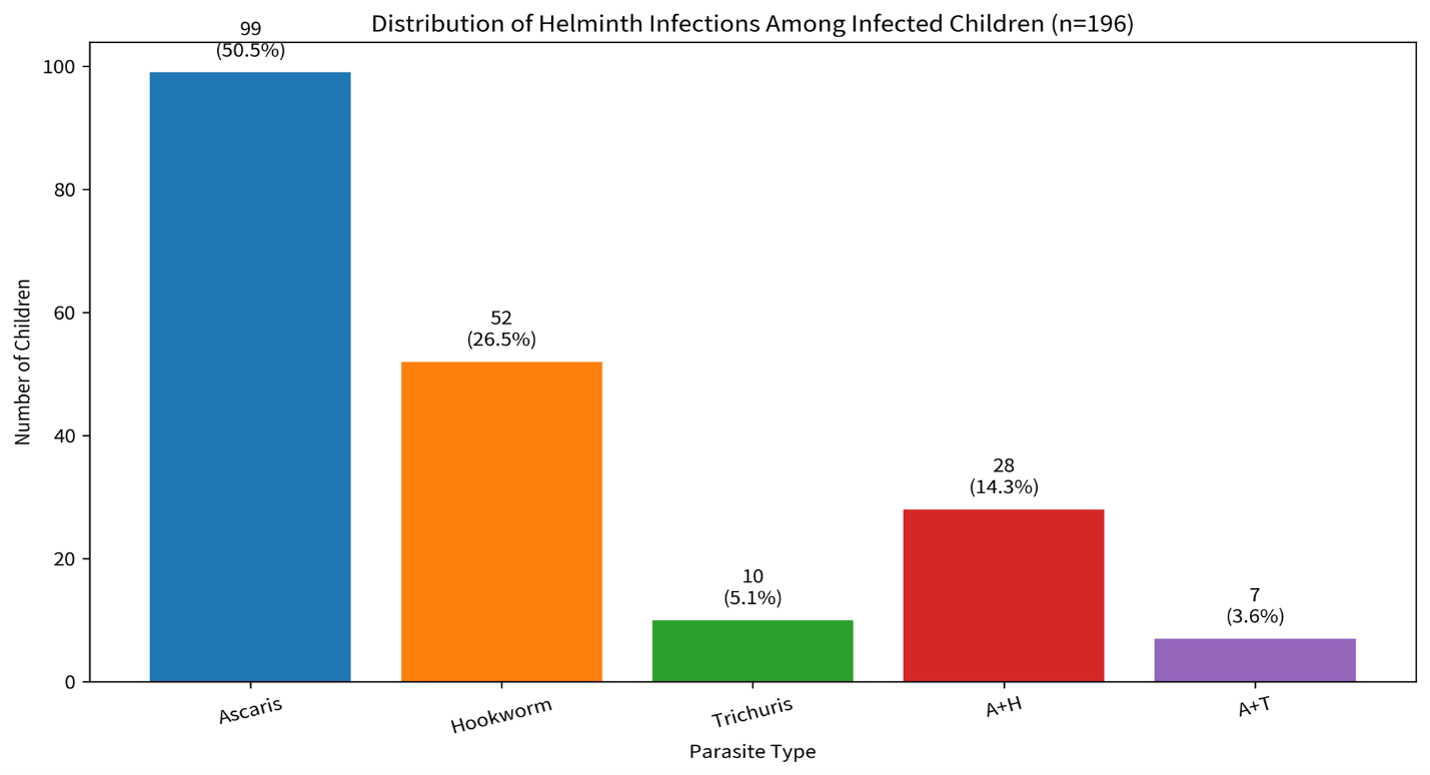
Malnutrition and anaemia among school-aged children, particularly in developing nations, are serious public health issues linked to soil-transmitted helminths (STHs). This study aimed to investigate STHs and their impact on the nutritional and anaemia status among school-aged children in some schools in Dutsin-Ma, Katsina State, Nigeria. A cross- sectional study involving 400 randomly selected school-aged children was conducted. All stool samples collected were examined for the presence of STHs using the formal-ether concentration technique. Anthropometric measurements were taken according to World Health Organisation (WHO) standards and haematocrit packed cell volume (PCV), respectively were used to determine the nutritional and anaemia condition of the sampled children. Questionnaire was administered to gather information on socio-demographic factors. The overall prevalence of STHs was 49.0% (196) in which three types of STHs were identified, Ascaris lumbricoides most dominant (50.5%) than hookworm (26.5%) and Trichuris trichiura (5.1%). A statistically significant association was observed between age group (χ² = 9.409, p = 0.009). Residing close to dumpsite, walking barefoot, and playing with sand, were not significantly associated with SHTs(p>0.05). However, washing hands with soap after toilet use was significantly associated with STHs(OR = 0.607, p = 0.017) provides a protective effect against STHs. The BMI for age shown that 26.3% were underweight and 2.8% overweight. Infected children were more anaemic though not statistically significant. Soil-Transmitted Helminthiases remains a public health concern among children and negatively affect children’s nutritional and anaemia status. Therefore, an integrated approach to STH management, nutrition, initiatives, iron supplementation and implementation of WASH are encouraged.
References
Adekola, S. S. Mayowa, O. O. and Bunmi, A. O. (2018). Prevalence of intestinal helminths among undergraduate students of Obafemi Awolowo University Ile Ife, Southwestern, Nigeria. JournalofParasitologyandVectorBiology,10(8),115-120. https://doi.org/10.5897/JPVB2018.0326
Adenusi, A. A., Sheba, K. F., Ugwueze, K. T. (2024). Community-based prevalence, intensity and risk factors associated with soil-transmitted helminthiases and intestinal schistosomiasis in Apojola, Ogun state, southwest Nigeria. BMC Infect Dis 24, 1302 https://doi.org/10.1186/s12879-024-10175-9
Adewale, B., Mafe, M. A., Mogaji, H. O., Balogun, J. B., Sulyman, M. A., Ajayi, M. B., Akande, D. O., & Balogun, E. O. (2024). Urinary schistosomiasis and anemia among school-aged children from southwestern Nigeria. Pathogens and Global Health, 118(4), 325–333. https://doi.org/10.1080/20477724.2024.2322800.
Ahmed, A. and Sani, A. (2019). Prevalence and risk factors associated with helminthic infections among pre-school children in Katsina metropolis, Katsina state, Nigeria. International Journal of Zoology and Applied Biosciences,4(3),126-133. https://doi.org/10.5281/zenodo
Ahmed, A., Al-Mekhlafi, H. M. and Al-Adhroey. A.H. The nutritional impacts of soil-transmitted helminths infections among Orang Asli schoolchildren in rural Malaysia. Parasites Vectors 5, 119 (2012). https://doi.org/10.1186/1756-3305-5-119.
Ajayi, M. B., Sani, A. H., Ezeugwu, S. M. C., Afocha, E. E. and Adesesan, A. A. (2017). Intestinal parasitic infection and body mass index among School children in Oshodi Lagos Nigeria. Advances in Cytology and Pathology,2(2),4449. https://doi.org/10.15406/acp.2017.02.00015.
Akinsanya, D., Akinseye, F. M., & Olayemi, I. K. (2019). Soil-transmitted helminth infections among school-aged children in Ogun State, Nigeria. Animal Research International, 16(3), 3508–3518. https://www.ajol.info/index.php/ari/article/view/192169
Anunobi, J. T., Okoye, I. C., Aguzie, I. O., Ndukwe, Y. E. and Okpasuo, O. J. (2019). Risk of Soil Transmitted Helminthiasis among Agrarian Communities of Kogi State, Nigeria. Annals of Global Health, 85(1), https://doi.org/10.5334/aogh.2563. 1–13.
Awotokun, F., Sowemimo, O. A., Olawoyin, R., and Adeleke, A. (2024). Soil-transmitted helminthiasis among school-aged children in selected primary schools in southwest Nigeria: A cross-sectional study. Christain Journal for Global Health, 11(1), 91-98. https://doi.org/10.15566/cjgh.v11i1.833
Bain. L. E., Awah. P. K, Geraldine.N, Kindong. N. P., Sigal. Y., Bernard. N, Tanjeko. A. T. Malnutrition in Sub-saharan Africa: burden, causes and prospects.PanAfr Med J. 2013;15:120. https://doi.org/10.11604/pamj.2013.15.120.2535.
Brooker, S., Hotez, P.J. and Bundy, D.A. (2010). The global atlas of helminth infection: mapping the way forward in neglected tropical disease control. PloSNegl Trop Dis; 4: e779.
Cheesbrough, M. (2006). District Laboratory Practice in Tropical Countries. Second edition, Cambridge University Press, United Kingdom, pp. 209-239.
Dahal, S.A., Francis, O.E., Francis, E.J. and Wamfas, I.F. (2019) Soil-Transmitted Helminths Infection and Associated Risk Factors among Elementary School Pupils in Dadin Kowa, Jos. Nigerian Medical Journal , 60, 181-185.
Eberemu, N. C., Olugbade, E. O. and Buah,J. D. ( 2023). Prevelence of Parasitic Contamination of Vegetables Sold in Dutsin-Ma Markets,Katsina States,Nigeria.Sahel journal of Life Sciences FUDMA, 1(1):147-154. https://doi.org/10.33003/sajpls-2023-0101-016
Elmonir, W., Elaadli, H., Amer, A., El-Sharkawy, H., Bessat, M., Mahmoud, S. F., Atta, M. S. and El-tras, W. F. (2021). Prevalence of intestinal parasitic infections and their associated risk factors among preschool and school children in Egypt. PLos ONE, 16(9), e0258037. https://doi.org/10.1371/journal.pone.0258037
https://idpjournal.biomedcentral.com/articles/10.1186/s40249018-0451-2
Ibrahim, A. G., Tijani, M. K., & Nwuba, R. I. (2022). Prevalence and risk factors of soil transmitted helminths infection and malnutrition among school-aged children in Ibadan. Anchor University Journal of Science and Technology, 2(2), 10–19.
Idowu, E. T., Fagbohun, I. K., Sanyaolu, O. L., Oguntuyi, K. O. and Otubanjo, O. A. (2019). Soil transmitted helminth infections among School aged Children in Lagos State, Nigeria. Animal Research International, 16(3), 3508–3518 www.zoo-unn.orgs
Igweachi R. O., Orpin J. B., & Isa A. (2025). Prevalence and Associated Risk Factors of Hookworm Infection in Dutsin Ma Town, Katsina State, Nigeria. Sahel Journal of Life Sciences FUDMA, 3(4): 140-146. DOI: https://doi.org/10.33003/sajols-2025-0304-17
Ihejirika, O. C.,Nwaorgu, O. C.,Ebirim, C. I. and Nwokeji, C. M. (2019). Effects of intestinal parasitic infections on nutritional status of primary children in Imo State Nigeria. Pan African Medical Journal,33,34. https://doi.org/10.11604/pamj.2019.33.34.1709
Imalele. E. E., Braide. E. I., Emangbe. U. E., Effanga. E. O. and Usang. A. U.(2023).Soil transmitted helminth infection among school-aged children in Ogoja,Nigeria;implication for control. Parasitology Research,122(4), 1015-1026.: https://doi.org/10.1007/s00436023-07809-3
Isma’il, I., Ahmed, A., Abdullahi, K., Yusuf, A. M., Yar’adua, Z. A., and Gidado, S. M. (2024). Prevalence and risk factors of intestinal parasitic infections among schoolchildren in Katsina Metropolis, Katsina State, Nigeria. Sahel Journal of Life Sciences FUDMA, 2(3), 62–68. https://doi.org/10.33003/sajols-2024-0203-09
Lawal, A., Abba, A. M., Omenesa, R. L., Jibrin, M. S. and Murtala, U. M. (2022). Impact of Soil Transmitted Helminthes (STHs) on nutritional and anemia status in school-aged children in Batagarawa Local Government Area, Katsina State, Nigeria. UMYU Scientifica, 1(1), 67 – 74. https://doi.org/10.47430/usci.1122.010
Lebu, S., Kibone, W., Muoghalu, C. C., Ochaya, S., Salzberg, A., Bongomin, F., & Manga, M. (2023). Soil-transmitted helminths: A critical review of the impact of co-infections and implications for control and elimination. PLOS Neglected Tropical Diseases, 17(8), e0011496.
Manir, N., Umar, L.M., and Abduhadi, B. J. (2017). Survey on prevalence of intestinal parasites associated with some primary school aged children in Dutsin-Ma Area, Katsina State, Nigeria. MOJ Biology and Medicine. 2(2):197‒201. https://doi.org/10.1506/mojbm.2017.02.00044
Mogaji, H.O., Oladunni, N.A., Olabanji,A.S., Johnson, O.O., Jessica.A.N., Mercy, O., Ikenna,M.O., Kayode H. O., Francisca, O,O., and Uwem F. E.(2026). Prevalence and risk factors of soil transmitted helminthiasis in some research-naïve communities in Ekiti State, Southwestern Nigeria. Discover Public Health, https://doi.org/10.1186/s12982-026 01735-2.
National Population Commission (2006). Population and housing census of the Federal Republic of Nigeria: Priority tables (Vol. 1). Abuja:NPC. Retrieve from https://catalog.ihsn.org/index.php/catalog/3340
Nepal:across-sectionalstudy. BMCPublicHealth 20, 1241 (2020). https://doi.org/10.1186/s12889 020-09302-3
Nwankwo, A., Onyebueke, A. C., Irikannu, K. C., Nzeukwu, C. I., Onwuzulike, I. V. and Okafor, N. M. (2021). Soil-Transmitted Helminths Infection and Associated Risk Factors among Primary School Pupils in Omogho and Awa Communities, Anambra State, Nigeria. International Journal of Tropical Disease and Health, 42(8), http://www.sdiarticle4.com/review history/69683
Pan American Health Organization. Soil transmitted helminthiasis. (2024). https://www.paho.org/en/topics/soil-transmitted-helminthiasis Accessed 10 May 2024.
Papier K, Williams GM, Luceres-Catubig R, Ahmed F, Olveda RM, (2014) Childhood malnutrition and parasitic helminth interactions. Clin Infect Dis 59: 234-243.
Pullan, R. L., Smith, J. L., Jasrasaria, R., & Brooker, S. J. (2014). Global numbers of infection and disease burden of soil-transmitted helminth infections in 2010. Parasites&Vectors,7(1),37.
Quiroz DJG, Del PilarAgudelo Lopez S, Arango CM, Acosta JEO, Parias LDB, Alzate LU, Prevalence of soil transmitted helminths in school-aged children, Colombia, 2012–2013. PLOS Negl Trop Dis. 2020;14(7):e0007613. https://doi.org/10.1371/journal.pntd.0007613.
Rhoda N, Mary E, and Chinonye O. E., International Journal of Biological and Pharmaceutical Sciences Archive, 2024, 07(01), 115–121. https://doi.org/10.53771/ijbpsa.2024.7.1.0026
Shrestha, A., Six, J., Dahal, D., Marks, S., & Meierhofer, R. (2020). Association of nutrition, water, sanitation and hygiene practices with children's nutritional status, intestinal parasitic infections and diarrhoea in rural Nepal: a cross-sectional study. BMC public health, 20(1), 1241. https://doi.org/10.1186/s12889-020-09302-3
Speich, B., Moser, W., Ali, S. M., Ame, S. M., Albonico,M., Hattendorf, J., and Keiser, J. (2016). Efficacy and reinfection with soil-transmitted helminths 18 weeks post-treatment with 145 albendazole-ivermectin, albendazole-mebendazole, albendazole-oxantel pamoate and mebendazole. Parasites and Vectors, 9(1), 123. https://doi.org/10.1186/s13071-016 1406-8
Strunz.E .C., Addiss D.G., Stocks. M.E. Ogden. S and Utzinger. J.(2014) Water, Sanitation and Soil-Transmitted Helminth Infection: A systematic Review and Mete-Analysis.PLOS Medicine 11(3): e1001620. https://doi.org/10.1371/journal.pmed.1001620
Usang,A. A., Edema E. I., Emmanuel, O. E., Ukoh, K.U. and Ituna, E. E. (2025) Soil-transmitted helminth infections and nutritional indices among children and adolescents in Calabar, Nigeria. BMC Public Health 25:1 https://doi.org/10.1186/s12889-024-21210-4.
WHO. Ending the neglect to attain the Sustainable Development Goals–A road map for neglected tropical diseases 2021–2030 Geneva. 2020a. https://www.who.int/neglected_diseases/Ending-the-neglect-to-attain-the-SDGs—NTD-Roadmap.pdf?ua=1 Accessed 10 May 2024.
WHO. Guideline: preventive chemotherapy to control soil-transmitted helminth infections in at risk population groups. 2017. https://iris.who.int/handle/10665/258983. Accessed 10 May 2024.
WHO. Intestinal worms: soil-transmitted helminthes. World Health Organization; 2011a.
World Health Organization (WHO). (2023). Soil-transmitted helminth infections.Retrieved from www.who.int.
World Health Organization (WHO). Soil-transmitted helminth infections.2023. https://www.who.int/newsroom/fact-sheets/detail/soil-transmitted-helminth-infections
World Health Organization. (2010). Working to overcome the global impact of neglected tropical diseases: First WHO Report on Neglected Tropical Diseases.
World Health Organization. https://apps.who.int/neglected_diseases/ntddata/sth/sth.html. Accessed 20 July 2020.
Zerdo Z, Yohanes T, Tariku B,. Association between Nutritional Status and Soil-Transmitted Helminthes Re-Infection among School-Age Children in Chencha District, Southern Ethiopia: A Cross Sectional Study. Transl Biomed. 2017, 8:2.
Downloads
Published
Issue
Section
Categories
License
Copyright (c) 2026 Maryam Yusuf, Adamu Isa, Esther Samuel Danjuma, Timothy Auta (Author)

This work is licensed under a Creative Commons Attribution-NonCommercial 4.0 International License.
- Attribution — You must give appropriate credit, provide a link to the license, and indicate if changes were made. You may do so in any reasonable manner, but not in any way that suggests the licensor endorses you or your use.
- NonCommercial — You may not use the material for commercial purposes.
- No additional restrictions — You may not apply legal terms or technological measures that legally restrict others from doing anything the license permits.