
Wireless Sensor Network-Based Border Security Using A Three-Tiered Hierarchical Surveillance Strategy: Architecture, Security And Deployment Considerations
DOI:
https://doi.org/10.70882/josrar.2026.v3i4.272Keywords:
Wireless Sensor Network, Border Surveillance, Hierarchical Architecture, Edge Artificial Intelligence, Raspberry Pi, MICAz, Intrusion Detection, CybersecurityAbstract
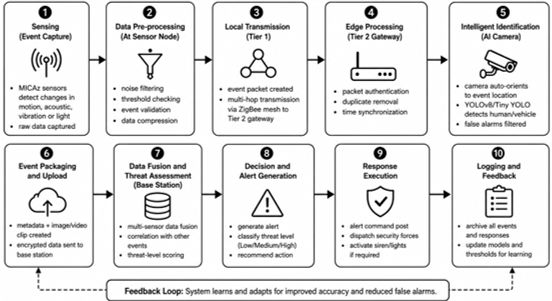
Border regions in Nigeria and the Sub-Saharan African and Sahelian security environment are characterised by expansive terrain, sparse state presence, transnational criminal mobility, irregular telecommunications coverage and a need for timely intelligence. Patrol-centred surveillance remains indispensable, but its reach, endurance and responsiveness are limited across hostile terrain. This design-oriented integrative study proposes a wireless sensor network (WSN)-based border-security system organised through a three-tiered hierarchical surveillance strategy. A synthesis of peer-reviewed studies, routing research, IoT security standards and technical documentation was used to derive operational requirements, identify limitations and formulate a reference architecture. Tier 1 comprises low-power MICAz-class nodes and multimodal sensors for motion, acoustic, seismic, vibration and environmental events. Tier 2 uses Raspberry Pi-based motorised camera nodes for event-triggered image acquisition and lightweight object classification. Tier 3 integrates gateways, secure messaging, geospatial dashboards, incident records and human-authorised response. The design separates continuous low-energy detection from computationally intensive visual confirmation, thereby reducing camera activation, bandwidth use and false-alarm burden. It also incorporates energy-aware clustering, location-informed routing, message buffering, mutual authentication, encrypted transport, signed firmware, network segmentation and degraded-mode operation. Rather than claiming unverified field performance, the paper presents a multidimensional evaluation framework and scenario-based validation model covering detection quality, latency, packet delivery, energy consumption, cybersecurity, maintainability, operator workload and lifecycle cost. The synthesis indicates that sustainable border surveillance depends on coordinated sensing, networking, edge inference, platform services, governance and maintenance. The architecture provides a basis for phased experimentation along national borders, state boundaries, forest reserves and sparsely monitored security corridors.
References
Africa Center for Strategic Studies. (2025). Region in focus: The Sahel. Africa Center for Strategic Studies.
Akyildiz, I. F., Su, W., Sankarasubramaniam, Y., & Cayirci, E. (2002). Wireless sensor networks: A survey. Computer Networks, 38(4), 393–422. https://doi.org/10.1016/S1389-1286(01)00302-4
Akkaya, K., & Younis, M. (2005). A survey on routing protocols for wireless sensor networks. Ad Hoc Networks, 3(3), 325–349. https://doi.org/10.1016/j.adhoc.2003.09.010
Arfaoui, I., Boudriga, N., Trimeche, K., & Abdallah, W. (2017). WSN-based border surveillance systems using estimated known crossing paths. In Proceedings of the 15th International Conference on Advances in Mobile Computing & Multimedia (pp. 182–190). ACM. https://doi.org/10.1145/3151848.3151869
Bhadwal, N., Madaan, V., Agrawal, P., Shukla, A., & Kakran, A. (2019). Smart border surveillance system using wireless sensor network and computer vision. In 2019 International Conference on Automation, Computational and Technology Management (ICACTM). IEEE.
Crossbow Technology. (2005). MICAz wireless measurement system: MPR2400 user manual and datasheet.
El Khediri, S., Khan, R. U., Nasri, N., & Kachouri, A. (2021). Energy efficient adaptive clustering hierarchy approach for wireless sensor networks. International Journal of Electronics, 108(1), 67–86. https://doi.org/10.1080/00207217.2020.1793415
European Telecommunications Standards Institute. (2024). Cyber security for consumer Internet of Things: Baseline requirements (ETSI EN 303 645 V3.1.3).
Farghly, M., Elgammal, A., & Elkhatib, M. (2021). Intelligent border using wireless sensor network. Military Technical College, Cairo, Egypt.
Hammoudeh, M., Al-Fayez, F., Lloyd, H., Newman, R., Adebisi, B., & Bounceur, A. (2017). A wireless sensor network border monitoring system: Deployment issues and routing protocols. IEEE Sensors Journal, 17(8), 2572–2582. https://doi.org/10.1109/JSEN.2017.2672501
He, T., Stankovic, J. A., Lu, C., & Abdelzaher, T. (2003). SPEED: A stateless protocol for real-time communication in sensor networks. In Proceedings of the 23rd International Conference on Distributed Computing Systems (pp. 46–55). IEEE. https://doi.org/10.1109/ICDCS.2003.1203451
Heinzelman, W. R., Chandrakasan, A., & Balakrishnan, H. (2000). Energy-efficient communication protocol for wireless microsensor networks. In Proceedings of the 33rd Hawaii International Conference on System Sciences. IEEE. https://doi.org/10.1109/HICSS.2000.926982
Hwang, B. R., & Shin, A. S. (2015). Design of border surveillance and control system based on wireless sensor network. KIPS Transactions on Computer and Communication Systems, 4(1), 11–14.
IEEE. (2020). IEEE standard for low-rate wireless networks (IEEE Std 802.15.4-2020). Institute of Electrical and Electronics Engineers.
Internet Engineering Task Force. (2018). The Transport Layer Security (TLS) protocol version 1.3 (RFC 8446). https://doi.org/10.17487/RFC8446
Jayachandran, J., & Vimaladevi, K. (2025). A dual-layer secure and energy-efficient model for border surveillance using sea-lion-inspired strategy in wireless sensor networks. Scientific Reports.
Kanoujiya, A., Jha, R., Rayal, S., & Khan, A. (2020). Border security system using Arduino, ultrasonic sensors and IoT. International Research Journal of Engineering and Technology, 7(5), 3293–3299.
Laouira, M. L., Abdelli, A., Ben Othman, J., & Kim, H. (2021). An efficient WSN based solution for border surveillance. IEEE Transactions on Sustainable Computing, 6(1), 54–65. https://doi.org/10.1109/TSUSC.2019.2894511
LoRa Alliance. (2020). LoRaWAN L2 1.0.4 specification. LoRa Alliance Technical Committee.
Marina, M. K., & Das, S. R. (2001). On-demand multipath distance vector routing in ad hoc networks. In Proceedings of the 9th IEEE International Conference on Network Protocols (pp. 14–23). IEEE. https://doi.org/10.1109/ICNP.2001.992756
National Institute of Standards and Technology. (2020). IoT device cybersecurity capability core baseline (NISTIR 8259A). https://doi.org/10.6028/NIST.IR.8259A
OASIS. (2019). MQTT version 5.0. OASIS Standard.
Okumu, W., & Ikelegbe, A. (Eds.). (2010). Militias, rebels and Islamist militants: Human insecurity and state crises in Africa. Institute for Security Studies.
Perkins, C. E., & Royer, E. M. (1999). Ad-hoc on-demand distance vector routing. In Proceedings of the 2nd IEEE Workshop on Mobile Computing Systems and Applications (pp. 90–100). IEEE. https://doi.org/10.1109/MCSA.1999.749281
Raspberry Pi Ltd. (2026). Raspberry Pi 4 Model B product brief and specifications.
Rehan, W., Fischer, S., & Rehan, M. (2017). A critical review of surveys emphasizing on routing in wireless sensor networks: Concepts, operational challenges and prospects for future applications. Sensors, 17(8), 1713. https://doi.org/10.3390/s17081713
Rescorla, E. (2018). The Transport Layer Security (TLS) protocol version 1.3 (RFC 8446). RFC Editor. https://doi.org/10.17487/RFC8446
Singh, R., & Singh, S. (2022). Smart border surveillance system using wireless sensor networks. International Journal of System Assurance Engineering and Management, 13(2), 880–894. https://doi.org/10.1007/s13198-021-01291-9
Texas Instruments. (2022). CC2420: 2.4 GHz IEEE 802.15.4/ZigBee-ready RF transceiver datasheet.
United Nations Institute for Disarmament Research. (2024). Banditry violence in Nigeria’s North West: Insights from affected communities. UNIDIR.
United Nations Office on Drugs and Crime. (2024). Impact of transnational organized crime on stability and development in the Sahel: Transnational organized crime threat assessment. UNODC.
Ultralytics. (2023). YOLOv8 documentation and model overview.
Yaseen, M. (2024). What is YOLOv8: An in-depth exploration of the internal features of the next-generation object detector. arXiv. https://doi.org/10.48550/arXiv.2408.15857
Yu, Y., Govindan, R., & Estrin, D. (2001). Geographical and energy aware routing: A recursive data dissemination protocol for wireless sensor networks. UCLA Computer Science Department Technical Report UCLA/CSD-TR-01-0023.
Zigbee Alliance. (2017). Zigbee specification. Connectivity Standards Alliance.
Downloads
Published
Issue
Section
License
Copyright (c) 2026 Akinwale Olusola Ojoawo, Abiodun Emmanuel Olorunisola, Mayowa Opakunle Idowu, Adewale Abayomi Alabi, I. I. Adeaga (Author)

This work is licensed under a Creative Commons Attribution-NonCommercial 4.0 International License.
- Attribution — You must give appropriate credit, provide a link to the license, and indicate if changes were made. You may do so in any reasonable manner, but not in any way that suggests the licensor endorses you or your use.
- NonCommercial — You may not use the material for commercial purposes.
- No additional restrictions — You may not apply legal terms or technological measures that legally restrict others from doing anything the license permits.