
Internet of Things-Based Smart Parking Systems: An Integrative Review of Architectures, Technologies and Deployment Challenges
DOI:
https://doi.org/10.70882/josrar.2026.v3i3.271Keywords:
Internet of Things, Smart Parking, Wireless Sensor Networks, Edge Computing, Intelligent Transportation Systems, CybersecurityAbstract
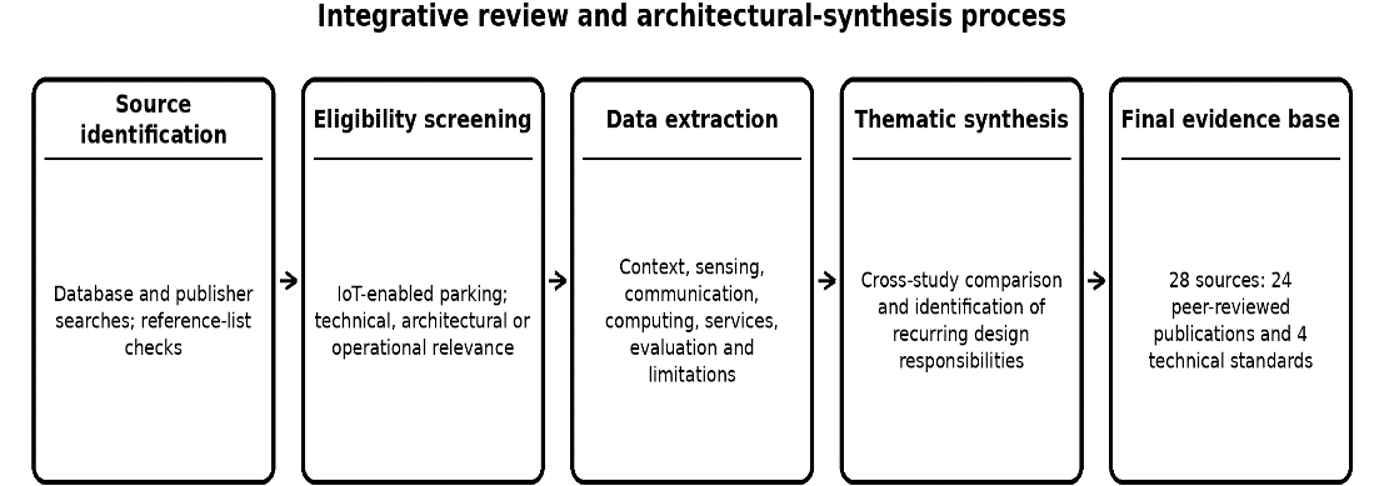
Rapid urbanisation, increasing vehicle ownership and inefficient parking operations have intensified search traffic, congestion and underutilisation of parking resources. This paper presents an integrative review of Internet of Things (IoT)-based smart parking systems, with emphasis on architecture, enabling technologies, operational requirements and deployment in resource-constrained environments. A transparent search and thematic-synthesis procedure was applied to 28 sources comprising 24 peer-reviewed publications and four recognised technical standards. Evidence was extracted on sensing and identification, communication, edge-fog-cloud processing, application services, security, performance evaluation and implementation constraints. The synthesis shows that reliable smart parking is not produced by a sensor or mobile application alone; it depends on coordinated responsibilities across six layers: perception and identification, edge and gateway processing, communication, platform and data management, application services, and security and governance. Ultrasonic, magnetic, infrared, inductive and camera-based methods provide different trade-offs in accuracy, coverage, energy demand, privacy and lifecycle cost. Wi-Fi and ZigBee are suited to bound facilities, while LoRaWAN and NB-IoT support dispersed low-power deployments. Edge and fog processing improve responsiveness and continuity, whereas cloud services support historical analysis and multi-site management. The review identifies persistent weaknesses in short-term prototype evaluation, cybersecurity, interoperability, maintenance planning, cost reporting and evidence from African cities. A phased, context-sensitive deployment framework and a multidimensional evaluation set are proposed for campuses, hospitals, commercial facilities and municipal parking environments.
References
Al-Turjman, F., & Malekloo, A. (2019). Smart parking in IoT-enabled cities: A survey. Sustainable Cities and Society, 49, 101608. https://doi.org/10.1016/j.scs.2019.101608
Ala’anzy, M. A., Abilakim, A., Zhanuzak, R., & Li, L. (2025). Real time smart parking system based on IoT and fog computing evaluated through a practical case study. Scientific Reports, 15, 33483. https://doi.org/10.1038/s41598-025-15507-6
Alam, M. R., Saha, S., Bostami, M. B., Islam, M. S., Aadeeb, M. S., & Islam, A. K. M. M. (2023). A survey on IoT driven smart parking management system: Approaches, limitations and future research agenda. IEEE Access, 11, 119523–119543. https://doi.org/10.1109/ACCESS.2023.3327306
Amato, G., Carrara, F., Falchi, F., Gennaro, C., Meghini, C., & Vairo, C. (2017). Deep learning for decentralized parking lot occupancy detection. Expert Systems with Applications, 72, 327–334. https://doi.org/10.1016/j.eswa.2016.10.055
Balfaqih, M., Jabbar, W. A., Khayyat, M., & Hassan, R. (2021). Design and development of smart parking system based on fog computing and Internet of Things. Electronics, 10(24), 3184. https://doi.org/10.3390/electronics10243184
Barriga, J. J., Sulca, J., León, J. L., Ulloa, A., Portero, D., Andrade, R., & Yoo, S. G. (2019). Smart parking: A literature review from the technological perspective. Applied Sciences, 9(21), 4569. https://doi.org/10.3390/app9214569
Barriga, J. J., Sulca, J., León, J., Ulloa, A., Portero, D., García, J., & Yoo, S. G. (2020). A smart parking solution architecture based on LoRaWAN and Kubernetes. Applied Sciences, 10(13), 4674. https://doi.org/10.3390/app10134674
Biyik, C., Allam, Z., Pieri, G., Moroni, D., O’Fraifer, M., O’Connell, E., Olariu, S., & Khalid, M. (2021). Smart parking systems: Reviewing the literature, architecture and ways forward. Smart Cities, 4(2), 623–642. https://doi.org/10.3390/smartcities4020032
Ditta, A., Ahmed, M. M., Mazhar, T., Shahzad, T., Alahmed, Y., & Hamam, H. (2025). Number plate recognition smart parking management system using IoT. Measurement: Sensors, 37, 101409. https://doi.org/10.1016/j.measen.2024.101409
Echendu, A. J., & Okafor, P. C. C. (2021). Smart city technology: A potential solution to Africa’s growing population and rapid urbanization? Development Studies Research, 8(1), 82–93. https://doi.org/10.1080/21665095.2021.1894963
Enríquez, F. J., Mejía-Muñoz, J.-M., Bravo, G., & Cruz-Mejía, O. (2024). Smart parking: Enhancing urban mobility with fog computing and machine learning-based parking occupancy prediction. Applied System Innovation, 7(3), 52. https://doi.org/10.3390/asi7030052
European Telecommunications Standards Institute. (2024). Cyber security for consumer Internet of Things: Baseline requirements (ETSI EN 303 645 V3.1.3).
Fahim, A., Hasan, M., & Chowdhury, M. A. (2021). Smart parking systems: Comprehensive review based on various aspects. Heliyon, 7(5), e07050. https://doi.org/10.1016/j.heliyon.2021.e07050
Geng, Y., & Cassandras, C. G. (2013). New smart parking system based on resource allocation and reservations. IEEE Transactions on Intelligent Transportation Systems, 14(3), 1129–1139. https://doi.org/10.1109/TITS.2013.2252428
Internet Engineering Task Force. (2018). The Transport Layer Security (TLS) protocol version 1.3 (RFC 8446). https://doi.org/10.17487/RFC8446
Jabbar, W. A., Wei, C. W., Azmi, N. A. A. M., & Haironnazli, N. A. (2021). An IoT Raspberry Pi-based parking management system for smart campus. Internet of Things, 14, 100387. https://doi.org/10.1016/j.iot.2021.100387
Jabbar, W. A., Tiew, L. Y., & Shah, N. Y. A. (2024). Internet of Things enabled parking management system using long range wide area network for smart city. Internet of Things and Cyber-Physical Systems, 4, 82–98. https://doi.org/10.1016/j.iotcps.2023.09.001
Ji, Z., Ganchev, I., O’Droma, M., Zhao, L., & Zhang, X. (2014). A cloud-based car parking middleware for IoT-based smart cities: Design and implementation. Sensors, 14(12), 22372–22393. https://doi.org/10.3390/s141222372
Kadusic, E., Zivic, N., Ruland, C., & Hadzajlic, N. (2022). A smart parking solution by integrating NB-IoT radio communication technology into the core IoT platform. Future Internet, 14(8), 219. https://doi.org/10.3390/fi14080219
Khalid, M., Wang, K., Aslam, N., Cao, Y., Ahmad, N., & Khan, M. K. (2021). From smart parking towards autonomous valet parking: A survey, challenges and future works. Journal of Network and Computer Applications, 175, 102935. https://doi.org/10.1016/j.jnca.2020.102935
Kotb, A. O., Shen, Y.-C., Zhu, X., & Huang, Y. (2016). iParker—A new smart car-parking system based on dynamic resource allocation and pricing. IEEE Transactions on Intelligent Transportation Systems, 17(9), 2637–2647. https://doi.org/10.1109/TITS.2016.2531636
Lee, C. P., Leng, F. T. J., Habeeb, R. A. A., Amanullah, M. A., & Rehman, M. H. (2022). Edge computing-enabled secure and energy-efficient smart parking: A review. Microprocessors and Microsystems, 93, 104612. https://doi.org/10.1016/j.micpro.2022.104612
Nasim, S., Oussalah, M., Outila, T., & Jutila, J. (2022). Smart parking system based on IoT architecture and intelligent sensors. In SMART 2022: The Eleventh International Conference on Smart Cities, Systems, Devices and Technologies (pp. 1–6). IARIA.
National Institute of Standards and Technology. (2020). IoT device cybersecurity capability core baseline (NISTIR 8259A). https://doi.org/10.6028/NIST.IR.8259A
OASIS. (2019). MQTT version 5.0. OASIS Standard.
Ozkaya, M., & Turunc, A. (2025). A reference architecture for smart car parking management systems. Systems, 13(2), 70. https://doi.org/10.3390/systems13020070
Paidi, V., Fleyeh, H., Håkansson, J., & Nyberg, R. G. (2018). Smart parking sensors, technologies and applications for open parking lots: A review. IET Intelligent Transport Systems, 12(8), 735–741. https://doi.org/10.1049/iet-its.2017.0406
Perković, T., Šolić, P., Zargariasl, H., Čoko, D., & Rodrigues, J. J. P. C. (2020). Smart parking sensors: State of the art and performance evaluation. Journal of Cleaner Production, 262, 121181. https://doi.org/10.1016/j.jclepro.2020.121181
Downloads
Published
Issue
Section
License
Copyright (c) 2026 Babatunde Emmanuel Olagoke, Adewale Abayomi Alabi, Akinwale Olusola Ojoawo, Olasunkanmi Olaogun Ogundipe, Bolarinwa Samson Adeleke (Author)

This work is licensed under a Creative Commons Attribution-NonCommercial 4.0 International License.
- Attribution — You must give appropriate credit, provide a link to the license, and indicate if changes were made. You may do so in any reasonable manner, but not in any way that suggests the licensor endorses you or your use.
- NonCommercial — You may not use the material for commercial purposes.
- No additional restrictions — You may not apply legal terms or technological measures that legally restrict others from doing anything the license permits.