Production and Characterization of Biodegradable Packaging Composites from Recycled Expanded Polystyrene Filled with Groundnut Shell Cassava Peel Powders
DOI:
https://doi.org/10.70882/josrar.2026.v3i5.268Keywords:
Biodegradable Packaging Material, Recycled Polystyrene, Cassava Peel Powder, Groundnut Shell Powder, Agro-waste filler, Packaging materialAbstract
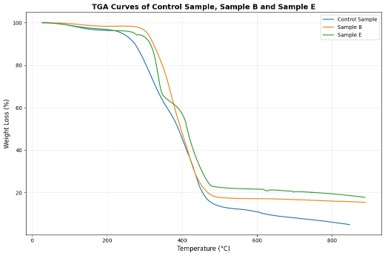
This study reports the production and characterization of biodegradable packaging materials made from recycled expanded polystyrene (REPS) filled with alkali-treated groundnut shell powder (GNSP) and cassava peel powder (CPP) as a green alternative to conventional Styrofoam, which are usually disposed in landfills or burnt in incinerator, resulting in material loss, emission of toxic and carcinogenic substances into the atmosphere, harming the environment and human life. Composite samples (A-E) were formulated with a fixed REPS, GNSP and varying CPP content, compounded on a two-roll mill and formed by compression moulding. The composites were characterized using thermogravimetric analysis, scanning electron microscopy, and Fourier transform infrared spectroscopy, and evaluated for tensile, impact, hardness, flexural, density, water absorption, and soil-burial biodegradability properties. TGA showed a multi-stage thermal decomposition profile for all composite specimens compared with the single-stage profile of the control, denoting reduced thermal stability with increasing filler content. SEM revealed homogeneous filler distribution at intermediate loading (Sample B) and agglomeration with crack formation at higher loading (Sample E). FTIR confirmed hydroxyl and carbonyl groups associated with the natural fillers. Tensile properties improved initially in Sample A (27.66 MPa), with Sample B recording the highest tensile strength (29.22 MPa), while Sample C gave the highest impact strength (0.183 J/mm) and flexural modulus (2686.93 MPa), after which performance declined at higher loadings. Density and hardness decreased, while water absorption increased, with increasing filler content. Biodegradation tests after 63 days showed progressive weight loss from the control to Sample E, with Sample C recording the highest weight loss (0.705%), confirming that natural fillers render the composites more susceptible to microbial attack and thereby enhance biodegradability.
References
Ahmed, T., Shahid, M., Azeem, F., Rasul, I., Shah, A. A., Noman, M., et al. (2018). Biodegradation of plastics: Current scenario and future prospects for environmental safety. Environmental Science and Pollution Research, 25, 7287–7298.
Anyanwu, C. N., Ibeto, C. N., Ezeoha, S. L., & Ogbuagu, N. J. (2015). Sustainability of cassava (Manihot esculenta Crantz) as industrial feedstock, energy, and food crop in Nigeria. Renewable Energy, 81, 745–752. https://doi.org/10.1016/j.renene.2015.03.075
Anyanwu, C. N., Ibeto, C. N., Ezeoha, S. L., & Ogbuagu, N. J. (2015). Sustainability of cassava (Manihot esculenta Crantz) as industrial feedstock, energy, and food crop in Nigeria. Renewable Energy, 81, 745-752. https://doi.org/10.1016/j.renene.2015.03.075
Babayemi, J. O., Ogundiran, M. B., Weber, R., & Osibanjo, O. (2018). Initial inventory of plastics imports in Nigeria as a basis for better sustainable management policies. Journal of Health and Pollution, 8(18).
Bakhtiyar, Y., Andrabi, S., Arafat, M. Y., & Tak, H. I. (2020). Plastic pollution and its impact on aquatic fauna. In Handbook of research on environmental and human health impacts of plastic pollution (pp. 160–177). IGI Global.
Bhatia, S. K., Gurav, R., Choi, T.-R., Jung, H.-R., Yang, S.-Y., Moon, Y.-M., Song, H.-S., Jeon, J.-M., Choi, K.-Y., & Yang, Y.-H. (2019). Bioconversion of plant biomass hydrolysate into bioplastics (PHA) using Ralstonia eutropha 5119. Bioresource Technology, 271, 306-315. https://doi.org/10.1016/j.biotech.2018.01.122
Bledzki, A. K., & Gassan, J. (1999). Composites reinforced with cellulose based fibres. Progress in Polymer Science, 24(2), 221-274. https://doi.org/10.1016/S0079-6700(98)00018-5
Callister, W. D., & Rethwisch, D. G. (2018). Materials science and engineering: An introduction (10th ed.). Wiley.
Czaikoski, A., Da Cunha, R. L., & Menegalli, F. C. (2020). Rheological behaviour of cellulose nanofibers from cassava peel. Carbohydrate Polymers, 248, 116744. https://doi.org/10.1016/j.carbpol.2020.116744
Edun, B. M., Ajayi, O. O., Afolalu, S. A., Nwankwo, S. O., & Fajugbagbe, A. A. (2023). Recycling of animal bone as partial replacement for coarse aggregate in lightweight hollow sandcrete blocks. E3S Web of Conferences, 430, 01219. https://doi.org/10.1051/e3sconf/202343001219
Emifoniye, U. E., Omoganiegbe, N., & Arhore, O. H. (2020). Design and fabrication of a furnace for plastic wastes recycling. Nigeria Journal of Engineering Science Research, 2(2), 15-26.
Eriksen, M., Lebreton, L. C., Carson, H. S., Thiel, M., Moore, C. J., Borerro, J. C., et al. (2014). Plastic pollution in the world's oceans. PLoS ONE, 9, e111913.
John, M. J., & Thomas, S. (2008). Biofibres and biocomposites. Carbohydrate Polymers, 71(3), 343-364. https://doi.org/10.1016/j.carbpol.2007.05.040
Kumar, R., Sabapathy, H. K., & Neethimanickam, I. (2015). Mechanical, physical, and chemical properties of sawdust briquette. World Journal of Engineering, 12(4), 347-352. https://doi.org/10.1260/1708-5284.12.4.347
Mohanty, A. K., Misra, M., & Hinrichsen, G. (2000). Biofibres, biodegradable polymers and biocomposites: An overview. Macromolecular Materials and Engineering, 276(1), 1-24.
Pradha, S. S., & Saranya, K. (2023). Recycling plastic waste into construction materials for sustainability. IOP Conference Series: Earth and Environmental Science, 1210, 012016. https://doi.org/10.1088/1755-1315/1210/1/012016
Prathiba, R., Shruthi, M., & Miranda, L. R. J. (2018). Pyrolysis of polystyrene waste in the presence of activated carbon in conventional and microwave heating using a modified thermocouple. Waste Management, 76, 528-536.
Premalatha, N. (2021). Pyrolysis of polypropylene waste using sulfonated carbon catalyst synthesized from sugarcane bagasse. Journal of Material Cycles and Waste Management, 23, 1002-1014.
Rameshkumar, S., Shaiju, P., & O'Connor, K. E. (2020). Bio-based polymers: Trends and challenges. Current Opinion in Green and Sustainable Chemistry, 21, 75–81.
Rathore, S. S., Shekhawat, K., Singh, R. K., Upadhyay, P. K., & Singh, V. K. (2018). Best practices for doubling oilseed productivity: Aiming India for self-reliance in edible oil. Indian Journal of Agricultural Sciences, 89(8), 1225-1231.
Shah, A. A., Hasan, F., Hameed, A., & Ahmed, S. (2008). Biological degradation of plastics. Biotechnology Advances, 26, 246–265.
Sheelendra, M. B., & Shilpa. (2014). Bioethanol production from economical agro waste (groundnut shell) in SSF. Research Journal of Pharmaceutical, Biological and Chemical Sciences, 5(6), 1210-1218.
Souto, L. R. F., Caliari, M., Soares Junior, M. S., Fiorda, F. A., & Garcia, M. C. (2016). Utilization of residue from cassava starch processing for the production of fermentable sugar by enzymatic hydrolysis. Food Science and Technology, 37(1), 19-24. https://doi.org/10.1590/1678-457x.0023
Thakur, S., Chaudhary, J., Sharma, B., Verma, A., Tamulevicius, S., & Thakur, V. K. (2018). Sustainability of bioplastics. Current Opinion in Green and Sustainable Chemistry, 13, 68–75.
Thakur, S., Chaudhary, J., Sharma, B., Verma, A., Tamulevicius, S., & Thakur, V. K. (2018). Sustainability of bioplastics: Opportunities and challenges. Current Opinion in Green and Sustainable Chemistry, 13, 68-75.
Ugwu, S. C., & Obele, C. M. (2023). Expanded polystyrene waste recycling and applications. World Journal of Advanced Engineering, Technology and Sciences, 315–329.
Vroman, I., & Tighzert, L. (2009). Biodegradable polymers. Materials, 2, 307–344.
Downloads
Published
Issue
Section
Categories
License
Copyright (c) 2026 Morgan M.I. Eimoga, Labaran Salihu, D. D. Nabaida (Author)

This work is licensed under a Creative Commons Attribution-NonCommercial 4.0 International License.
- Attribution — You must give appropriate credit, provide a link to the license, and indicate if changes were made. You may do so in any reasonable manner, but not in any way that suggests the licensor endorses you or your use.
- NonCommercial — You may not use the material for commercial purposes.
- No additional restrictions — You may not apply legal terms or technological measures that legally restrict others from doing anything the license permits.