
Hepatitis B Virus Knowledge, Preventive Practices, and Vaccination Status Among People Living with HIV at the Nigerian Institute of Medical Research, Lagos: A Cross-Sectional Study
DOI:
https://doi.org/10.70882/josrar.2026.v3i5.266Keywords:
Hepatitis B, HIV, Vaccination, Knowledge, Attitude, PracticeAbstract
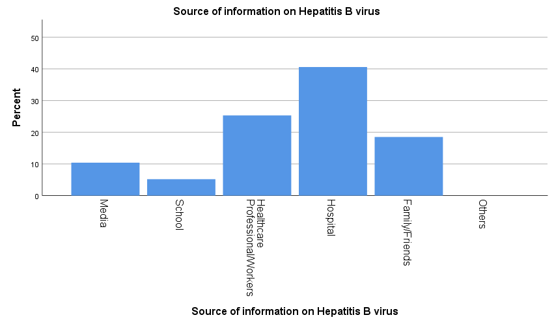
Hepatitis B Virus (HBV) co-infection substantially increases liver-related morbidity and mortality among people living with HIV (PLHIV). Although vaccination remains the most effective strategy for prevention HBV infection, its uptake is conventionally assumed to depend on adequate knowledge and positive attitudes towards vaccination. This study assessed knowledge, attitudes, and practices regarding HBV vaccination among HIV-positive patients and examined whether knowledge significantly predicts vaccination uptake. A cross-sectional institutional survey was conducted among 374 HIV-positive patients receiving care at the Nigerian Institute of Medical Research (NIMR), Yaba, Lagos State. Participants were selected using purposive sampling. and data were collected using a structured questionnaire. Data were analysed using SPSS version 26.0, through descriptive statistics, chi-square tests, and logistic regression with statistical significance set at p<0.05. The majority of respondents were female (70.2%), married (62.9%), and had tertiary-educated (40.7%). Overall, 82% of participants demonstrated low levels of knowledge regarding HBV infection and vaccination (Mean=1.20±0.443), while 58% exhibited negative attitudes toward HBV vaccination (Mean=2.73±0.580). Despite these findings, self-reported HBV vaccination uptake was relatively high (79.6%, Mean = 1.4\11±0.423). Healthcare facilities were identified as the primary source of HBV related information. Education level were significantly associated with vaccination status (p=0.025), while gender was significantly associated with knowledge level (p = 0.010). Occupation was not significantly associated with attitude (p = 0.466). Logistic regression analysis indicated that knowledge was not a significant predictor of vaccination uptake (χ² = 4.49, p = 0.106, R² = 0.018). The findings demonstrate a notable disconnect between knowledge and predominantly negative attitudes. This challenge the conventional assumption that knowledge necessarily drives vaccination behavior and suggest that health-system factors, including routine vaccine provision and health-care provider recommendations, may play a more important role in vaccination uptake among PLHIV. Interventions should therefore combine improved vaccine accessibility and provider-led vaccination strategies with targeted education, particularly through the integration of HBV vaccination into routine HIV care.
References
Andrade C, Menon V, Ameen S, Kumar Praharaj S. Designing and Conducting Knowledge, Attitude, and Practice Surveys in Psychiatry (2020). Practical Guidance. Indian J Psychol Med.42(5):478-481. https://doi.org/10.1177/0253717620946111. PMID: 33414597; PMCID: PMC7750837
Akabuike O.M, Aworh M.K, Uzoebo N.L, Erwat J, Agukwe O, Ngong K, Dangana A, Enwerem K, & Abdullahi I.N. (2024). Evaluating hepatitis B screening, prevalence, vaccination coverage, and linkage to care in Abuja, Nigeria: insights from a cross-sectional study. BMC Public Health.24(1):3475. https://doi.org/10.1186/s12889-024-21017-3. PMID: 39696217; PMCID: PMC11657572
Chou R, Blazina I, Bougatsos C, Holmes R, Selph S, Grusing S, & Jou J. (2020) Screening for Hepatitis B Virus Infection in Nonpregnant Adolescents and Adults: Updated Evidence Report and Systematic Review for the US Preventive ServicesTaskForce.JAMA.324(23):2423-2436. https://doi.org/10.1001/jama.2020.19750. PMID: 33320229
Dubé, E., Ward, J. K., Verger, P., & MacDonald, N. E. (2021). Vaccine hesitancy, acceptance, and anti-vaccination: Trends and future prospects for public health. Annual Review of Public Health, 42, 175–191.
Health Quality BC. (2009). John Ruedy Immunodeficiency Clinic: Providence Health Care
Ladan, M.S., Lateef, A.B., & Hamzat, O.A. (2026) Knowledge, Attitude, and Practice (KAP) Towards Hepatitis B Vaccination Among HIV Patients at Nigeria Institute of Medical Research, Yaba-Lagos: A Cross-Sectional Study. FUDMA Journal of Sciences (FIS) Vol. 10 No.9, 245 – 252. https://doi.org/10.33003/fjs-2026-1009-5399.
Ladi-Akinyemi, T. W., Ajayi, T. O., Nkamigbo, M. C., & Babawale, D. D. (2026). Knowledge, perception, and preventive practices against hepatitis B virus infection among young adults in selected local government areas of Lagos Nigeria. Journal of Community Medicine and Primary Health Care, 38(1). https://www.ajol.info/index.php/jcmphc/article/view/321811
MacDonald NE, Butler R, Dubé E. Addressing barriers to vaccine acceptance: an overview. (2018) Hum Vaccine Immunother.14(1):218-224. https://doi.org/10.1080/21645515.2017.1394533. Epub 2017 Nov 29. PMID: 29048975; PMCID: PMC5791591
Magaji, A., Mahmud, Z. ., Kwarau, N. L. ., Ibrahim, Z. ., Yakubu, A. ., Maradun, . R. S. ., Aminu, S. ., & Aminu, S. (2025). Epidemiology of Hepatitis B Virus infection: Prevalence, vaccine coverage and its barriers in Katagum Local Government Area, Bauchi State Nigeria. Science World Journal, 20(1), 437–444. https://doi.org/10.4314/swj.v20i1.59
Musa, B. M., Bussell, S., Borodo, M. M., & Samaila, A. A. (2020). Prevalence of hepatitis B virus infection in Nigeria, 2000–2018: A systematic review and meta-analysis. Nigerian Journal of Gastroenterology and Hepatology, 12(1), 12–21.
Olayinka AT, Oyemakinde A, Balogun MS, Ajudua A, Nguku P, Aderinola M, Egwuenu-Oladejo A, Ajisegiri SW, Sha'aibu S, Musa BO, Gidado S, Nasidi A (2016) Seroprevalence of Hepatitis B Infection in Nigeria: A National Survey. Am J Trop Med Hyg..95(4):902-907. https://doi.org/10.4269/ajtmh.15-0874. Epub 2016 Aug 15. PMID: 27527630; PMCID: PMC5062798.
Shauna H. Gunaratine, Marguerite A. Urban, Rona M. Vail, AAHIVS, Sanjiv S. Shah., Steven M. Fine., Joseph P. McGowan,Samuel T. Merrick., Anne K. Monroe., Jessica Rodrigues., Christopher J. Hoffmann., Brianna L. Norton., & Charles J. Gonzalez. (2026). Immunizations for Adults with HIV
Shoyemi E, Aghedo OG, Obi C, Uwaoma CPK, Azeez OS, Oyeniyi O (2026) Impact of demographic factors and HIV status on Hepatitis B vaccination adherence and completion rate among high-risk populations in Lagos State, Nigeria. PLoS One 21(3): e0321434. https://doi.org/10.1371/journal.pone.0321434
Schlüter, K., Vamos, S., Wacker, C., & Welter, V. D. E. (2020). A Conceptual Model Map on Health and Nutrition Behavior (CMMHB/NB). International Journal of Environmental Research and Public Health, 17(21), 7829. https://doi.org/10.3390/ijerph17217829
Singh, K. P., Crane, M., Audsley, J., & Lewin, S. R. (2017). HIV-hepatitis B virus coinfection: Epidemiology, pathogenesis, and treatment. AIDS, 31(15), 2035–2052.
Spearman, C. W., Afihene, M., & Ally, R. (2017). Hepatitis B in sub-Saharan Africa: Strategies to achieve the 2030 elimination goals. The Lancet Gastroenterology & Hepatology, 2(12), 900–909.
Thaler, R. H., & Sunstein, C. R. (2021). Nudge: The final edition. Yale University Press.
Thio, C.L. (2009) Hepatitis B and Human Immunodeficiency Virus Coinfection. Hepatology, 49, S138-S145. http://dx.doi.org/10.1002/hep.22883
World Health Organization. (2015). Guidelines for the prevention, care and treatment of persons with chronic hepatitis B infection. Geneva: World Health Organization. https://www.who.int/publications/i/item/9789241549059
Zwawua, O., Ukpekeh, S. T., & Ityodugh, J. I. (2025). Knowledge and practice of hepatitis B virus infection prevention among young adults in Benue North-East: A cross-sectional study. Insights in Public Health Journal, 5(2). https://jos.unsoed.ac.id/index.php/iphj/article/view/13676
Downloads
Published
Issue
Section
Categories
License
Copyright (c) 2026 Musa Sanni Ladan, Akeem Blessing Lateef, Itohan Florence Ulikhifun, Motunrayo Mariam Oyelude (Author)

This work is licensed under a Creative Commons Attribution-NonCommercial 4.0 International License.
- Attribution — You must give appropriate credit, provide a link to the license, and indicate if changes were made. You may do so in any reasonable manner, but not in any way that suggests the licensor endorses you or your use.
- NonCommercial — You may not use the material for commercial purposes.
- No additional restrictions — You may not apply legal terms or technological measures that legally restrict others from doing anything the license permits.