
Impact of Invasive Species from Different Land Use on Vegetation Structure and Soil Microbial Dynamics in Warwade, Sudan Savanna, Jigawa State, Nigeria
DOI:
https://doi.org/10.70882/josrar.2026.v3i4.259Keywords:
invasive, Plant Species, Diversity, Spatial Distribution, Sudan SavannaAbstract
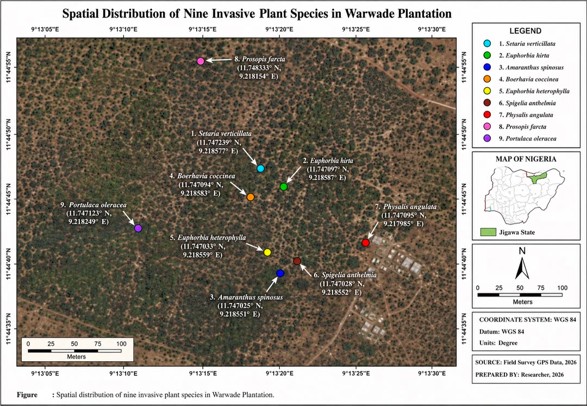
This study assessed the vegetation structure which was classify into indigenous and exotic to determine invasive plant species and microbial population across ecological zones. Randon sampling using twenty quadrats across three ecological zones. Plant species encountered within each quadrat were identified, enumerated, and classified using Plant NET and iNATURALIST. Coordinates of invasive species were recorded using a Global Positioning System receiver to determine their spatial distribution. A total of 29 plant species, 256 individuals and 33 occurrences were recorded. Plantation had the highest species richness 14 and abundance 124 individuals, followed by Fallow 13 species, 82 individuals, while Agricultural landscape had the lowest 12 species, 64 individuals. Fabaceae 43.5% dominated plant families. Plantation recorded the highest diversity indices, indicating greater species evenness and reduced dominance. Exotic species 52.2% slightly outnumbered natives 47.8%, reflecting anthropogenic influence. Sorensen similarity indicated substantial species overlap among zones. Prosopis farcta, Portulaca oleracea, Physalis angulata, Euphorbia hirta, Setaria verticillata, Boerhavia erecta, Euphorbia heterophylla, Amaranthus spinosus, and Spigelia anthelmia were identified as invasive species. Forest Land recorded the highest bacterial count at 3.4×10⁸ CFU/g, but differences were not significant. Bacillus sp. occurred in all land uses, while Klebsiella and Enterobacter indicated anthropogenic inputs. Five fungal genera were recorded, with Aspergillus, Penicillium, and Rhizopus present in all zones. Study area supports diverse plant community despite the occurrence of invasive exotic species. Continuous monitoring, early detection, and appropriate management strategies are recommended to minimize the spread of invasive species and conserve the indigenous flora of the plantation.
References
Adcock, K., Emslie, R. and Kotze, D. (2017). The conservation and management of protected areas under invasive species pressure. IUCN Species Survival Commission.
Adekoya, A. O. (2021). Ecological implications of land use/land cover changes in the Marguba Range of Old Oyo National Park, Nigeria (Doctoral dissertation).
Ahimbisibwe, V. (2014). Invasive plant species and their ecological impacts on protected ecosystems in East Africa. African Journal of Ecology, 52(3), 289–298.
Ahungwa, G. T., Abdullahi, K. U., Aker, E. I., & Gama, E. N. (2026). Economics Of The Adoption Of Climate-Smart Agricultural Practices Among Smallholder Rice Farmers In Dutse, Jigawa State, Nigeria. Nigerian Journal of Agriculture and Agricultural Technology, 6(1A), 137-148.
Aigbe, H. I., Omokhua, G. E., and Uwagboe, E. O. (2015). Plant species diversity in natural forest and plantation ecosystems in Edo State, Nigeria. Journal of Forestry Research and Management, 12(1), 1-10.
Appiagyei, B. D., & Adejoke, A. O. (2021). Natural regeneration status and soil seed bank composition in IITA Forest Reserve, Ibadan, Oyo State, Nigeria. Southern Forests: a Journal of Forest Science, 83(1), 1-9.
Corlett, R. T. (2016). Plant diversity in a changing world: status, trends, and conservation needs. Plant diversity, 38(1), 10-16.
Gebre, T., Haile, M., Birhane, E., Tewolde-Berhan, S., & Girmay, Z. (2022). Multipurpose benefits and scaling-up strategies for Bauhinia thonningii Schumacher: a review. Agroforestry Systems, 96(2), 265-280.
Holm, L., Doll, J., Holm, E., Pancho, J., & Herberger, J. (1997). World Weeds: Natural Histories and Distribution. John Wiley & Sons.
Madigan MT, Martinko JM (2004) Brock Biología de Los Microorganismos, 10th edn. Pearson, Madrid, España
Mahajan, N. C., Jat, L., Tiwari, R., & Yadav, A. (2018). Soil organic carbon fractions, soil microbial biomass carbon, and enzyme activities impacted by crop rotational diversity and nservation tillage in North West IGP: A review. Int. J. Curr. Microbiol. App. Sci, 7(11), 3573-3600
Muoghalu, L. N., and Akanwa, A. O. (2021). Ecological intensification for sustainable agriculture: the Nigerian perspective. In Ecological intensification of natural resources for sustainable agriculture (pp. 521-564). Singapore: Springer Singapore.
Obermeier, M. M. (2021). Influence of Agricultural Management Practices on the Restoration of Marginal Land with Special Emphasis on the Development of Plant-Microbe Interactions (Doctoral dissertation, Technische Universität München).
Offiong, R. A., Iwara, A. I., and Enyiekere, S. I. (2021). Dynamics in Vegetation Floristic and Structural Composition in Varying Fallows of Agoi-Ekpo, South-Southern Nigeria. Turkish Online Journal of Qualitative Inquiry, 12(9).
Oladoye, A. O., Akindele, S. O., and Adekunle, V. A. J. (2024). Development of Diameter Distribution Models for The Management of Omo Biosphere Reserve, Ogun State, Nigeria. Development, 29(2), 8-17.
Onyekwelu, J. C., Mosandl, R., and Stimm, B. (2006). Productivity and diversity of Gmelina arborea plantations in Nigeria. Forest Ecology and Management, 229(1-3), 214-227.
Osunkoya, O. O., Perrett, C., Fernando, C., Clark, C., & Raghu, S. (2012). Stand dynamics and spatial patterns across varying sites in the invasive Lantana camara L. (Verbenaceae). Plant Ecology, 213(6), 883-897.
Packer, J. G., Meyerson, L. A., Richardson, D. M., Brundu, G., Allen, W. J., Bhattarai, G. P., ... & Pyšek, P. (2017). Global networks for invasion science: benefits, challenges and guidelines. Biological Invasions, 19(4), 1081-1096.
Richardson, D. M. and Pyšek, P. (2006). Plant invasions: merging the concepts of species invasiveness and community invasibility. Progress in Physical Geography, 30(3), 409-431. https://doi.org/10.1191/0309133306pp490pr
Rothenheber, D. (2017). Microbial Source Tracking in Coastal Recreational Waters of Southern Maine: Relationships Between Enterococci, Environmental Factors, Potential Pathogens, and Fecal Sources (Master's thesis, University of New Hampshire).
Saka, M. G., Aujara, Y. I., Ilu, K. J., Salami, K. D., & Yakubu, M. (2020). Composition and diversity of non-timber forest products (NTFPs) in Baturiya Wetland Game Reserve, Jigawa State, Nigeria. FUDMA Journal of Sciences, 4(3), 416-425.
Salami, K. D., & Akinyele, A. O. (2017). Tree species diversity and abundance in degraded Gambari Forest Reserve, SouthWest Nigeria. Translating research findings into policy in developing countries. Contributions from Humboldt Kolleg, 276-287.
Salami, K. D., & Akinyele, A. O. (2018). Floristic composition, structure and diversity distribution in Omo biosphere reserve, Ogun State, Nigeria. Ife Journal of Science, 20(3), 639-648.
Salami, K. D., Kareem Akeem, A., Ahmed, B., Gidado, A. H., Harisu, S., & Umar, A. (2021). Assessment of Growth Variables and Regression Models for the tree Volume Prediction of Azardirachta indica (A. Juss) at Warwade Plantation, Dutse, Jigawa State, Nigeria. Journal of Research in Forestry, Wildlife & Environment, 13, 239-250.
Sharma, C. M., Mishra, A. K., Krishan, R., Tiwari, O. P., & Rana, Y. S. (2016). Variation in vegetation composition, biomass production, and carbon storage in ridge top forests of high mountains of Garhwal Himalaya. Journal of Sustainable Forestry, 35(2), 119-132.
Syliver, B., Ribeiro, N., Cavane, E., & Salimo, M. (2020). Abundance, distribution and ecological impacts of invasive plant species in Maputo Special Reserve, Mozambique. International Journal of Biodiversity and Conservation, 12(4), 305-315.
Thapa, S., Chitale, V., Rijal, S. J., Bisht, N. and Shrestha, B. B. (2014). Understanding the dynamics in distribution of invasive alien plant species under predicted climate change in Western Himalaya. PLoS ONE, 9(5), e96224.
Tsarelunga, A. A., and Blagoveschenskaya, E. Y. (2024). Phylloplane as fungi habitat. Biology Bulletin Reviews, 14(3), 271-285.
Witt, A., and Luke, Q. (2017). Guide to the Invasive Plant Species of Africa. CABI Publishing.
Wittenberg, R., and Cock, M. J. (2001). Invasive plant management.
Downloads
Published
Issue
Section
License
Copyright (c) 2026 Kaseem Dele Salami, Z. Tunde Egbewole, Emmanuel D. Kuje, G. Ayomide Ogundeji, B. Mfedoo Iba, C. Obadiah (Author)

This work is licensed under a Creative Commons Attribution-NonCommercial 4.0 International License.
- Attribution — You must give appropriate credit, provide a link to the license, and indicate if changes were made. You may do so in any reasonable manner, but not in any way that suggests the licensor endorses you or your use.
- NonCommercial — You may not use the material for commercial purposes.
- No additional restrictions — You may not apply legal terms or technological measures that legally restrict others from doing anything the license permits.