
Influence of Acetate Enrichment on Bacterial Community and Bio-electrochemical Performance of Low-Cost Dual-Chamber Microbial Fuel Cell
DOI:
https://doi.org/10.70882/josrar.2026.v3i4.258Keywords:
Acetate Enrichment, Anodic Biofilm, Bacillus spp, Microbial Fuel CellAbstract
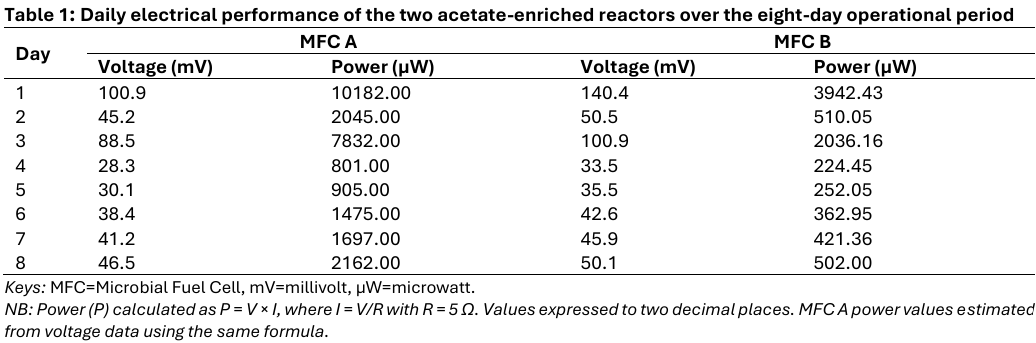
Acetate enrichment is one of the most widely tested substrate strategies for improving the bio-electrochemical performance of microbial fuel cells (MFCs), yet its influence on anodic microbial community under resource-limited condition remains understudied, particularly in sub-Saharan African contexts. This study investigated the influence of acetate enrichment on bacterial community and bio-electrochemical performance of low-cost dual-chamber MFC in Sokoto State. Two reactors received sodium acetate supplementation: MFC A (1g/L daily throughout an eight-day period) and MFC B (2g/L on Day 0 followed by 1g/L daily). Both reactors were inoculated with domestic wastewater from the Fadama area of Sokoto metropolis, which served simultaneously as substrate and microbial inoculum. Electrical performance was assessed daily through voltage, current, and power measurements, while microbial population dynamics were tracked using viable plate counts (CFU/mL). Anodic biofilm bacteria were isolated and characterized using morphological and standard biochemical tests. MFC B achieved a peak voltage of 140.4mV and power output of 3,942.43μW on Day 1, substantially exceeding MFC A. Colony counts surged from 2.5×10⁵ CFU/mL on Day 0 to 1.5×10⁷ CFU/mL within 24 hours, with a Pearson correlation coefficient of r = 0.9975 (p < 0.05) between CFU/mL and daily voltage. Biofilm analysis recovered eighteen bacterial isolates dominated by Bacillus spp. (72.2%), Proteus spp. (16.7%), Staphylococcus saprophyticus (5.6%), and Corynebacterium spp. (5.6%). These findings demonstrate that initial high-dose acetate loading accelerates electrogenic biofilm, amplifies power generation, and indigenous Bacillus-dominated communities from domestic wastewater are capable of sustained bioelectricity generation in low-cost dual-chamber systems.
References
American Public Health Association (APHA). (2017). Standard methods for the examination of water and wastewater (23rd ed.). APHA, American Water Works Association, Water Environment Federation.
Bazina, N., Ahmed, T. G., Almdaaf, M., Jibia, S., & Sarker, M. (2023). Power generation from wastewater using microbial fuel cells: A review. Journal of Biotechnology, 374, 17–30. https://doi.org/10.1016/j.jbiotec.2023.07.006
Bond, D. R., & Lovley, D. R. (2003). Electricity production by Geobacter sulfurreducens attached to electrodes. Applied and Environmental Microbiology, 69(3), 1548–1555. https://doi.org/10.1128/AEM.69.3.1548-1555.2003
Boone, D. R., Castenholz, R. W., & Garrity, G. M. (Eds.). (2001). Bergey's manual of systematic bacteriology (2nd ed., Vol. 1): The Archaea and the deeply branching and phototrophic bacteria. Springer-Verlag.
Logan, B. E. (2008). Microbial fuel cells. John Wiley & Sons.
Logan, B. E., Hamelers, B., Rozendal, R., Schröder, U., Keller, J., Freguia, S., Aelterman, P., Verstraete, W., & Rabaey, K. (2006). Microbial fuel cells: Methodology and technology. Environmental Science & Technology, 40(17), 5181–5192. https://doi.org/10.1021/es0605016
Malik, S., Kishore, S., Dhasmana, A., Kumari, P., Mitra, T., Chaudhary, V., Kumari, R., Bora, J., Ranjan, A., Minkina, T., & Rajput, V. (2023). A perspective review on microbial fuel cells in treatment and product recovery from wastewater. Water, 15(2), Article 316. https://doi.org/10.3390/w15020316
Obileke, K., Onyeaka, H., Meyer, E. L., & Nwokolo, N. (2021). Microbial fuel cells, a renewable energy technology for bio-electricity generation: A mini-review. Electrochemistry Communications, 125, Article 107003. https://doi.org/10.1016/j.elecom.2021.107003
Pant, D., Van Bogaert, G., Diels, L., & Vanbroekhoven, K. (2010). A review of the substrates used in microbial fuel cells (MFCs) for sustainable energy production. Bioresource Technology, 101(6), 1533–1543. https://doi.org/10.1016/j.biortech.2009.10.017
Rabaey, K., & Verstraete, W. (2005). Microbial fuel cells: Novel biotechnology for energy generation. Trends in Biotechnology, 23(6), 291–298. https://doi.org/10.1016/j.tibtech.2005.04.008
Downloads
Published
Issue
Section
License
Copyright (c) 2026 Aliyu Jalaluddeen Kware, Mustapha Gani, U. B. Ibrahim, A. A. Farouq, A. Y. Fardami (Author)

This work is licensed under a Creative Commons Attribution-NonCommercial 4.0 International License.
- Attribution — You must give appropriate credit, provide a link to the license, and indicate if changes were made. You may do so in any reasonable manner, but not in any way that suggests the licensor endorses you or your use.
- NonCommercial — You may not use the material for commercial purposes.
- No additional restrictions — You may not apply legal terms or technological measures that legally restrict others from doing anything the license permits.