
Experimental Evaluation of Distance-Dependent User Exposure to Extremely Low-Frequency Magnetic Fields from Computer Devices Under Typical Operating Conditions
DOI:
https://doi.org/10.70882/josrar.2026.v3i4.257Keywords:
Extremely low frequency, Computer radiation, User exposure, Electromagnetic field meter, MeasurementsAbstract
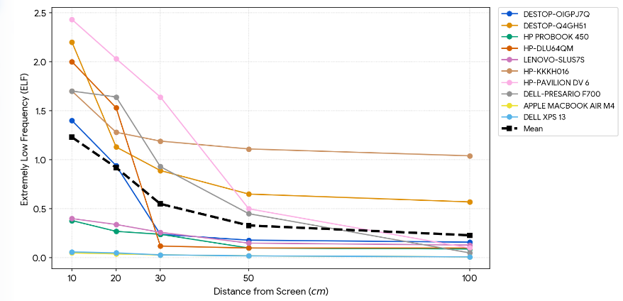
Extremely low-frequency (ELF) magnetic fields emitted by information technology equipment have raised public health concerns regarding continued occupational and academic exposure. As computers become essential tools in higher education, enumerating user contact levels is crucial for establishing safety baselines and promoting optimized best practices. This study therefore, evaluated user exposure to extremely low-frequency (ELF) magnetic fields at varying distances from computer devices at the National Open University of Nigeria, Abuja. Ten commonly used desktop and laptop computer models operated continuously for 90–120 minutes prior to measurement. A calibrated GM3120 electromagnetic field meter was used to measure ELF magnetic field strength at distances of 10cm, 20cm, 30cm, 50cm, and 100cm from the front and rear surfaces of the devices. Preliminary measurements indicated the ELF magnetic field measurements from the left and right sides of the devices were insignificant. The experimental results demonstrated that magnetic field strength decreased consistently as the distance from the computer screens increased. For the front screen, radiation values ranged from 0.05 to 2.43 milliGauss (mG) at the closest measurement distance (10 cm), dropping significantly to between 0.01 and 1.04 mG at a 100 cm. Similarly, rear-surface measurements ranged from 0.03 to 0.90 mG at 10cm and decreased to between 0.01 and 0.30 mG at 100cm. Notably, modern laptop models like the Apple MacBook Air M4 and Dell XPS 13 emitted the lowest overall radiation levels. The study concludes that increasing the distance between users and computer devices from both desktop and laptop computer screens significantly minimizes personal exposure to ELF magnetic field exposure
References
Bellieni, C. V., Pinto, I., Bogi, A., Zoppetti, N., Gorello, G., & Buonocore, G. (2012). Exposure to electromagnetic fields from laptop computers of "unborn children" and users. Archives of Environmental & Occupational Health, 67(2), 112–119.
Chowdhury, S., & Kaur, R. (2025). The compounding burden of screen-based occupational hazards: Digital eye strain and modern computing. Journal of Clinical and Diagnostic Ophthalmology, 19(2), 112–119.
Correa-Correa, V., Flores-Ramírez, R., Godínez-Cervantes, A., & Pérez-Garza, L. (2025). Evaluating non-thermal bio-effects of extremely low-frequency magnetic fields: A comprehensive review of recent literature. Bioelectromagnetics, 46(1), 34–48
Gopal, S., Ramachandran, V., & Swaminathan, A. (2021). Characterization and mitigation of extremely low frequency (ELF) magnetic fields in modern thin-film transistor (TFT) display architectures. Journal of Electromagnetic Compatibility and Engineering, 34(3), 204–215.
Hanindhito, B., & Chen, L. (2026). Digital over-engagement, circadian disruption, and mental health trajectories in high-exposure professionals. International Journal of Environmental Health Research, 36(3), 289–304.
Jalilian, H., & Röösli, M. (2025). A systematic review of the impact of electromagnetic waves on human biological systems: Untangling heterogeneous methodologies. Environmental Epidemiology & Health, 9(4), e12444.
Jaryal, A., Sharma, R., Thakur, S., & Negi, P. (2025). Knowledge, attitude, and preventive practices regarding digital eye strain among high-exposure populations. International Journal of Research Publication, 14(1), 1001–1011.
Kaszuba-Zwoińska, J., Gremba, J., Gałdzińska-Calik, B., Wójcik-Piotrowicz, K., & Rokita, E. (2022). Cellular mechanisms of electromagnetic field biological interactions. Postepy Higieny i Medycyny Doswiadczalnej, 76(1), 15–28.
Sharma, P., & Gupta, A. (2025). Ergonomic stressors and musculoskeletal dysfunction in the hybrid workplace era. Occupational Ergonomics Journal, 22(1), 45–58.
Li, X., Wang, Q., Zhang, J., & Chen, H. (2024). Evaluation of stray electromagnetic field emissions from legacy and modern consumer electronics: A comparative analysis of shielding effectiveness. Radiation Protection Dosimetry, 199(4), 312–321.
Mild, K. H., & Mattsson, M. O. (2022). Electromagnetic fields from visual display units: Internal sources, spatial distributions, and component shielding. Bioelectromagnetics, 43(1), 45– 58.
Ramirez-Vazquez, R., Rodriguez-Valdez, J., & Mendoza-Lopez, A. (2024). Proximity-dependent exposure assessments of extremely low frequency (ELF) radiation in domestic and occupational settings. Environmental Monitoring and Assessment, 196(2), 89–102.
Zaky, M. E., Elsayed, S. M., Alsadaan, N., Awad Ali, S. A., & Farghaly, S. M. (2025). Growing challenges in education: Prevalence and mediating role of computer vision syndrome in the relationship between visual fatigue and sleep disturbance. BMC Nursing, 25(1), 91
Downloads
Published
Issue
Section
License
Copyright (c) 2026 Joseph Teryima Iortile, Simon Kahugu John, Efiong Akpan Ibanga, Felix Obadare (Author)

This work is licensed under a Creative Commons Attribution-NonCommercial 4.0 International License.
- Attribution — You must give appropriate credit, provide a link to the license, and indicate if changes were made. You may do so in any reasonable manner, but not in any way that suggests the licensor endorses you or your use.
- NonCommercial — You may not use the material for commercial purposes.
- No additional restrictions — You may not apply legal terms or technological measures that legally restrict others from doing anything the license permits.