
Gender Influence on Functional and Psychosocial Competencies Development in Architectural Internships
DOI:
https://doi.org/10.70882/josrar.2026.v3i4.256Keywords:
Architectural internship, Competency development, Functional competencies, Psychosocial competencies, Gender, Architecture studentsAbstract
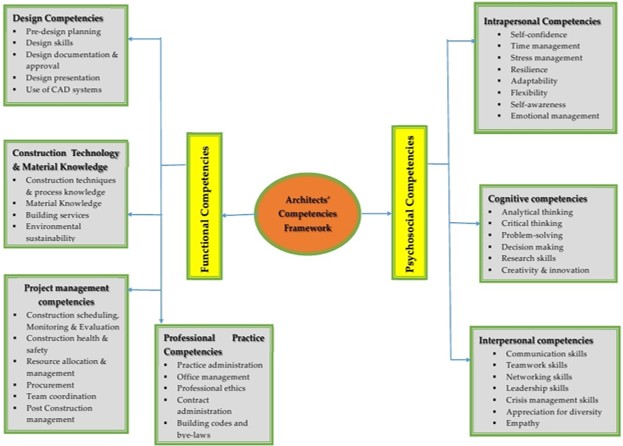
Architectural internship is expected to facilitate the development of both functional and psychosocial competencies required for professional practice. However, evidence remains limited on whether competency development during internship differs by gender, particularly within the Nigerian system. The study examined the relationship between gender and exposure to functional competency domains, as well as psychosocial competency development, among undergraduate architecture students during internship. A cross-sectional survey design was adopted involving 263 architecture students from nine universities in Southwest Nigeria. Data were collected using a structured questionnaire based on a competency framework comprising four functional and three psychosocial competency domains. Descriptive statistics, including the Relative Exposure Index (REI) and Relative Development Index (RDI) analysed competency levels, while independent-samples t-tests examined gender differences. Both male and female students reported moderate exposure across all functional competency domains and high levels of psychosocial competency development. Construction Technology and Material Knowledge recorded the highest functional competency exposure, while Practice Management ranked lowest. Intrapersonal competency recorded the highest psychosocial development for both groups. Although male students reported marginally higher composite scores than female students, no statistically significant gender differences were found in functional competency exposure (t = 1.083, p = 0.280) or psychosocial competency development (t = 0.896, p = 0.371). The findings indicate that gender is not a significant determinant of functional or psychosocial competency development during undergraduate architectural internships. The study provides empirical evidence supporting gender equity in architectural internship outcomes and informs the design of competency-based internship programmes.
References
Boyatzis, R. E. (2007). Competencies in the 21st century. Journal of Management Development, 27(1), 5–12. https://doi.org/10.1108/02621710810840730
Cavanagh, S. (2020). Architecture and Feminism: Gender Equity in Architectural Education and the Profession. Routledge.
Chan, C. C., & Anteby, M. (2016). Task Segregation as a Mechanism of Commercial Gender Stratification. Administrative Science Quarterly, 61(2), 184–216. https://doi.org/10.1177/0001839215611447
Collaborative for Academic, Social, and Emotional Learning. (2020). What is the CASEL framework? CASEL. https://casel.org/
Datta, A. (2007). Gender and Learning in the Design Studio. Journal for Education in the Built Environment, 2(2), 21–35. https://doi.org/10.11120/jebe.2007.02020021
Domínguez, J. J., & Montinari, N. (2026). Unintended Effects of Gender Quotas on Task Assignment and Firm Performance. Economica. 1 – 22. https://doi.org/10.1111/ecca.70066
Enwerekowe, E. O., & Diyenaan, M. D. (2019). Why Does Female Underrepresentation Persist in Nigerian Architecture? Civil Engineering and Architecture, 7(4), 89–98. https://doi.org/10.13189/cea.2019.070401
Ezeafulukwe, C., Bello, B. G., Ike, C. U., Onyekwelu, S. C., Onyekwelu, N. P., & Asuzu, O. F. (2024). Inclusive Internship Models across Industries: An Analytical Review. International Journal of Applied Research in Social Sciences, 6(2), 151–163. https://doi.org/10.51594/ijarss.v
Fulani, O., & Amole, D. (2016). Gender and Learning in the Architectural Design Studio. International Journal of Architectural Research: ArchNet-IJAR, 10(3), 136–149. https://doi.org/10.21125/edulearn.2016.1761
Guo, C., Wu, W., Hu, T. & Gao, T. (2025). Unequal Access, Equal Outcomes? Gender Differences in the Relationship between University Led STEM Program Factors and Undergraduates’ Career Commitment in STEM. International Journal of STEM Education 12(46) https://doi.org/10.1186/s40594-025-00569-9
Gutiérrez-Pulido, H. & Orozco-Rodríguez, C. (2025). The Contribution of Professional Internships to the Academic Development of Engineering and Science Students: A Case Study. Frontiers in Education, 10, Article 1563361. https://doi.org/10.3389/feduc.2025.1563361
Hyde, J. S. (2014). Gender Similarities and Differences. Annual Review of Psychology, 65, 373–398. https://doi.org/10.1146/annurev-psych-010213-115057
Jackson, D. (2015). Employability Skill Development in Work-Integrated Learning: Barriers and Best Practice. Studies in Higher Education, 40(2), 350–367. https://doi.org/10.1080/03075079.2013.842221
Kolb, D. A. (1984). Experiential learning: Experience as the source of learning and development. Prentice Hall.
Le Deist, F. D., & Winterton, J. (2005). What is Competence? Human Resource Development International, 8(1), 27–46. https://doi.org/10.1080/1367886042000338227
Maina, J. J., & Umoru, S. (2020). Exploring Gender Disposition of Architecture Students in Design Studio. Gazi University Journal of Science, 33(2), 45–58. https://dergipark.org.tr/tr/pub/gujsb/article/643394
Ndashiru, M. (2025). Evaluation of Career Competency Development in Undergraduate Architectural Internship Practices in Southwest Nigeria [Unpublished Ph.D. Dissertation, Ladoke Akintola University of Technology (LAUTECH), Ogbomoso].
Olayeni K. P., & Adisa B. (2019). Gender and Architectural Profession in Nigeria: Are Female Architects Up to the Task? International Journal of Gender & Women Studies. 7(2), 102 – 110. https://doi.org/10.15640/ijgws.v7n2p11
Parlak Bicer, Z. O. (2013). Is Gender Important on Understanding Construction Course in Architectural Education? Procedia - Social and Behavioral Sciences, 106, 1636–1647. https://doi.org/10.1016/j.sbspro.2013.12.186
Putibungsu, V. S., Anjani, L., Sari, P. & Na’imah, T. (2026). Research Trends on Gender Bias in the Workplace: A Bibliometric Analysis. West Science Social and Humanities Studies, 4(06), 780-787. https://doi.org/10.58812/wsshs.v4i06.2927
Rodrigues, M. (2021). Analysing Competencies by Gender in Internships [Master's thesis, University of Porto]. https://link.springer.com/chapter/10.1007/978-3-030-62066-0_31
Santelices, R. (2024). Examining Gender-Related Quantitative Disparities in Intern Performance: A Comparative Analysis. International Journal of Research and Innovation in Social Science, 8(3), 1893–1900. https://dx.doi.org/10.47772/IJRISS.2024.803135
Sen, A., Amole, D., & Adeyemi, E. (2017). Student Learning Approaches of Architecture Students: Deep or Surface Learning Approach. International Journal of Learning, Teaching and Educational Research, 16(8), 102–117. https://doi.org/10.26803/ijlter.20.2.8
Sharif, A. A., Alshdiefat, A. S., Lee, A., Rana, M. Q., & Abu Ghunmi, N. M. (2024). Gender Equality in Architecture and Construction: An Assessment Framework at the Institutional and Sectoral Levels in Jordan. Buildings, 14(3), Article 764. https://doi.org/10.3390/buildings14030764
Taufik, N, & Kismono, G. (2026), When Internships Build More than Skills and Transform the Professional Self in Emerging HE Contexts. Higher Education, Skills and Work-based Learning, 16(2), 440–455. doi: https://doi.org/10.1108/HESWBL-07-2025-0267
UNESCO. (2021). Global education monitoring report 2021/22: Non-state actors in education. UNESCO.
Uzuegbunam, F. O., Ebem, E., & Ezezue, A. M. (2023). Interaction Patterns in Architecture Studios and Lecture Rooms in the Nigerian University Context: Implications for Gender Mainstreaming in Architectural Education. Journal of Engineering, Design and Technology, 4(3), 1-26. DOI: https://doi.org/10.1007/s10798-023-09819-9
Voyer, D., & Voyer, S. D. (2014). Gender Differences in Scholastic Achievement: A Meta-Analysis. Psychological Bulletin, 140(4), 1174–1204. https://doi.org/10.1037/a0036620
Vu, H. T. T., Nguyen, T. T., & Do, H. T. T. (2025). Gender and Internship Experiences of Non-Education Students: A Cross-Sectional Study. Multidisciplinary Science Journal, 8(4), 2026321. https://doi.org/10.31893/multiscience.2026321
Zehr, S. M., & Korte, R. (2020). Student internship experiences: learning about the workplace. Education + Training, 62(3), 311–324. https://doi.org/10.1108/ET-11-2018-0236
Downloads
Published
Issue
Section
License
Copyright (c) 2026 Martins Ndashiru, Oluronke Omolola Odunjo, Ayangbemi Segun Ayankola, Abayomi Razzaq Ayoola (Author)

This work is licensed under a Creative Commons Attribution-NonCommercial 4.0 International License.
- Attribution — You must give appropriate credit, provide a link to the license, and indicate if changes were made. You may do so in any reasonable manner, but not in any way that suggests the licensor endorses you or your use.
- NonCommercial — You may not use the material for commercial purposes.
- No additional restrictions — You may not apply legal terms or technological measures that legally restrict others from doing anything the license permits.