
Comparative Assessment of the Nutritional Quality of Selected Cultured Fish Species in Argungu, Kebbi State, Nigeria: A Multivariate Statistical Approach
DOI:
https://doi.org/10.70882/josrar.2026.v3i4.253Keywords:
Cultured fish, Nutritional quality, Proximate composition, Mineral composition, Principal Component AnalysisAbstract
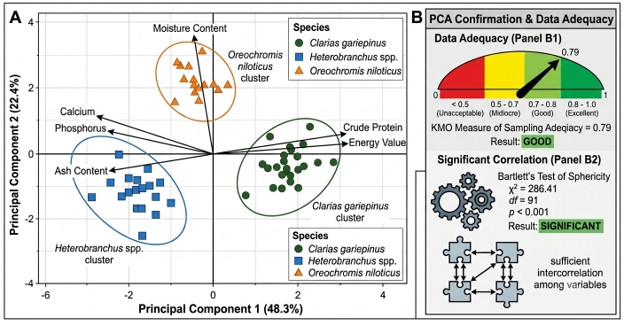
Fish is an important source of high-quality protein and essential nutrients that contribute to food security and human health. This study comparatively assessed the nutritional quality of selected cultured fish species in Argungu, Kebbi State, Nigeria, using proximate composition, mineral analysis, and multivariate statistical techniques. A comparative laboratory-based design was adopted, and 45 fish samples comprising Clarias gariepinus, Oreochromis niloticus, and Heterobranchus spp. were collected from commercial fish farms. Proximate and mineral compositions were determined using standard AOAC procedures, while data were analysed using descriptive statistics, Pearson correlation, Principal Component Analysis (PCA), and Hierarchical Cluster Analysis (HCA). Results showed considerable variations in nutritional composition among the fish species. Clarias gariepinus recorded the highest crude protein (20.84 ± 0.62%) and energy value (121.68 ± 2.34 kcal/100 g), whereas Heterobranchus spp. exhibited the highest lipid (3.84 ± 0.21%) and ash (2.18 ± 0.10%) contents. Heterobranchus spp. also recorded higher calcium, phosphorus, magnesium, and zinc concentrations, while Clarias gariepinus had the highest iron content. Significant correlations were observed between protein and energy (r = 0.84, p < 0.001), protein and phosphorus (r = 0.71, p = 0.003), and moisture and energy (r = −0.82, p < 0.001). PCA extracted three components explaining 82.6% of total nutritional variation, while HCA classified Clarias gariepinus and Heterobranchus spp. as nutritionally similar. The study concludes that cultured fish species in Argungu possess considerable nutritional value, although their contributions vary by species. Multivariate techniques effectively identified nutritional patterns and species similarities. It is recommended that fish farmers, consumers, and relevant stakeholders consider species-specific nutritional characteristics in fish production, dietary selection, and aquaculture management to promote improved nutrition and sustainable aquaculture development.
References
Akter, S., Haque, M. A., Sarker, M. A. A., Atique, U., Iqbal, S., Sarker, P. K., Paray, B. A., Arai, T., & Hossain, M. B. (2024). Efficacy of using plant ingredients as partial substitute of fishmeal in formulated diet for a commercially cultured fish, Labeo rohita. Frontiers in Sustainable Food Systems, 8, Article 1376112. https://doi.org/10.3389/fsufs.2024.1376112
Anarado, C. J. O., Ekolie, E., Iziga, C. G., Anarado, C. E., & Eboatu, A. N. (2023). A comparative study of the nutritional composition, fatty acid profiles and organoleptic evaluation of Clarias gariepinus (African catfish) and Oreochromis niloticus (Nile tilapia) raised under wild and pond-cultured systems. European Journal of Nutrition & Food Safety, 15(9), 118–126. https://doi.org/10.9734/ejnfs/2023/v15i91340
Association of Official Analytical Chemists. (2023). Official methods of analysis of AOAC International (22nd ed.). AOAC International. https://www.aoac.org/official-methods-of-analysis/
Begum, M., Mim, F., Reza, M. S., Ferdousi, L., Hossain, M. S., Juliana, F. M., Hasan, M. R., Ahmed, S., Al Mamun, M. Z. U., Hossen, M. S., Sathee, R. A., & Goshwami, A. (2024). Exploring the nutritional profiles and dietary value of indigenous fish species from the Mathabanga River in Bangladesh. Food Chemistry Advances, 5, Article 100786. https://doi.org/10.1016/j.focha.2024.100786
Birie, S., Mingist, M., Kibret, M., Atlog, T. Y., Geremew, H., & Getnet, B. (2025). Proximate composition, microbiological quality and safety of raw and open sun-dried fish products in Lake Tana, Ethiopia. Food Science & Nutrition, 13, Article e4671. https://doi.org/10.1002/fsn3.4671
Epinipre, B., Ekwu, A. O., & Ekpo, I. E. (2024). Determination of proximate composition of four commonly consumed fish species in Akwa Ibom State, Nigeria. Journal of Wetlands and Waste Management, 6(1), 73–84.
Food and Agriculture Organization of the United Nations. (2024). The state of world fisheries and aquaculture 2024: Blue transformation in action. FAO. https://doi.org/10.4060/cd0683en
Hoa, T. H. T., Jaganathan, G. K., Guo, B. L., & Tien, D. T. K. (2025). Diversity and justification of quality differences in cultivated and wild fish: A systematic review. Vietnam Journal of Agricultural Sciences, 8(4), 2777–2790. https://doi.org/10.31817/vjas.2025.8.4.10
Imam, I. M., Giddy, I. N., & Saidu, M. (2025). Comparative studies of proximate and mineral composition of fresh and smoked Clarias gariepinus, Oreochromis niloticus, and Bagrus bayad from River Rima, Nigeria. West African Journal of Applied Ecology, 33(2), 1–8.
Mustafa, T., Roy, T., Begum, M. H., Rana, M. M., Islam, S., Khalil, F., & Hossain, M. A. (2023). Proximate composition and mineral content of three wild and cultured fish species of Bangladesh. Jagannath University Journal of Life and Earth Sciences, 7(2), 77–86.
Oyekanmi, F. B., Ekundare, O. V., & Oyekanmi, O. A. (2024). Effects of processing on the proximate and mineral composition of cultured and captured Clarias gariepinus. FUDMA Journal of Sciences, 8(4), 377–381. https://doi.org/10.33003/fjs-2024-0804-2716
Prakash, P., Mohanta, K. N., Sahu, N. P., Renuka, V., Varghese, T., Nayak, S. K., Baraiya, R., & Khalasi, Y. (2025). Optimizing dietary protein and lipid levels for better growth performance, nutrient retention and flesh quality of grow-out striped catfish (Pangasianodon hypophthalmus). Scientific Reports, 15, Article 33874. https://doi.org/10.1038/s41598-025-07933-3
World Health Organization. (2024). Healthy diet. https://www.who.int/news-room/fact-sheets/detail/healthy-diet
Downloads
Published
Issue
Section
License
Copyright (c) 2026 Ibrahim Aminu Rdoruwa, Balkisu Hassan Augie, Mubarak Hassan Augie (Author)

This work is licensed under a Creative Commons Attribution-NonCommercial 4.0 International License.
- Attribution — You must give appropriate credit, provide a link to the license, and indicate if changes were made. You may do so in any reasonable manner, but not in any way that suggests the licensor endorses you or your use.
- NonCommercial — You may not use the material for commercial purposes.
- No additional restrictions — You may not apply legal terms or technological measures that legally restrict others from doing anything the license permits.