
Physics-Informed Neural Networks for Sonic Log Synthesis and Petrophysical Prediction: A Leave-One-Well-Out Uncertainty Assessment
DOI:
https://doi.org/10.70882/josrar.2026.v3i4.250Keywords:
Physics-informed neural networks, Synthetic sonic log, Uncertainty, Leave-one-well-out cross-validationAbstract
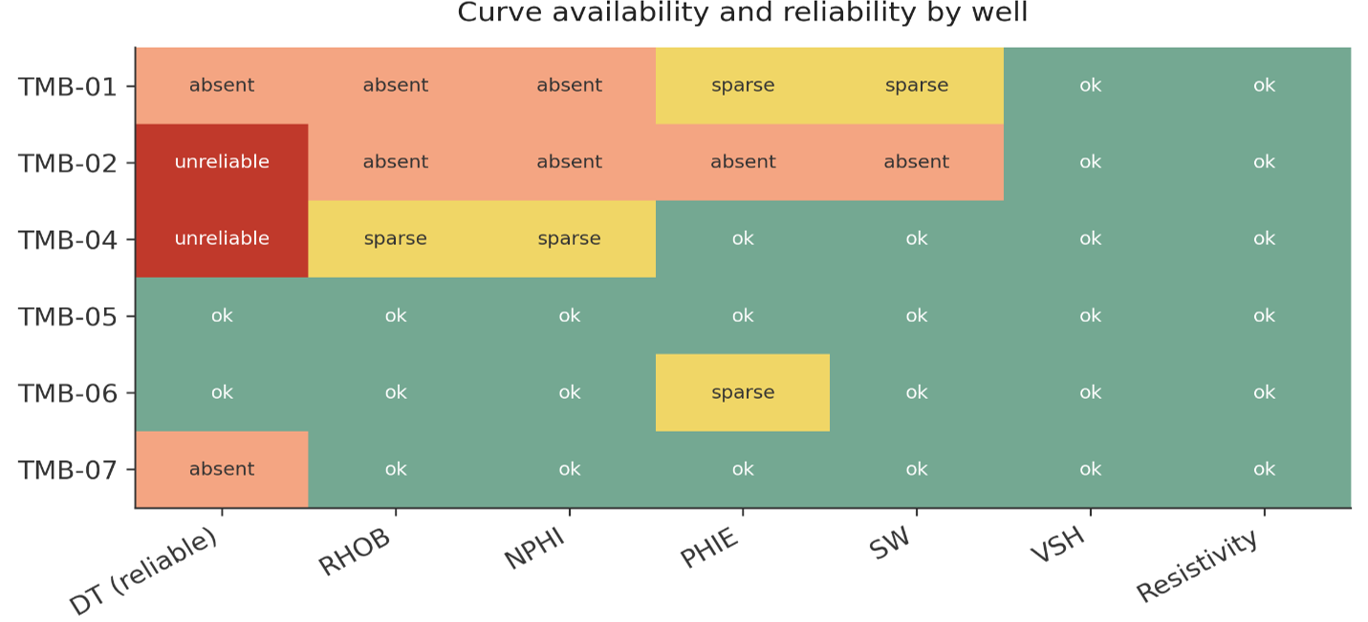
Missing logs in petrophysical analysis of Niger Delta Wells (especially Sonic DT logs) is a common problem and most of the time a regression fit or a synthetic sonic log is sometimes used to solve for this missing logs. When a sonic log is synthesized rather than measured, does the uncertainty of that synthesis actually affect the porosity and permeability predicted from it? This study builds a three-stage physics-informed neural network (PINN) pipeline for six TMB field wells. Stage 1 predicts sonic transit time from gamma ray, resistivity, spontaneous potential, and shale volume, constrained by a Wyllie time-average residual. Stage 2 jointly predicts porosity and permeability from a wider log suite, tied together by a Timur-Coates residual. Stage 3 tests whether ensemble spread widens when its sonic input is synthetic rather than measured. Leave-one-well-out cross-validation gave Stage 1 R² between -1.47 and -0.45, a result random-split validation missed entirely. In Stage 2, one-fold initially failed because an input feature fell outside the training range; injecting random-magnitude synthetic noise into the DT input during training fixed it, recovering all folds. Porosity R² ranged from 0.68 to 0.88, permeability R² from 0.78 to 0.93. A controlled sweep of stated DT uncertainty, holding all else constant, showed ensemble spread narrowing, not widening, as declared uncertainty increased: the network leaned harder on its more robust inputs and agreed with itself more — the opposite of what a downstream user would want. Deep-ensemble spread captures cross-well extrapolation risk well, but it does not propagate a known upstream uncertainty downstream; treating ensemble variance as a stand-in for input-confidence tracking will quietly mislead.References
Kingma, D. P., & Ba, J. (2014). Adam: A method for stochastic optimization. arXiv. https://doi.org/10.48550/arXiv.1412.6980
Lakshminarayanan, B., Pritzel, A., & Blundell, C. (2017). Simple and scalable predictive uncertainty estimation using deep ensembles. Advances in Neural Information Processing Systems, 30, 6402–6413.
Owoyemi, A. O. (2005). Sequence stratigraphy of Niger Delta, Delta field, offshore Nigeria (Doctoral dissertation, Texas A&M University).
Pothana, P., & Ling, K. (2025). Physics-integrated neural networks for improved mineral volumes and porosity estimation from geophysical well logs. Energy Geoscience, 6(2), 100410. https://doi.org/10.1016/j.engeos.2025.100410
Raissi, M., Perdikaris, P., & Karniadakis, G. E. (2019). Physics-informed neural networks: A deep learning framework for solving forward and inverse problems involving nonlinear partial differential equations. Journal of Computational Physics, 378, 686–707. https://doi.org/10.1016/j.jcp.2018.10.045
Timur, A. (1968). An investigation of permeability, porosity, and residual water saturation relationships for sandstone reservoirs. The Log Analyst, 9(4), 8–17.
Ubuara, D. O., Olayinka, Y. A., Emujakporue, G. O., & Soronnadi-Ononiwu, G. C. (2024). Evaluation of formation susceptibility and sand production potential in an offshore field, Niger Delta Basin, Nigeria. Energy Geoscience, 5(1), 100213. https://doi.org/10.1016/j.engeos.2023.100213
Wyllie, M. R. J., Gregory, A. R., & Gardner, L. W. (1956). Elastic wave velocities in heterogeneous and porous media. Geophysics, 21(1), 41–70. https://doi.org/10.1190/1.1438217
Yu, Y., Xu, C., Misra, S., Li, W., Ashby, M., Pan, W., Deng, T., Jo, H., Santos, J. E., Fu, L., Wang, C., Kalbekov, A., Suarez, V., Kusumah, E. P., Aviandito, M., Pamadya, Y., & Izadi, H. (2021). Synthetic sonic log generation with machine learning: A contest summary from five methods. Petrophysics, 62(4), 393–406. https://doi.org/10.30632/PJV62N4-2021a4
Downloads
Published
Issue
Section
License
Copyright (c) 2026 Oludare Olukayode Babalola, Odunayo Christiana Ogunleye, Racheal Foluke Oloruntola, Rukayat Damilola Adedokun (Author)

This work is licensed under a Creative Commons Attribution-NonCommercial 4.0 International License.
- Attribution — You must give appropriate credit, provide a link to the license, and indicate if changes were made. You may do so in any reasonable manner, but not in any way that suggests the licensor endorses you or your use.
- NonCommercial — You may not use the material for commercial purposes.
- No additional restrictions — You may not apply legal terms or technological measures that legally restrict others from doing anything the license permits.