
Influence Of Vertical Soil Moisture To Root Growth And Biomass Allocation In Acacia Senegal Linn Seedlings From Two Provenances
DOI:
https://doi.org/10.70882/josrar.2026.v3i5.248Keywords:
Gross alpha activity; Gross beta activity; Liquid scintillation counting; Mining-impacted water; NORM; Sokoto Basin; Radiological risk assessmentAbstract
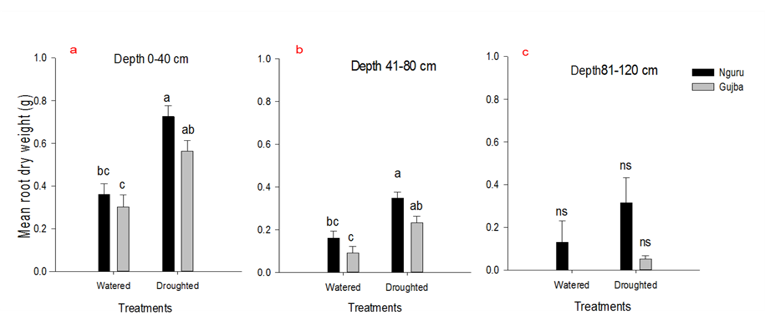
Acacia senegal is an important drought-tolerant species, but limited information exists on how vertical soil moisture affects its early growth from different provenances. Uneven moisture distribution in drylands may influence root development and biomass allocation, affecting seedling establishment. Therefore, this study aims to investigate the influence of vertical soil moisture gradients on root growth and biomass allocation in Acacia senegal seedlings from two provenances, to determine best provenance and moisture condition for survival. Study was conducted in the greenhouse at Federal University Dutse using 36 glass-fronted rhizotrons (120 x 30 cm) filled with 7 kg sieved sandy-loam topsoil. Acacia seeds from provenances were germinated and transplanted into rhizotrons arranged in Randomized Complete Block Design with watered and 10% drought treatments. Shoot and root lengths, soil moisture at four depths, and biomass at three soil sections were measured for 56 days. Drought significantly reduced shoot length in species, with Nguru provenance showing greater shoot inhibition than Gujba. Root length increased under drought, with Nguru developing significantly longer roots (122.00 cm) than Gujba, indicating a drought-avoidance strategy. Root dry weight was highest in the 0–40 cm depth, and Nguru had greater total root dry weight and higher root:shoot ratios across treatments. Lateral root number varied by depth and provenance, decreasing with soil depth. Water uptake shifted progressively downward as upper layers dried, with root distribution patterns matching water extraction. Nguru (arid) provenance exhibited stronger stomatal closure and deeper rooting, suggesting superior drought adaptation through enhanced water acquisition and reduced transpiration. Nguru provenance showed superior drought adaptation through deeper roots and higher root:shoot ratio, while Gujba maintained greater shoot growth.
References
Abba, L., & Dahuwa, D. (2023). Gross alpha and gross beta activity concentrations and annual effective dose due to intake of water from the cement producing area of Sokoto, North-western Nigeria. Dutse Journal of Pure and Applied Sciences, 9(1b), 219–227. https://doi.org/10.4314/dujopas.v9i1b.21
Abdulrasheed, A., Muhammed, J., Bala, A. A., Dankawu, U. M., Zubairu, N., & Hafeez, H. Y. (2024). Assessment of excess lifetime cancer risk from radon concentration in borehole water samples collected from Katagum LGA, Bauchi State, Nigeria. Dutse Journal of Pure and Applied Sciences, 10(1C), 191–200. https://doi.org/10.4314/dujopas.v10i1c.18
Ademola, J. A., & Ogele, N. O. (2013). Radionuclide contents in water samples around a phosphate mining area in Nigeria. Journal of Environmental Radioactivity, 126, 119–123. https://doi.org/10.1016/j.jenvrad.2013.07.015
Ahijjo, Y. M. (2019). A Radiological Assessment of Mining Sites in the Sokoto Basin (Unpublished PhD Thesis). Usmanu Danfodiyo University, Sokoto, Nigeria.
Ahijjo, Y. M. (2021). Gross alpha/beta radioactivity determination in water samples from some mining sites, Wurno LGA, Sokoto state, Nigeria. Mediterranean Journal of Basic and Applied Sciences, 5(3), 18–28. https://doi.org/10.46382/MJBAS.2021.5302
Ahijjo, Y. M., & Baba-Kutigi, A. N. (2023a). Natural radioactivity levels and radiological hazards indices of soil samples from selected mining sites, Dange-Shuni, Sokoto State, Nigeria. FUDMA Journal of Sciences, 7(1), 290–296. https://doi.org/10.33003/fjs-2023-0701-2064
Ahijjo, Y. M., & Baba-Kutigi, A. N. (2023b). Determination of gross alpha/beta radioactivity of water samples around mining sites, Dange-Shuni LGA, Sokoto State. FUDMA Journal of Sciences, 7(1). https://doi.org/10.33003/fjs-2023-0701-2065
Al-Hamarneh, I. F., & Awadallah, M. I. (2024). Gross alpha/beta activity concentrations in imported bottled drinking water in Saudi Arabia. Journal of Radiation Research and Applied Sciences, 17(2), Article 100667. https://doi.org/10.1016/j.jrras.2024.100667
Alharbi, A. (2022). Naturally occurring radioactive materials in water resources: A review of sources, mobilization mechanisms, and health implications. Journal of Environmental Radioactivity, 238, 106735. https://doi.org/10.1016/j.jenvrad.2021.106735.
Baba-Kutigi, A. N., Joseph, E., Tikyaa, E. V., & Sanni, D. M. (2016). Investigation of the gross alpha and beta activity concentrations of hand dug well water from Dutsin-Ma Local Government, Katsina State-Nigeria. Journal of Natural Sciences Research, 6(4), 64–70.
Bem, H., Bem, E. M., & Kamińska, I. A. (2023). Gross alpha and beta activity in drinking water from the north-eastern region of Poland. Journal of Environmental Radioactivity, 264, Article 107077. https://doi.org/10.1016/j.jenvrad.2023.107077
Jibiri, N. N., & Fasae, K. P. (2012). Activity concentrations of natural radionuclides in soil samples from some mining sites in Nigeria. Journal of Environmental Science and Health, Part A, 47(10), 1374–1383. https://doi.org/10.1080/10934529.2012.680820
Koua, A. M., Kouassi, A. M., & Trokourey, A. (2024). Gross alpha and beta activities and related lifetime risks assessment due to ingestion of drinking water from different sources in the District of Abidjan, Cote d'Ivoire. Journal of Environmental Protection, 15(1), 1–15. https://doi.org/10.4236/jep.2024.151001
Okeji, M. C., Agwuna, C. A., & Onwuka, O. S. (2017). Assessment of natural radioactivity in phosphate ore, soil and water samples from a phosphate mining area in Nigeria. Radiation Physics and Chemistry, 141, 231–237. https://doi.org/10.1016/j.radphyschem.2017.07.004
Singh, R. V. K., & Audu, A. (2013). Efficiency of ratio estimators in stratified random sampling using information on auxiliary attribute. International Journal of Engineering Science and Innovative Technology, 2(4), 166–172.
Taskin, H., Karavus, M., Ay, P., Topuzoglu, A., Hidiroglu, S., & Karahan, G. (2009). Radionuclide concentrations in soil and lifetime cancer risk due to gamma radioactivity in Kirklareli, Turkey. Journal of Environmental Science and Health, Part A, 44(4), 384–392. https://doi.org/10.1080/10934520802659671
Tso, M. Y. W., Leung, J. K. C., & Cheng, S. H. (2016). A review of radiation dose assessment in natural and artificial radioactivity in water resources. Journal of Radiological Protection, 36(1), R13–R38. https://doi.org/10.1088/0952-4746/36/1/R13
Tuo, F., Zhou, Q., Yang, B., Li, Z., Qin, W., & Kong, S. (2024). Interpretation of gamma-ray spectrometry method for the determination of radionuclides in environmental and biological samples. Chinese Journal of Radiological Health, 33(2), 111–118. https://doi.org/10.13491/j.issn.2096-3610.2024.02.001
UNSCEAR. (2000). Sources and effects of ionizing radiation: United Nations Scientific Committee on the Effects of Atomic Radiation UNSCEAR 2000 report to the General Assembly, with scientific annexes. United Nations.
WHO. (2011). Guidelines for drinking-water quality (4th ed.). World Health Organization.
WHO. (2017). Guidelines for drinking-water quality: Fourth edition incorporating the first addendum. World Health Organization.
Zarma, I. H., Sadiq, M. A., & Ahmed, S. A. (2024). Assessment of natural radioactivity in drinking water from Michika Districts, Adamawa State, Nigeria. Journal of Environmental Radioactivity, 252, Article 106897.
Downloads
Published
Issue
Section
Categories
License
Copyright (c) 2026 Jibo Abdullahi Umar, Salami Kaseem Dele, Muhammad Yayo Karage (Author)

This work is licensed under a Creative Commons Attribution-NonCommercial 4.0 International License.
- Attribution — You must give appropriate credit, provide a link to the license, and indicate if changes were made. You may do so in any reasonable manner, but not in any way that suggests the licensor endorses you or your use.
- NonCommercial — You may not use the material for commercial purposes.
- No additional restrictions — You may not apply legal terms or technological measures that legally restrict others from doing anything the license permits.