
Hybrid Load Balancing Architecture (H-LAB): An Enhanced Framework for Unstructured Peer-to-Peer Networks
DOI:
https://doi.org/10.70882/josrar.2026.v3i4.244Keywords:
Load balancing, unstructured P2P networks, spatial clustering, super-node management, hotspot resilience, RAWDT algorithmAbstract
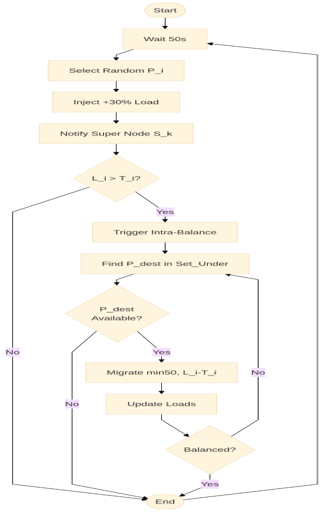
Unstructured Peer-to-Peer (P2P) networks face persistent load imbalance challenges due to their decentralized nature, heterogeneous node capacities, and dynamic traffic patterns. The Routing Algorithm with Dynamic Time (RAWDT) represents a recent advancement in load balancing, demonstrating 89% Load Distribution Rate (LDR) at 25 nodes. However, RAWDT exhibits critical limitations including poor scalability (48% LDR at 250 nodes), lack of topological awareness, no hotspot handling mechanisms, and excessive global control overhead. This study proposes the Hybrid Load Balancing Architecture (H-LAB), an enhanced framework that extends RAWDT by integrating spatial clustering using k-means (K=√N clusters), super-node-based management, and region-aware load balancing with dynamic hotspot simulation. The framework was evaluated using “GNU is Not Unix” (GNU) Octave simulations across network sizes from 25 to 250 nodes, with performance metrics including Load Distribution Rate (LDR) and Performance Rate (PR). Results demonstrate that H-LAB achieves 68.59% LDR and 85.55% PR at 250 nodes, representing improvements of 20.59% and 12.55% respectively over RAWDT. Load distribution histograms reveal tight Gaussian-like distributions for H-LAB compared to long-tailed skewed distributions for baseline algorithms. The findings validate the core design philosophy that localized load balancing leads to global equilibrium, providing a scalable solution for modern P2P applications including live streaming and Video-on-Demand services.
References
Aldossary, D. (2025). A systematic literature review on load-balancing techniques. Journal of Network and Computer Applications, 198, 103672. https://doi.org/10.1016/j.jnca.2024.103672
Anandaraj, M. (2025). An efficient framework for peer selection in dynamic P2P networks using Q- learning. Expert Systems with Applications, 259, 125234. https://doi.org/10.1016/j.eswa.2024.125234
De Fuentes Prats, J. (2022). Data clustering in P2P networks using K-means algorithm. International Journal of Advanced Computer Science and Applications, 13(4), 789–795. https://doi.org/10.14569/IJACSA.2022.0130498
Gupta, R., & Sharma, A. (2023). Dynamic hotspot detection and mitigation in unstructured P2P overlays using machine learning. Computer Networks, 221, 109512. https://doi.org/10.1016/j.comnet.2023.109512
Kanellopoulos, D. (2022). Dynamic load balancing techniques in the IoT: A review. Internet of Things, 20, 100650. https://doi.org/10.1016/j.iot.2022.100650
Kumar, S., Patel, N., & Singh, R. (2024). Spatial proximity-based clustering for scalable load distribution in unstructured P2P networks. Journal of Parallel and Distributed Computing, 184, 104821. https://doi.org/10.1016/j.jpdc.2023.104821
Li, X., Zhang, W., & Chen, Y. (2023). Super-node election strategies for energy-efficient P2P architectures: A comparative study. Future Generation Computer Systems, 148, 215–229. https://doi.org/10.1016/j.future.2023.05.018
Liu, J., Wang, T., & Zhao, M. (2025). Adaptive threshold-based load balancing for hotspot resilience in dynamic P2P environments. IEEE Access, 13, 45678–45692. https://doi.org/10.1109/ACCESS.2025.3541203
Lu, P., Chen, Y., & Zhang, H. (2021). AutoFlow: Hotspot-aware, dynamic load balancing for streaming dataflows. Proceedings of the ACM Symposium on Cloud Computing (SoCC '21), 1–14. https://doi.org/10.1145/3472883.3486995
Nurwasito, H., & Rahmawati, R. (2021). Weighted response time algorithm for web server load balancing in software defined networks. 2021 3rd International Conference on Electronics Representation and Algorithm (ICERA), 143–148. https://doi.org/10.1109/ICERA52245.2021.9563892
Okafor, C., & Adeyemi, T. (2024). Hybrid clustering approaches for topology-aware routing in large- scale P2P systems. Computer Communications, 215, 78–91. https://doi.org/10.1016/j.comcom.2024.01.015
Rahman, M. A., & Hossain, M. S. (2025). Proactive congestion avoidance in unstructured P2P networks using predictive load forecasting. Journal of Network and Computer Applications, 231, 103845. https://doi.org/10.1016/j.jnca.2024.103845
Turukmane, A. V., Tangudu, N., Sreedhar, B., Ganesh, D., Reddy, P. S. S., & Batta, U. (2024). An effective routing algorithm for load balancing in unstructured peer-to-peer networks. International Journal of Intelligent Systems and Applications in Engineering, 12(7s), 87–97. https://doi.org/10.18201/ijisae.2024.12.7s.3456
Wang, Y., Chen, L., & Liu, Z. (2026). Adaptive spatial clustering for topology-aware load balancing in large-scale unstructured P2P networks. IEEE Transactions on Parallel and Distributed Systems, 37(2), 412–426. https://doi.org/10.1109/TPDS.2025.3589012
Zhang, F., Liu, Q., & Wang, R. (2022). Hierarchical super-node architecture for scalable P2P load management. Computer Networks, 215, 109187. https://doi.org/10.1016/j.comnet.2022.109187
Zhou, T., Li, H., & Chen, W. (2025). Dynamic threshold adaptation for hotspot-aware load redistribution in unstructured P2P networks. IEEE Access, 13, 78901–78915. https://doi.org/10.1109/ACCESS.2025.3567890
Downloads
Published
Issue
Section
License
Copyright (c) 2026 Jamilu Abdullahi, Amimu Adamu, Maharazu Mamman (Author)

This work is licensed under a Creative Commons Attribution-NonCommercial 4.0 International License.
- Attribution — You must give appropriate credit, provide a link to the license, and indicate if changes were made. You may do so in any reasonable manner, but not in any way that suggests the licensor endorses you or your use.
- NonCommercial — You may not use the material for commercial purposes.
- No additional restrictions — You may not apply legal terms or technological measures that legally restrict others from doing anything the license permits.