
Altered Liver and Kidney Function in SARS-CoV-2-Positive Patients in Nigerian Isolation Centers
DOI:
https://doi.org/10.70882/josrar.2026.v3i5.241Keywords:
COVID-19, SARS-CoV-2, Renal function, Liver function, Electrolytes, Nigeria, AzotemiaAbstract
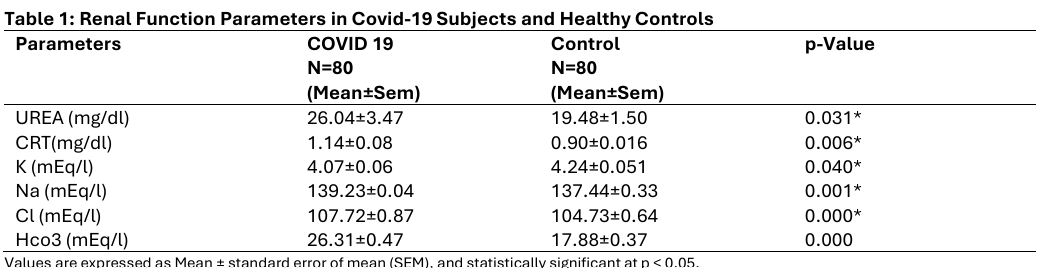
The COVID-19 pandemic has presented major immunological and nutritional challenges globally, yet Nigeria’s contribution to global research accounts for only 0.8% of scientific outputs. This study investigated liver and kidney function status in SARS-CoV-2-positive patients compared to negative controls across two isolation centers in Ogun and Lagos States (Olabisi Onabanjo University Teaching Hospital and Lagos State University Teaching Hospital). A total of 160 participants were recruited: 80 COVID-19-positive patients (46 males, 34 females; mean age 51.53±1.86) and 80 COVID-19-negative controls (28 males, 52 females; mean age 54.21±1.89). Nasopharyngeal swabs and venous blood samples were collected. Spectrophotometry was used to assess total and direct bilirubin, AST, ALT, total protein, albumin, ALP, urea, chloride, and creatinine. Sodium and potassium were determined via flame photometry, and bicarbonate by titration. Biochemical analysis revealed that COVID-19-positive patients had significantly elevated levels (p < 0.05) of plasma urea, creatinine, sodium, chloride, bicarbonate, total bilirubin, direct bilirubin, AST, ALT, and ALP compared to controls. Conversely, a significant decrease in plasma total protein and potassium was observed in COVID-19 patients. There were no significant differences (p > 0.05) in age or albumin levels between the two groups. In conclusion, SARS-CoV-2 infection induces multi-organ biochemical derangements characterized by acute renal azotemia, electrolyte imbalance, hepatocellular damage, intrahepatic cholestasis, and hypoproteinemia. Comprehensive baseline liver and kidney biomarker screening is crucial for guiding clinical intervention and management.
References
Ahmed, J., Rizwan, T., Malik, F., Akhter, R., Malik, M., Ahmad, J., Khan, A. W., Chaudhary, M. A., & Usman, M. S. (2020). COVID-19 and liver injury: A systematic review and meta-analysis. Cureus, 12(7), e9424.
Ali, F. E. M., Abd El-Aziz, M. K., Ali, M. M., Ghogar, O. M., & Bakr, A. G. (2023). COVID-19 and hepatic injury: Diversity and risk assessment. World Journal of Gastroenterology, 29(3), 425–449.
Bloom, P. P., Meyerowitz, E. A., Reinus, Z., Daidone, M., Gustafson, J., Kim, A. Y., Chung, R. T., & Cohen, A. G. (2020). Liver biochemistries, clinical trajectories, and post-acute outcomes in patients with COVID-19. Hepatology Communications, 5(1), 58–68. https://doi.org/10.1002/hep4.1610
Benedé-Ubieto, R., Estévez-Vázquez, O., Flores-Perojo, V., Macías-Rodríguez, R. U., Ruiz-Margáin, A., Martínez-Naves, E., Regueiro, J. R., Ávila, M. A., Trautwein, C., Bañares, R., Bosch, J., Cubero, F. J., & Nevzorova, Y. A. (2021). Abnormal liver function test in patients infected with Coronavirus (SARS-CoV-2): A retrospective single-center study from Spain. Journal of Clinical Medicine, 10(5), 1039. https://doi.org/10.3390/jcm10051039
Cancarevic, I., Nassar, M., Foster, A., Umar, Z., Parikh, A., Ahammed, M. R., Shaban, L., Abosheaishaa, H., Mergen, D., Amin, T., Ozkan, B. I., Sánchez Ruiz, A. M., Hosna, A., ul Rasool, M. H., Ahmed, N., Ayotunde, F., Ashfaq, S., Lopez, R., & Rizzo, V. (2024). Electrolyte disturbances in patients hospitalized for COVID-19 infection: An observational study. Medicine, 103(20), e37749.
Cai, Q., Huang, D., Yu, H., Zhu, Z., Xia, Z., Su, Y., Li, Z., Zhou, G., Gou, J., Qu, J., et al. (2020). COVID-19: Abnormal liver function tests. Journal of Hepatology, 73(3), 566–574.
Chen, J., Qi, T., Liu, L., Ling, Y., Qian, Z., Li, T., Li, F., Xu, Q., Zhang, Y., Xu, S., & Lu, H. (2020). Clinical progression of patients with COVID-19 in Shanghai, China. Journal of Infection, 80(5), e1–e6.
Coperchini, F., Chiovato, L., Croce, L., Magri, F., & Rotondi, M. (2020). The cytokine storm in COVID-19: An overview of the involvement of the chemokine/chemokine-receptor system. Cytokine & Growth Factor Reviews, 53, 25–32.
Effenberger, M., Grander, C., Grabherr, F., Griesmacher, A., Ploner, F., Hartig, F., Bellmann-Weiler, R., Weiss, G., & Tilg, H. (2021). Systemic inflammation determines liver injury in COVID-19. Journal of Hepatology, 74(1), 241–243.
Egbi, O. G., & Tuko, G. (2020). A case report of COVID-19 complicated with acute kidney injury (AKI) requiring renal replacement therapy. PAMJ Clinical Medicine, 4(111).
Fan, Z., Chen, L., Li, J., Cheng, X., Yang, J., Tian, C., Zhang, Y., Jia, S., & Liu, R. (2020). Clinical features of COVID-19-related liver functional damage. Clinical Gastroenterology and Hepatology, 18(7), 1561–1566
Grein, J., Ohmagari, N., Shin, D., Diaz, G., Asperges, E., Castagna, A., Feldt, T., Green, G., Green, M. L., Lescure, F. X., et al. (2020). Compassionate use of remdesivir for patients with severe Covid-19. The New England Journal of Medicine, 382(24), 2327–2336.
Hong, X., Chi, Z., Liu, G., Huang, H., Guo, S., Fan, J., Lin, X., Qu, L., Chen, R., Wu, L., Wang, L., Zhang, Q., Wu, S., Pan, Z., Lin, H., Zhou, Y., & Zhang, Y. (2020). Characteristics of renal function in patients diagnosed with COVID-19: An observational study. Frontiers in Medicine, 7, Article 409.
Huang, C., Wang, Y., Li, X., Ren, L., Zhao, J., Hu, Y., et al. (2020). Clinical features of patients infected with 2019 novel coronavirus in Wuhan, China. Lancet, 395, 497–506.
Jothimani, D., Venugopal, R., Abedin, M. F., Kaliamoorthy, I., & Rela, M. (2020). COVID-19 and the liver. Journal of Hepatology, 73(5), 1231–1240.
Macit, Ç., & Macit, C.Transient Aggravating Effect of COVID-19 Disease on Liver Function Parameters of Patients Hospitalized in the Intensive Care Unit. Haydarpaşa Numune Medical Journal (HNH Journal).Volume/Issue/Pages: Vol. 63, No. 3, pp. 307–311
Mekuanint, A., Ambachew, S., Worede, A., Asrie, F., Sinishaw, M. A., Gelaw, Y., Dagnew, M., Gelaw, A., Negash, M., Kassa, E., Bizuneh, S., Wudineh, D., Dimah, B., Abebe, W., Chane, E., & Fetene, G. (2024). Assessment of abnormal liver function tests and associated factors among COVID-19-infected patients in Addis Ababa, Ethiopia, 2022: A facility-based comparative cross-sectional study. BMJ Open, 14(9), e076647.
Mészáros, M., Kuti, D., Barna, J., Dénes, Á., & Szabó, G. (2020). COVID-19-associated liver injury: Clinical characterization, pathophysiology, and practical guidelines. Physiological International, 107(3), 329–346.
Piano, S., Dalbeni, A., Vettore, E., Benfaremo, D., Mattioli, M., Gambino, C. G., Barchi, A., Russo, F. P., & Angeli, P. (2020). Abnormal liver cell enzymes in patients with COVID-19: A multicenter cohort study. Digestive and Liver Disease, 52(8), 816–822.
Ponziani, F. R., Del Zompo, F., Nesci, A., Santopaolo, F., Ianiro, G., Pompili, M., & Gasbarrini, A. (2020). Liver involvement is not associated with mortality: Results from a large cohort of SARS-CoV-2-infected patients. Journal of Hepatology, 73(4), 996–998.
Richardson, S., Hirsch, J. S., Narasimhan, M., Crawford, J. M., McGinn, T., Davidson, K. W., Northwell, C.-R. C., Barnaby, D. P., Becker, L. B., Chelico, J. D., et al. (2020). Presenting characteristics, comorbidities, and outcomes among 5700 patients hospitalized with COVID-19 in the New York City area. JAMA, 323, 2052–2059.
Sabaghian, T., Kharazmi, A. B., Ansari, A., Omidi, F., Kazemi, S. N., Hajikhani, B., Vaziri-Harami, R., Tajbakhsh, A., Omidi, S., Haddadi, S., Shahidi Bonjar, A. H., Nasiri, M. J., & Mirsaeidi, M. (2022). COVID-19 and acute kidney injury: A systematic review. Frontiers in Medicine, 9, Article 705908.
Sabaghian, T., Koomleh, A. A., Nassiri, A. A., Kharazmi, A. B., & Khalili, S. (2022). Acute kidney injury outcome in COVID-19 patients. Iranian Journal of Kidney Diseases, 16(1), 44–51. Taci Hoca, N., & Berktaş, B. M. (2022). Baseline electrolyte disorders predict disease severity and mortality in patients with COVID-19. Medicine, 101(52), e32397.
Tian, S., Hu, N., Lou, J., Chen, K., Kang, X., Xiang, Z., Chen, H., Wang, D., Liu, N., Liu, D., et al. (2020). Characteristics of COVID-19 infection in Beijing. Journal of Infection, 80(4), 401–406.
Wang, X., Fang, X., Cai, Z., et al. (2020). Comorbid chronic diseases and acute organ injuries are strongly correlated with disease severity and mortality among COVID-19 patients: a systemic review and meta-analysis. Research, 1–17.
Xu, L., et al. (2020). "Liver injury in COVID-19: management and challenges." The Lancet Gastroenterology & Hepatology.
Yang, W., Cao, Q., Qin, L., Wang, X., Cheng, Z., Pan, A., Dai, J., Sun, Q., Zhao, F., Qu, J., et al. (2020). Clinical characteristics and imaging manifestations of the 2019 novel coronavirus disease (COVID-19): A multi-center study in Wenzhou city, Zhejiang, China. Journal of Infection, 80(4), 388–393.
Yip, T. C., Lui, G. C., Wong, V. W., Chow, V. C., Tse, Y. K., Ma, H. M., ... & Wong, G. L. (2021). Liver injury is associated with poor outcomes in patients with COVID-19: A systemic review and meta-analysis. Hepatology International, 15(4), 1031–1042.
Yuki, K., Fujiogi, M., & Koutsogiannaki, S. (2020). COVID-19 Pathophysiology: A Review: Clinical ImmunologyVolume/Pages: Vol. 215, Article 108427
Zaim, S., Chong, J. H., Sankaranarayanan, V., & Harky, A. (2020). COVID-19 and Multiorgan Response. Current Problem
Downloads
Published
Issue
Section
Categories
License
Copyright (c) 2026 Omobola A. Ogundahunsi, Adebusola Adedoyin Shakunle, Olatunbosun A. Olawale, Wasiu Olooto, Oluwafemi Omoniyi Oguntibeju (Author)

This work is licensed under a Creative Commons Attribution-NonCommercial 4.0 International License.
- Attribution — You must give appropriate credit, provide a link to the license, and indicate if changes were made. You may do so in any reasonable manner, but not in any way that suggests the licensor endorses you or your use.
- NonCommercial — You may not use the material for commercial purposes.
- No additional restrictions — You may not apply legal terms or technological measures that legally restrict others from doing anything the license permits.