
Species Composition and Diversity of Reptile in Hadejia Wetlands National Park Jigawa State, Nigeria
DOI:
https://doi.org/10.70882/josrar.2026.v3i4.239Keywords:
Composition, Distribution, Diversity, Reptiles, WetlandsAbstract
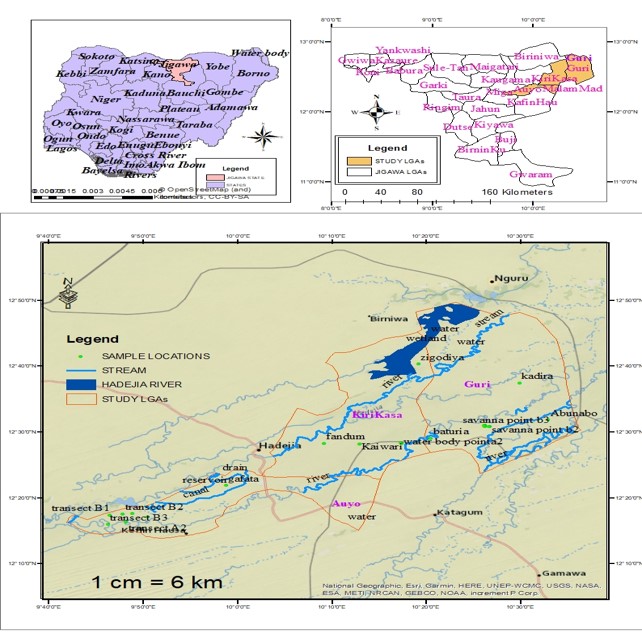
Reptiles are among the most threatened vertebrate groups globally, however, baseline ecological information remains scarce for many African biodiversity hotspots, including Hadejia Wetlands National Park, Nigeria. This study assessed the species composition, distribution, and diversity of reptiles across forest, savannah, and aquatic habitats during dry and wet seasons using visual encounter surveys and active search techniques. A total of 141 individuals representing 21 species were recorded during the wet season, while 127 individuals representing the same number of species were documented during the dry season. Forest habitats consistently supported the highest reptile abundance, whereas water bodies recorded the lowest abundance. Agama agama was the dominant species in both seasons, contributing 23.94% and 19.12% of wet and dry season records, respectively. Other relatively abundant species included Trachylepis perrotetii, Mochlus guineensis, and Pelusios castaneus. Diversity analyses showed that forest and savannah habitats generally exhibited higher Shannon–Wiener diversity (H′ = 2.455, H′ = 2.354) and species richness values (3.592, 3.501) compared to water bodies (0.2899, 1.82), while evenness was highest in aquatic habitats (0.8258, 0.9172). Seasonal variation influenced reptile abundance and distribution patterns, with several arboreal and aquatic species occurring in low numbers. The study provides important baseline ecological data for reptile conservation in Hadejia Wetlands National Park and highlights the significance of reptiles as indicators of wetland ecosystem health and environmental stability.
References
Ahmed, T., Bargali, H. S., Verma, N., & Khan, A. (2018). Status of Wildlife Habitats in Ramnagar Forest Division, Terai-Arc Landscape, Uttarakhand, India. Geoscience Research, 3(1), pp 1-8.
Akulenko, N. M., Dziubenko, N. V., Marushchak, O. Y., Nekrasova, O. D. & Oskyrko, O. S. (2019). Histological Changes in Common Toad, Bufo bufo (Anura, Bufonidae), Liver Tissue under Conditions of Anthropogenically Transformed Ecosystems. Vestnik Zoologii 53 (6): pp 501 506. https://doi.org/10.2478/vzoo-2019-0045
AmphibiaWeb (2018). Amphibians of Nigeria. Available at: https://amphibiaweb.org/cgi/amphib_query?rel–isocc=like& orderbyaw=Order&where isocc=Nigeria. Last accessed on 1 October, 2024.
Baudena, M., Dekker, S.C., Van Bodegom, P.M., Cuesta, B., Higgins, S.I., Lehsten, V., Reick, C.H., Rietkerk, M., Scheiter, S., Yin, S., Zavala, V.M., Brovkin, V. (2015): Forests, Savannahs, and Grasslands: Bridging the Knowledge Gap between Ecology and Dynamic Global Vegetation Models. Biogeosciences 12: pp 1833–1848.
Behangana, M., Magala, R., Katumba, R., Ochanda, D., Kigoolo, S., Mutebi, S., Dendi, D., Luiselli, L. and Hughes, D. F. (2020). Herpetofaunal Diversity and Community Structure in the Murchison Falls-Albert Delta Ramsar Site, Uganda. European Journal of Ecology, 6(2), pp 1-17.
BirdLife International. (2023). Hadejia–Nguru Wetlands Key Biodiversity Area Factsheet. Available at http://datazone.birdlife.org/quicksearch?=Avifauna[accessed 11 November, 2024
Catenazzi, A. (2015). State of the World's Amphibians. Annual Review of Environment and Resources 40 (1): pp 91 119. https://doi.org/10.1146/annurev-environ-102014-021358
Cox, Neil & Young, Bruce & Bowles, Phil & Fernández, Miguel & Marin, Julie & Rapacciuolo, Giovanni & Böhm, Monika & Brooks, Thomas & Hedges, S. & HiltonTaylor, Craig & Hoffmann, Michael & Jenkins, Richard & Tognelli, Marcelo & Alexander, Graham & Allison, Allen & Ananjeva, Natalia & Auliya, Mark & Avila, L.J. & Chapple, David & Xie, Yan. (2022). A Global Reptile Assessment Highlights Shared Conservation needs of Tetrapods. Nature. 605. https://doi.org/10.1038/s41586-022-04664-7.
Da Silva, K. R., Gomes, L. G., Ferreira, F. L., Strüssmann, C & Moreira, L. F. B. (2022). Seasonal Changes in Taxonomic and Functional Diversity of Lizard Communities in Southern Brazilian Pantanal. An Acad Bras Cienc (2022) 94(Suppl. 3): e20201793 https://doi.org/10.1590/0001-37652022202017
Demkowska-Kutrzepa, M., Studzińska, M., Roczeń-Karczmarz, M., Tomczuk, K., Abbas, Z. and Różański, P. (2018). A Review of the Helminths Co-introduced with Trachemys scripta elegans – a Threat to European Native Turtle Health. Amphibia-Reptilia 39(2), 177 189. https://doi.org/10.1163/15685381-17000159
Frost, D. R. (2021), Amphibian Species of the World: an Online Reference. Version 6.1 (12, December, 2025). Electronic Database Accessible at https://amphibiansoftheworld.amnh.org/index.php. American Museum of Natural History, New York, USA. https://doi.org/10.5531/db.vz.0001.
García‐Díaz, P., Ross, J., Woolnough, A. and Cassey, P. (2016). The Illegal Wildlife Trade is a likely Source of Alien Species. Conservation Letters 10(6), pp 690 698. https://doi.org/10.1111/conl.12301
Gibbons, J.W. (2003). Terrestrial Habitat: A Vital Component for Herpetofauna of Isolated Wetlands. Wetlands, 23, pp 630–635.
Greenberg, D. and Palen, W. (2021). Hydrothermal Physiology and Climate Vulnerability in Amphibians. Proceedings of the Royal Society B: Biological Sciences 288 (1945), 20202273. https://doi.org/10.1098/rspb.2020.2273
Kirchhof, S., Wasonga, V., Mazuch., T., Spawls, S. and Malonza, K.P. (2023). An Annotated Checklist of the Herpetofauna of the Sibiloi National Park in Northern Kenya based on Field Surveys. Amphibian & Reptile Conservation 17(1/2) pp 1–18 (e324)
Luiselli, L. Dendi, D. Petrozzi, F. and Segniagbeto, G.H. (2022). Lizard Community Structure and Spatial Resource use along a Forestsavannah-Urban Habitat Gradient in the Dahomey Gap (West Africa). Urban Ecosyst. 25, pp 1015–1026.
Mehra, G. S.,Shrotriya, S., Bisht, D., Bisht, S., Bargali, H. S., Ahmad, T., Verma, N., Mohanty N. and Dutta, S. K. (2021). Seasonal Variations in the Diversity of Amphibians and Reptiles in Western Terai Arc Landscape, India, International Journal of Zoology and Applied Biosciences ISSN: 2455-9571. 6(4), 194-202, http://www.ijzab.com https://doi.org/10.55126/ijzab.2021.v06.i04.019
Musah, Y., Ofori, B. Y., & Attuquayefio, D. K. (2019). Herpetofauna Community Diversity and Composition of a Changing Coastal Wetland in Ghana. West African Journal of Applied Ecology, 27(1), pp 52-65.
Nekrasova, O., Smirnov, N., Marushchak, O., Korshunov, O. and Kotserzhynska, I. (2019). Change in the Protection Status and Points of Finds of the Crested Newt Triturus cristatus (Amphibia, Salamandridae) in Ukraine. Materials for the 4th edition of the Red Book of Ukraine. Fauna, 3. Conservation Biology in Ukraine, Kyiv, 24.09.2019. I. I. Schmalhause Institute of Zoology NAS of Ukraine, Kyiv, 3, 10 pp. [In Ukrainian]. URL: https://uncg.org.ua/tvarynnyj-svit/ [ISBN 978-966-02-9013].
Nneji, L. M., Adeniyi, A. C., Fang, Y., Okeyoyin, A. O., Olagunju, T. E., Omotoso, O., … Che, J. (2018). Cryptic Diversity of Nigerian Agama within West African radiation. Russian Journal of Herpetology, 25(2), pp 97–112.
Nneji, L.M., Adeola, A.C., Okeyoyin, A., Onadeko, A.B., Eniang, E.A., Adeyi, A.O., Oladipo S.O., Adedeji, B.E., Usongo, J.Y., Andem, A.B., Ugwumba, O.A., Ugwumba, A.A.A., Olory, C. (2019) First Record of Foulassi Screeching Frog, Arthroleptis adelphus (Perret, 1966) (Anura, Arthroleptidae, Arthroleptinae), from Nigeria, with Notes on its Phylogenetic Position. Check List 15(2), pp 253–258.
Olalekan, E.I., Abimbola, l.M., Saheed, M., Damilola, O.A. (2014): Wetland Resources of Nigeria: Case Study of the Hadejia-Nguru Wetlands. Poultry, Fisheries and Wildlife Sciences 2: p 123.
Onadeko, A.B. and Ogunkanmi, L.A. (2024). Comparative Geographical Distribution and Abundance of Xenopus Species and Hymenochirus Species in a Secondary Swamp Forest, Okpara Inland, Delta State, Niger Delta Region, Nigeria. Zimbabwe Journal of Science & Technology 19: pp 1-11.
Oni, F. L., Assou, D., Lameed, G. A., D’Cruze, N., Kulik, L., & Luiselli, L. (2024). Effect of Seasonal Variation on Feeding and Food Preference of Olive Baboons (Papio anubis) in a Protected Guinean Savannah of West Africa. Mammalia. https://doi.org/10.1515/mammalia-2024-0019
Onyishi, I. E., Nwonyi, S. K., Pazda, A. and Prokop, P. (2021). Attitudes and Behaviour toward Snakes on the Part of Igbo People in Southeastern Nigeria. Science of the Total Environment 763:143045 https://doi.org/10.1016/j.scitotenv.2020.143045.
Pereira, E. A., Ceron, K., Da Silva, H. R., Santana, D. J. (2022). The Dispersal between Amazonia and Atlantic Forest during the Early Neogene Revealed by the Biogeography of the Tree Frog Tribe Sphaenorhynchini (Anura, Hylidae). Ecology and Evolution, 12, e8754
Pincheira-Donoso, D., Bauer, A. M., Meiri, S., & Uetz, P. (2013). Global Taxonomic Diversity of Living Reptiles. PLoS One, 8(3), e59741.
Ramsar, G. (2009). Journal of National Conservation Strategies, pp 34;-45
Rödel, M.-O., & Ernst, R. (2004). Measuring and monitoring amphibian diversity in tropical forests. I. An evaluation of methods with recommendations for standardization. Ecotropica, 10(1), 1-14.
Sanusi, M. (2021). Forest Management Indices in Baturiya National Park, Kir-kasamma, Jiagwa State, Nigria. Undergraduate Reserch Submitted to the Department of Forestry and Wildlife Management, Fedral University Dutse Jigawa State Nigeria.
Segniagbeto, G.H., Dekawole, J.K., Ketoh, G.K., Dendi, D., Luiselli, L. (2022). Herpetofaunal Diversity in a Dahomey Gap Savannah of Togo (West Africa): Effects of Seasons on the Populations of Amphibians and Reptiles. Diversity, 14, 964. https://doi.org/10.3390/d14110964
Tingley, R., Meiri, S., & Chapple, D. G. (2016). Addressing Knowledge Gaps in Reptile Conservation. Biological Conservation, 204, 1-5. https://doi.org/10.1016/j.biocon.2016.07.021
Uetz, P. & Hošek, J. (Eds.) (2018) The Reptile Database, http://www.reptile-database.org
Uetz, P., Freed, P., Aguilar, R., and Hošek, J. (2021). The Reptile Database. http://www.reptile-database.org.
Uetz, P., Freed, P., Aguilar, R., Reyes, F., Kudera, J. & Hosek, J. (2024). The Reptile Database. 2024 (Eds). http://www.ReptileDatabase.Org Accessed October 8, 2025.
Vasyliuk, O., Prylutskyi, O., Marushchak, O., Kuzemko, A., Kutsokon, I., Nekrasova, O., Raes, N. and Rusin, M. (2022). An Extended Dataset of Occurrences of Species Listed in Resolution 6 of the Bern Convention from Ukraine. Biodiversity data journal 10: e84002. https://doi.org/10.3897/bdj.10.e84002
Villamarín, F.; Moraes, L.J.; Ferrara, C.R.; Kaefer, I.L.;Werneck, F.P.; de Fraga, R. (2022). Ecology and Conservation of Wetland Amphibians and Reptiles. In Encyclopedia of Inland Waters, 2nd ed.; Mehner, T., Tockner, K., Eds.; Elsevier: Amsterdam, The Netherlands, 3, pp 256–266.
Vitt, L. J and Caldwell, J. P. (2014). Herpetology: An Introductory Biology of Amphibians and Reptiles. Fourth Edition, Academic Press is an imprint of Elsevier, p 749.
Yahaya, M., Benjamin, Y. O. and Daniel, K. A. (2019). Herpetofauna Community Diversity and Composition of a Changing Coastal Wetland in Ghana. West African Journal of Applied Ecology, 27(1) pp 52-64.
Downloads
Published
Issue
Section
License
Copyright (c) 2026 Tukur Yahuza Nasir, Ali Abubakar, Callistus Akosim (Author)

This work is licensed under a Creative Commons Attribution-NonCommercial 4.0 International License.
- Attribution — You must give appropriate credit, provide a link to the license, and indicate if changes were made. You may do so in any reasonable manner, but not in any way that suggests the licensor endorses you or your use.
- NonCommercial — You may not use the material for commercial purposes.
- No additional restrictions — You may not apply legal terms or technological measures that legally restrict others from doing anything the license permits.