
Deep Learning Enhanced Energy-Aware Task Scheduling for Efficient Cloud Datacenter Management
DOI:
https://doi.org/10.70882/josrar.2026.v3i4.234Keywords:
Energy Efficiency, Cloud Computing, Task Scheduling, Deep Learning, Hybrid OptimizationAbstract
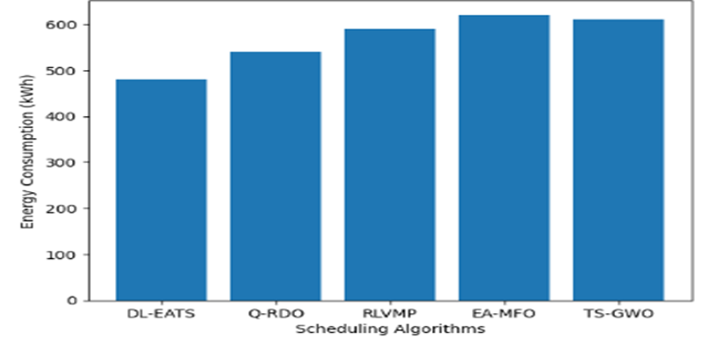
Energy efficiency in cloud computing has become a critical concern due to the growing energy demands of large-scale datacenters, operational costs and environmental impacts. This research proposes Deep Learning-Enhanced Energy-Aware Task Scheduling (DL-EATS), a novel solution that combines LSTM-based workload prediction with a hybrid multi-objective optimization model integrating Genetic Algorithm and Particle Swarm refinement. DL-EATS intelligently schedules tasks to virtual machines or containers by anticipating workload variations, thereby minimizing energy consumption, ensuring SLA compliance and maximizing system throughput. The method was evaluated against state-of-the-art algorithms, including Reinforcement Learning-based Virtual Machine Placement (RLVMP), Enhanced Adaptive Moth-Flame Optimization (EA-MFO), Q-Learning-based Resource Dynamic Optimization (Q-RDO) and Task Scheduling using Grey Wolf Optimizer (TS-GWO), under identical cloud workload scenarios. Experimental results demonstrate that DL-EATS achieves the lowest energy consumption (480 kWh), shortest makespan (38 s), minimal SLA violation rate (1.2%) and highest resource utilization (92%), representing an 18.5% improvement in energy efficiency over the next best method and substantial gains across all performance metrics. These findings confirm that integrating predictive deep learning with hybrid heuristic optimization provides a scalable, reliable and energy-efficient solution for modern cloud datacenter management.
References
Al-Jumaili, A. H. A., Muniyandi, R. C., Hasan, M. K., Singh, M. J., Paw, J. K. S. and Amir, M. (2023). Advancements in intelligent cloud computing for power optimization and battery management in hybrid renewable energy systems: A comprehensive review. Energy Reports, 10, 2206–2227. https://doi.org/10.1016/j.egyr.2023.10.124
Alsadie, D. and Alsulami, M. (2025). Modified grey wolf optimization for energy-efficient Internet of Things task scheduling in fog computing. Scientific Reports, 15, 14730. https://doi.org/10.1038/s41598-025-99837-5
Beena, B. M., Ranga, P. C., Holimath, V., Sridhar, S., Kamble, S. S., Shendre, S. P. and Priya, M. Y. (2024). Adaptive energy optimization in cloud computing through containerization. IEEE Access. https://doi.org/10.1109/ACCESS.2024.0429000
Beena, B. M., Ranga, P. C., Manideep, T. S. S., Saragadam, S. and Karthik, G. (2025). A green cloud-based framework for energy-efficient task scheduling using carbon intensity data for heterogeneous cloud servers. IEEE Access, 13, 73927–73935. https://doi.org/10.1109/ACCESS.2025.3562882
Bhasker, B., Kaliraj, S., Gobinath, C. and Sivakumar, V. (2025). Optimizing energy task offloading technique using IoMT cloud in healthcare applications. Journal of Cloud Computing: Advances, Systems and Applications, 14(9). https://doi.org/10.1186/s13677-025-00733-0
Castro, V., Georgiou, M., Jackson, T., Hodgkinson, I. R., Jackson, L. and Lockwood, S. (2024). Digital data demand and renewable energy limits: Forecasting the impacts on global electricity supply and sustainability. Energy Policy, 195, 114404. https://doi.org/10.1016/j.enpol.2024.114404
Chauhan, S. (2024). The growing energy demand of data centers: Impacts of AI and cloud computing. International Journal for Multidisciplinary Research, 6(4). https://doi.org/10.36948/ijfmr.2024.v06i04.26591
Feng, N. and Ran, C. (2025). Design and optimization of distributed energy management system based on edge computing and machine learning. Energy Informatics, 8(17). https://doi.org/10.1186/s42162-025-00471-2
Hou, H. and Ismail, A. (2024). EETS: An energy-efficient task scheduler in cloud computing based on improved DQN algorithm. Journal of King Saud University - Computer and Information Sciences, 36(8), 102177. https://doi.org/10.1016/j.jksuci.2024.102177
Katal, A., Dahiya, S. and Choudhury, T. (2022). Energy efficiency in cloud computing data center: A survey on hardware technologies. Cluster Computing, 25(1), 1–31. https://doi.org/10.1007/s10586-021-03431-z
Kirdak, J. G. and Raut, S. V. (2025). Energy optimization in green cloud computing: A sustainable approach using AI techniques. International Scientific Journal of Engineering and Management, 4(10), 1–7. https://doi.org/10.55041/ISJEM05113
Long, S., Li, Z., Xing, Y., Tian, S., Li, D. and Yu, R. (2020). A reinforcement learning-based virtual machine placement strategy in cloud data centers. In 2020 IEEE 22nd International Conference on High Performance Computing & Communications; IEEE 18th International Conference on Smart City; IEEE 6th International Conference on Data Science and Systems (HPCC/SmartCity/DSS). https://doi.org/10.1109/HPCC-SmartCity-DSS50907.2020.00028
Nataraj, N., Purushothaman, P. and Aruna, R. (2025). Quantum-enhanced Red Deer Optimization for optimizing task scheduling and energy efficiency in cloud-based healthcare systems. TPM Journal, 32(S3), 2124–2135. https://www.tpmap.org/
Semwal, A., Rauthan, M. S., Barthwal, V., Shah, S. S., Singh, K. and Pokhriyal, N. (2025). AI-driven energy optimization for virtual machines in cloud computing. In R. Nagariya et al. (Eds.), Proceedings of the International Conference on Sustainable Business Practices and Innovative Models (ICSBPIM-2025). Advances in Economics, Business and Management Research, 349. https://doi.org/10.2991/978-94-6463-872-1_19
Yin, X., Zhang, X., Pei, L., Hu, R., Ye, K. and Cai, K. (2025). Optimization and benefit evaluation model of a cloud computing-based platform for power enterprises. Scientific Reports, 15, 26366. https://doi.org/10.1038/s41598-025-10314-5
Downloads
Published
Issue
Section
License
Copyright (c) 2026 Abdulmumini Adamu, Adebayo A. Abdulwasiu (Author)

This work is licensed under a Creative Commons Attribution-NonCommercial 4.0 International License.
- Attribution — You must give appropriate credit, provide a link to the license, and indicate if changes were made. You may do so in any reasonable manner, but not in any way that suggests the licensor endorses you or your use.
- NonCommercial — You may not use the material for commercial purposes.
- No additional restrictions — You may not apply legal terms or technological measures that legally restrict others from doing anything the license permits.