
Influence of Drying Temperature and Osmotic Pretreatment on Heat and Mass Transfer, Drying Kinetics and Quality of Dried Sweet Potato
DOI:
https://doi.org/10.70882/josrar.2026.v3i4.233Keywords:
Sweet potato, Drying Kinetic, Mass Transfer, Heat Transfer, Diffusivity, RehydrationAbstract
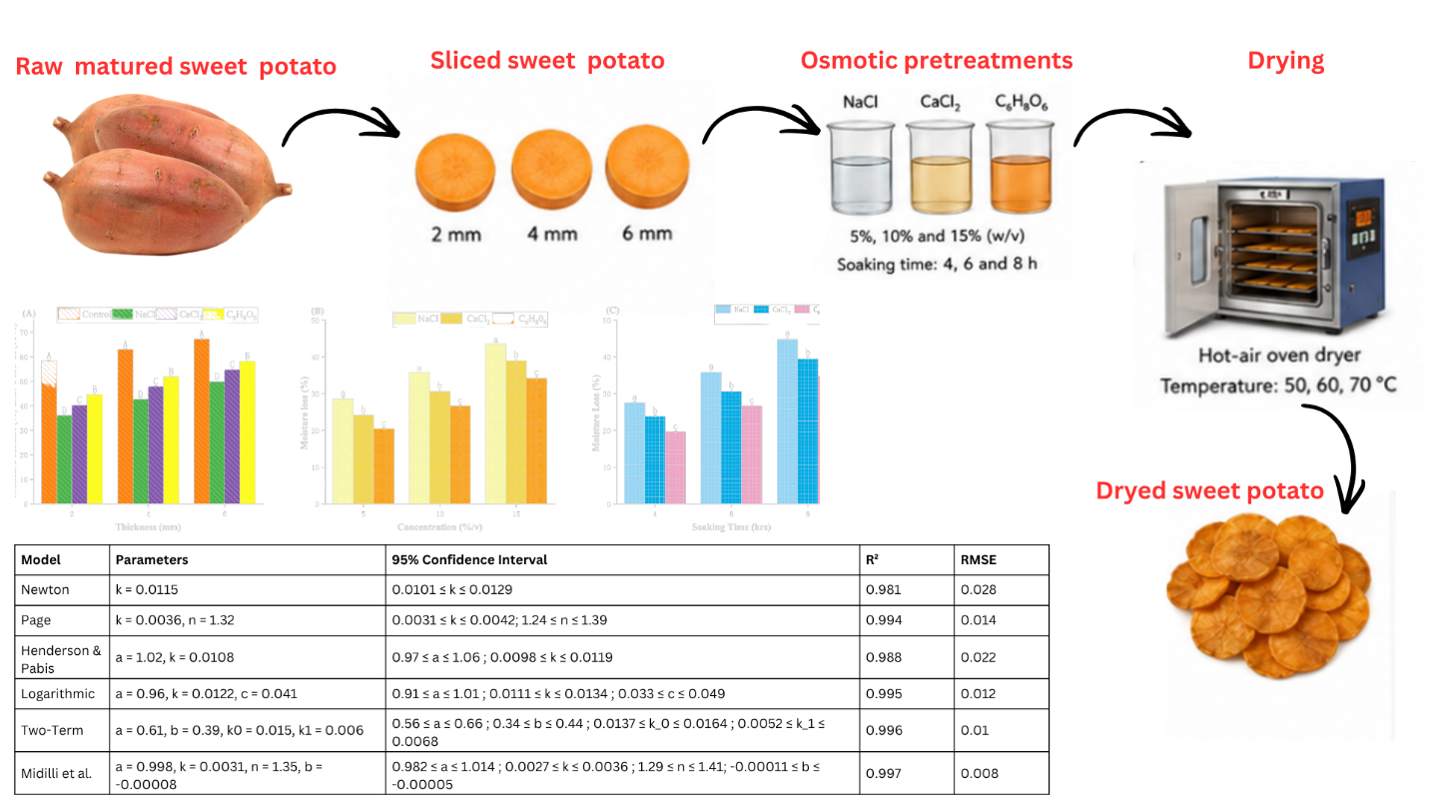
The study investigated the effects of osmotic pretreatment and drying temperature on drying kinetics, heat and mass transfer and quality attributes of sweet potato slices. Mature sweet potato were sliced into 2, 4 and 6 mm thicknesses and subjected to osmotic pretreatment using NaCl, CaCl2 and C6H8O6 solutions at concentration of 5, 10 and 15% (w/v) for 4, 6, and 8 hours. Drying experiments were conducted in a hot air oven dryer at 50, 60 and 70°C. The results showed that moisture reduction during osmotic pretreatment significantly increased (p<0.005) with increasing solution concentration, soaking time, and drying temperature, ranging from 12.84 ± 0.31% in the control sample to 43.54 ± 0.67% in treated samples, whereas thinner slices recorded faster moisture migration. Samples pretreated with 15% NaCl recorded the highest moisture loss (27.48 ± 0.41% to 44.73 ± 0.66 %) and fastest drying rate, whereas untreated samples showed slower moisture reduction. Effective moisture diffusivity ranged from (1.12 ± 0.05) × 10 − 8 to (4.21 ± 0.14) × 10 − 8 m2/s in NaCl-treated samples at 70°C and increased with temperature and pretreatment intensity. The Midilli et al. model best described the drying behavior, producing the highest coefficient of determination (R2= 0.997) and lowest root mean square error (RMSE= 0.008). Drying at 60°C provided an optimal balance between drying efficiency, energy utilization, and sweet potato quality.
References
Aboyeji, O. O., Oloke, J. K., Arinkoola, A. O., Oke, M. A., & Ishola, M. M. (2020). Optimization of media components and fermentation conditions for citric acid production from sweet potato peel starch hydrolysate by Aspergillus niger. Scientific African, 10, e00554. https://doi.org/10.1016/j.sciaf.2020.e00554
Akpinar, E. K. (2006). Mathematical modelling of thin layer drying process under open sun of some aromatic plants. Journal of Food Engineering, 77(4), 864–870. https://doi.org/10.1016/j.jfoodeng.2005.08.014
AOAC. (2023). In Official Methods of Analysis of AOAC INTERNATIONAL. Oxford University Press. https://doi.org/10.1093/9780197610145.003.1384
Arun S. Mujumdar. (2014). Handbook of Industrial Drying (A. S. Mujumdar (Ed.)). CRC Press. https://doi.org/10.1201/b17208
Calín-Sánchez, Á., Lipan, L., Cano-Lamadrid, M., Kharaghani, A., Masztalerz, K., Carbonell-Barrachina, Á. A., & Figiel, A. (2020). Comparison of Traditional and Novel Drying Techniques and Its Effect on Quality of Fruits, Vegetables and Aromatic Herbs. Foods, 9(9), 1261. https://doi.org/10.3390/foods9091261
Chu, Q., Li, L., Duan, X., Zhao, M., Wang, Z., Wang, Z., Ren, X., Li, C., & Ren, G. (2023). Effect mechanism of different drying methods on the quality and browning for daylily. LWT, 182, 114862. https://doi.org/10.1016/j.lwt.2023.114862
Clifford, I. O., Kingsley, E., Chika, C. O., & Chinyere, I. I. (2014). Effects of Osmotic Dewatering and Oven Drying on β-Carotene Content of Sliced Light Yellow-Fleshed Sweet Potato (Ipomea batatas L.). Nigerian Food Journal, 32(2), 25–32. https://doi.org/10.1016/S0189-7241(15)30114-4
Doymaz, İ. (2012). Evaluation of some thin-layer drying models of persimmon slices (Diospyros kaki L.). Energy Conversion and Management, 56, 199–205. https://doi.org/10.1016/j.enconman.2011.11.027
Drosou, C., Krokida, M., & Biliaderis, C. G. (2022). Encapsulation of β-carotene into food-grade nanofibers via coaxial electrospinning of hydrocolloids: Enhancement of oxidative stability and photoprotection. Food Hydrocolloids, 133, 107949. https://doi.org/10.1016/j.foodhyd.2022.107949
Dung, N. C., Thuy, N. M., Giau, T. N., Van Hao, H., Van Thanh, N., Minh, V. Q., & Van Tai, N. (2026). Evaluation of quality characteristics, antioxidant activity, functional groups of sweet potato by-products and their usage in sandwich bread processing. Food Chemistry: X, 35, 103731. https://doi.org/10.1016/j.fochx.2026.103731
Falade, K. O., & Oyedele, O. O. (2010). Effect of osmotic pretreatment on air drying characteristics and colour of pepper (Capsicum spp) cultivars. Journal of Food Science and Technology, 47(5), 488–495. https://doi.org/10.1007/s13197-010-0083-4
Fathi, F., N. Ebrahimi, S., Matos, L. C., P. P. Oliveira, M. B., & Alves, R. C. (2022). Emerging drying techniques for food safety and quality: A review. Comprehensive Reviews in Food Science and Food Safety, 21(2), 1125–1160. https://doi.org/10.1111/1541-4337.12898
Guo, X., Zhang, J., Xiong, H., Zhang, T., Yang, R., & Wang, X. (2026). A multi-defect detection framework for sweet potato based on feature fusion and adaptive attention under complex postharvest conditions. Journal of Stored Products Research, 116, 102937. https://doi.org/10.1016/j.jspr.2025.102937
Hadj-Taieb, L., Joseph, A., Abdullah, A. S., & Sharshir, S. W. (2025). Performance evaluation of a reflector-assisted evacuated tube solar dryer for drying banana, mango, and sweet potato. Case Studies in Thermal Engineering, 75, 107166. https://doi.org/10.1016/j.csite.2025.107166
Issaka, D. S., Lazarovitch, N., Villordon, A., Ben-Gal, A., Rachmilevitch, S., & Ilani, T. (2026). Response of sweet potato (cv. Georgia Jet) to water limitation under drip and sprinkler irrigation. Scientia Horticulturae, 361, 114846. https://doi.org/10.1016/j.scienta.2026.114846
Kim, S.-Y., Jeong, U.-C., Ju, H.-I., Jeong, S., & Lee, D.-U. (2023). Effect of pulsed electric field pretreatment on mass transfer during hot air drying: Drying and rehydration properties of sweet potato. Innovative Food Science & Emerging Technologies, 89, 103449. https://doi.org/10.1016/j.ifset.2023.103449
Kudra, T., & Mujumdar, A. S. (2009). Advanced Drying Technologies. CRC Press. https://doi.org/10.1201/9781420073898
Lagnika, C., Riaz, A., Jiang, N., Song, J., Li, D., Liu, C., Wei, Q., & Zhang, M. (2021). Effects of pretreatment and drying methods on the quality and stability of dried sweet potato slices during storage. Journal of Food Processing and Preservation, 45(10). https://doi.org/10.1111/jfpp.15807
Lewicki, P. P. (2006). Design of hot air drying for better foods. Trends in Food Science & Technology, 17(4), 153–163. https://doi.org/10.1016/j.tifs.2005.10.012
Midilli, A., Kucuk, H., & Yapar, Z. (2002). A NEW MODEL FOR SINGLE-LAYER DRYING. Drying Technology, 20(7), 1503–1513. https://doi.org/10.1081/DRT-120005864
Mortensen, A. B., & Wallin, H. (1989). Gravimetric Determination of Ash in Foods: NMKL Collaborative Study. Journal of AOAC INTERNATIONAL, 72(3), 481–483. https://doi.org/10.1093/jaoac/72.3.481
Ntsowe, K. (2026). Nutritional properties, health benefits and impact of drying on quality of different sweet potato varieties. In Processing, Nutrition and Value Addition Principles of Neglected and Underutilized African Foods (pp. 505–511). Elsevier. https://doi.org/10.1016/B978-0-443-33433-7.00039-3
Petikirige, J., Karim, A., & Millar, G. (2022). Effect of drying techniques on quality and sensory properties of tropical fruits. International Journal of Food Science & Technology, 57(11), 6963–6979. https://doi.org/10.1111/ijfs.16043
Rashid, M. T., Liu, K., Jatoi, M. A., Safdar, B., Lv, D., & Li, Q. (2022). Energy efficient drying technologies for sweet potatoes: Operating and drying mechanism, quality-related attributes. Frontiers in Nutrition, 9. https://doi.org/10.3389/fnut.2022.1040314
Rifka Alkhilyatul Ma’rifat, I Made Suraharta, I. I. J. (2024). No Title 済無No Title No Title No Title (Vol. 2, pp. 306–312).
Roy, J., Sun, H., Ma, M., & Mu, T. (2026). Influence of combined xanthan gum, egg white protein, and cellulose nanofibers on the rheological, fermentation and microstructural properties of gluten-free sweet potato dough and its breads quality characteristics. Food Hydrocolloids, 179, 112748. https://doi.org/10.1016/j.foodhyd.2026.112748
Roy, J., Sun, H., Ma, M., Mu, T., & Maimaiti, Z. (2026). Nutritional, physico‐chemical, and pasting properties of sweet potato raw powder: effects of color protection combined with different drying methods. Journal of the Science of Food and Agriculture, 106(2), 818–830. https://doi.org/10.1002/jsfa.70207
Singh, R. P., & Heldman, D. R. (2014). Mass Transfer. In Introduction to Food Engineering (pp. 617–644). Elsevier. https://doi.org/10.1016/B978-0-12-398530-9.00010-3
Torreggiani, D. (1993). Osmotic dehydration in fruit and vegetable processing. Food Research International, 26(1), 59–68. https://doi.org/10.1016/0963-9969(93)90106-S
Wang, Z., Hou, Y., Liao, C., Wang, J., Shui, C., Tang, Z., Xu, Y., Peng, X., & Sun, Z. (2026). Valorization Pathways of Sweet-Potato Residues: Integrated Strategies for Nutritional Enhancement, Processing Innovation, and Multifield Applications. Food Reviews International, 1–29. https://doi.org/10.1080/87559129.2026.2614386
Yakubu, H., Kabir, K., & Sambo, B. E. (2026). Quality Assessment of Sweetpotato Roots (Ipomoea batatas L.) as Influenced by Ridge Height, Vine Cutting and Vine Orientation. Journal of Science Research and Reviews, 3(2), 8–16. https://doi.org/10.70882/josrar.2026.v3i2.175
Yuan, Q., Zhang, Z., Xie, S., Hu, J., Zhang, M., Chen, X., Zhong, Y., & Zhao, X. (2026). Evaluation of flavor characteristics of sweet potato wines produced by different processing methods using multiple analytical and sensory techniques. Journal of Food Composition and Analysis, 153, 109122. https://doi.org/10.1016/j.jfca.2026.109122
Zeng, Z., Han, C., Wang, Q., Yuan, H., Zhang, X., & Li, B. (2024). Analysis of drying characteristic, effective moisture diffusivity and energy, exergy and environment performance indicators during thin layer drying of tea in a convective-hot air dryer. Frontiers in Sustainable Food Systems, 8. https://doi.org/10.3389/fsufs.2024.1371696
Zhu, A., & Jiang, F. (2014). Modeling of mass transfer performance of hot-air drying of sweet potato (Ipomoea Batatas L.) slices. Chemical Industry and Chemical Engineering Quarterly, 20(2), 171–181. https://doi.org/10.2298/CICEQ120509122Z
Downloads
Published
Issue
Section
License
Copyright (c) 2026 Hadiza Kabir Bako, Moses Zipporah (Author)

This work is licensed under a Creative Commons Attribution-NonCommercial 4.0 International License.
- Attribution — You must give appropriate credit, provide a link to the license, and indicate if changes were made. You may do so in any reasonable manner, but not in any way that suggests the licensor endorses you or your use.
- NonCommercial — You may not use the material for commercial purposes.
- No additional restrictions — You may not apply legal terms or technological measures that legally restrict others from doing anything the license permits.