
The Nature of Highrise Residential Estates: A Comparative Analysis of Design Characteristics and Typologies
DOI:
https://doi.org/10.70882/josrar.2026.v3i3.227Keywords:
High-rise residential estates, Building typology, Vertical housing, Architectural design, Residential towers, Urban housingAbstract
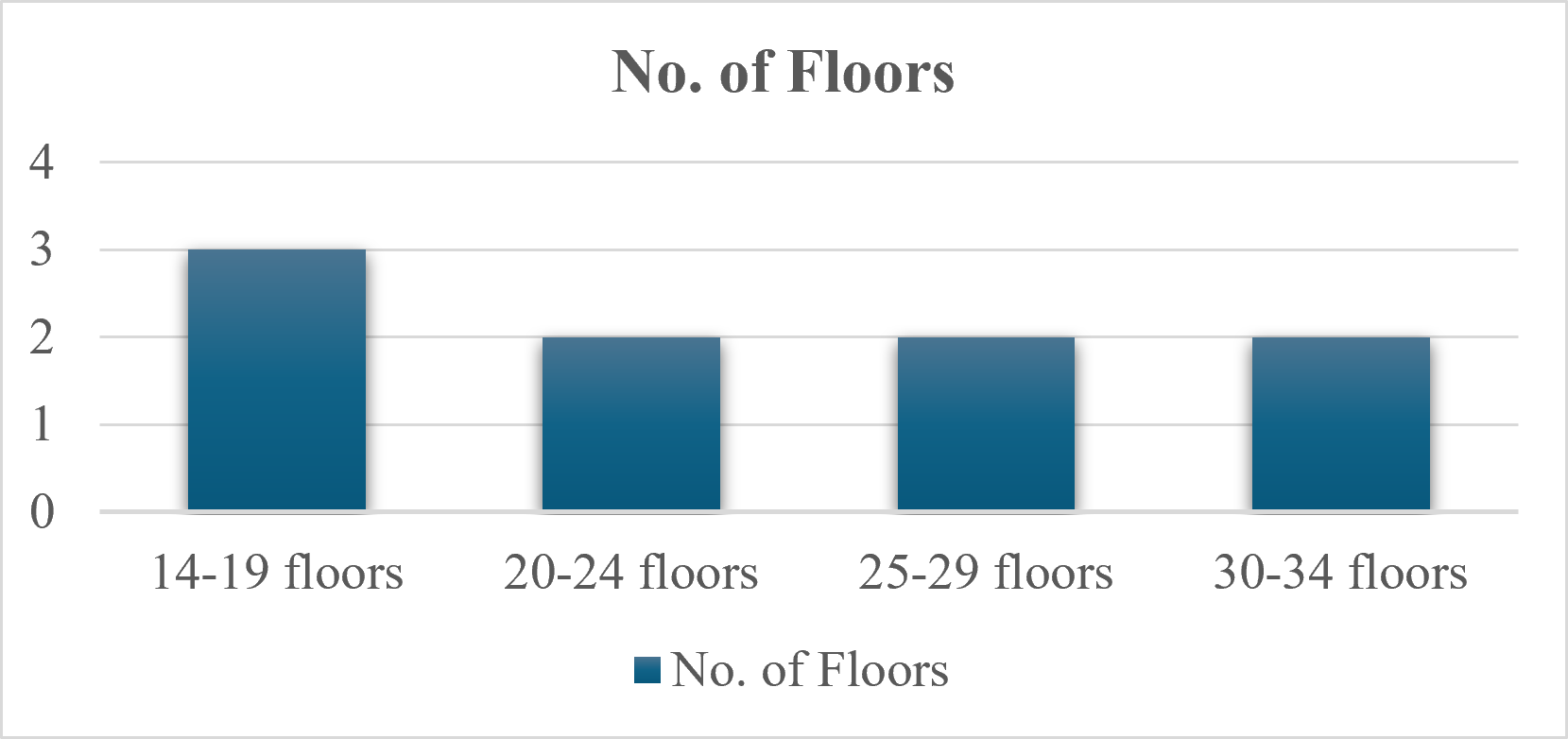
This study examines the nature of high-rise residential estates through a comparative analysis of seven case studies selected from Nigeria, Italy, Australia, and Israel. Using a mixed-method research approach, the study evaluates building height distribution, apartment typologies, provision of essential services, prototype variation, and building orientation patterns. Qualitative methods included visual observation, architectural analysis, and case study examination, while quantitative methods involved descriptive statistical analysis of measurable building characteristics. The findings reveal those high-rise residential buildings within the selected cases range between 14 and 34 storeys. Nigerian examples predominantly fall within the 14–26 storey range, whereas international examples demonstrate greater verticality. Two-bedroom and three-bedroom apartments were identified in all case studies (100%), indicating a universal preference for family-oriented housing. Essential facilities such as elevators, staircases, balconies, terraces, and parking were also universally provided across all developments. Prototype variation differed significantly among the case studies: 1004 Housing Estate contained six prototypes, Eko Court Complex had three, Bosco Verticale and One Central Park featured two each, while Bourdillon, A&A Towers Eko, and Tel Aviv Tower each adopted a single prototype configuration. In terms of orientation, 71% of the buildings adopted a north–south orientation to optimize ventilation and solar control. The study contributes baseline typological data for understanding contemporary high-rise residential development and provides practical recommendations for architects, urban planners, and policymakers involved in vertical housing design.
References
Adeoye, B. (2026, March 24). Skyscrapers key to industrial growth and urban transformation Adeoye. The Sun Nigeria. https://thesun.ng/skyscrapers-key-to-industrial-growth-and-urban-transformation-adeoye/
Chukwujindu, K. E., Bansal, N., & Kasiraman, G. (2023). Evaluation of bioclimatic principles in design of tropical high-rise dwellings – Case studies from Africa. African Journal of Environmental Research. https://ajer.org.ng/index.php/journal/article/view/87
Council on Tall Buildings and Urban Habitat (CTBUH). (2022). CTBUH height criteria. https://www.ctbuh.org/resource/height
Dangiwa, A. M. (2024, June 27). Housing construction key to stimulating inclusive growth, lifting 100 million Nigerians out of poverty. Federal Ministry of Information and National Orientation. https://fmino.gov.ng/housing-construction-key-to-stimulating-inclusive-growth-lifting-100-million-nigerians-out-of-poverty-dangiwa/
Ekhaese, E. N., & Adewale, B. A. (2025). Enhancing thermal comfort in high-rise condominiums through passive design strategies in Lagos, Nigeria. International Journal of Sustainable Development and Planning, 20(5), 1797-1811. https://doi.org/10.18280/ijsdp.200501
Nguyen, P. M. L. (2025). High-rise living: Stimulating social interaction in high-rise apartment buildings [Doctoral dissertation, Eindhoven University of Technology]. https://research.tue.nl/nl/publications/high-rise-living-stimulating-social-interaction-in-high-rise-apar/
Pfeifer, G., & Brauneck, P. (2015). Residential buildings: A typology. Birkhäuser.
Smith, B. S., & Coull, A. (2021). Tall building structures: Analysis and design. Wiley.
United Nations, Department of Economic and Social Affairs. (2023). World urbanization prospects: The 2022 revision. https://population.un.org/wup/
Veal, A. J. (2006). Research Methods for Leisure and Tourism: A Practical Guide (3rd ed.). Pearson Education.
Downloads
Published
Issue
Section
License
Copyright (c) 2026 Isaiah Oluwatimilehin Adebambo, Kolawole Opeyemi Morakinyo, Sunday Favour Olawale, Abdulrasheed Mustapha, Seyi Oloyede Farodoye (Author)

This work is licensed under a Creative Commons Attribution-NonCommercial 4.0 International License.
- Attribution — You must give appropriate credit, provide a link to the license, and indicate if changes were made. You may do so in any reasonable manner, but not in any way that suggests the licensor endorses you or your use.
- NonCommercial — You may not use the material for commercial purposes.
- No additional restrictions — You may not apply legal terms or technological measures that legally restrict others from doing anything the license permits.