
Barriers and Enablers to Renewable Energy Adoption in Rural Northern Nigeria: A Systematic Review (2018–2025)
DOI:
https://doi.org/10.70882/josrar.2026.v3i3.218Keywords:
renewable energy; rural electrification; Northern Nigeria; solar home systems; mini-grids; barriers; enablers; systematic review; energy accessAbstract
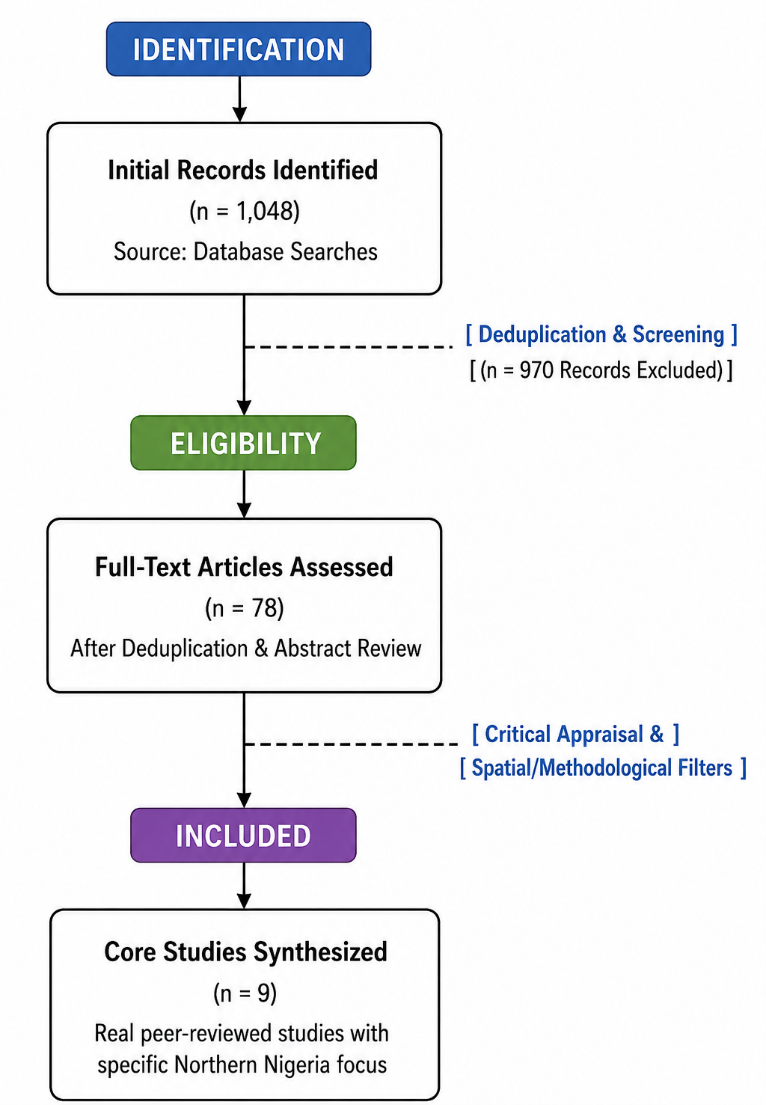
Northern Nigeria continues to experience very low rural electrification rates despite significant solar potential. National efforts to promote decentralized renewable energy technologies (RETs) have not yet translated into widespread household and community adoption in many northern rural areas. This systematic review synthesizes available peer-reviewed evidence published between 2018 and 2025 on the barriers and enablers influencing renewable energy technology adoption in rural Northern Nigeria. A PRISMA 2020-compliant search was conducted across Scopus, Web of Science, Google Scholar, and African Journals Online. Key peer-reviewed studies focusing on rural Northern Nigeria were identified and thematically synthesized. Financial and affordability constraints emerged as the most significant barrier. Technical capacity and maintenance challenges, socio-cultural and gender-related factors, and gaps in policy implementation were also important. Promising enablers included flexible financing models and community engagement. The available evidence base remains limited and geographically concentrated. Adoption of renewable energy technologies in rural Northern Nigeria is constrained by interconnected financial, technical, and institutional barriers. Integrated interventions and expanded primary research are needed to support more effective deployment.
Downloads
Published
Issue
Section
License
Copyright (c) 2026 Sule Muhammad Zubairu (Author)

This work is licensed under a Creative Commons Attribution-NonCommercial 4.0 International License.
- Attribution — You must give appropriate credit, provide a link to the license, and indicate if changes were made. You may do so in any reasonable manner, but not in any way that suggests the licensor endorses you or your use.
- NonCommercial — You may not use the material for commercial purposes.
- No additional restrictions — You may not apply legal terms or technological measures that legally restrict others from doing anything the license permits.