
Coupled VOC Oxidation Pathways and the Integrated Formation of Tropospheric Ozone and Secondary Organic Aerosols: A Systematic Review of Mechanistic Insights and Modelling Challenges
DOI:
https://doi.org/10.70882/josrar.2026.v3i3.212Keywords:
VOC Oxidation,, Tropospheric Ozone, Secondary Organic Aerosol (SOA),, Autoxidation, Peroxy Radicals, Atmospheric ModellingAbstract
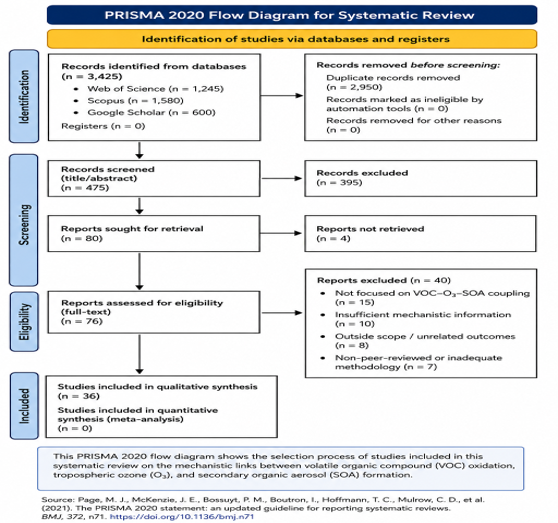
Volatile organic compounds (VOCs) are key precursors of both tropospheric ozone and secondary organic aerosols (SOA), which are two major air pollutants in the troposphere. O3 and SOA are often treated as two different species and are studied independently, while evidence of their formation coupling through shared VOC oxidation pathways is growing. Here, we performed a systematic review according to the Preferred Reporting Items for Systematic Reviews and Meta-Analyses (PRISMA 2020) guidelines to summarize current understanding of the mechanistic links between VOC oxidation, ozone formation and SOA production. A total of 3,425 articles retrieved from Web of Science, Scopus and Google Scholar were screened, and 36 peer-reviewed papers were selected based on defined criteria for qualitative synthesis. The review found that organic peroxy radical (.RO2) is an important intermediate that dictates the competition between ozone producing pathways and aerosol forming pathways. It was shown that elevated NOx concentrations favours O3 formation through the RO2 + NOx reaction, whereas low-NOx conditions lead to autoxidation and RO2 + HO2 pathways that favour the formation of highly oxygenated organic molecules (HOMs) and SOA mass. The review also identified several persistent challenges with atmospheric models such as the incomplete treatment of intermediate-volatility organic compounds (IVOCs), uncertainties in RO2 branching chemistry and shortcomings in multiphase process and autoxidation mechanism representations. The results demonstrate the necessity for integrated multi-pollutant control strategies and robust atmospheric models that represent the coupled O3-SOA system. We link gas-phase oxidation chemistry and aerosol microphysics to provide an overall framework to advance air quality forecast and climate forcing estimate.
References
Akimoto, H. (2016). Atmospheric Reaction Chemistry. Springer Japan. https://link.springer.com/book/10.1007/978-4-431-55870-5
Atkinson, R., & Arey, J. (2003). Gas-phase tropospheric chemistry of biogenic volatile organic compounds: a review. Atmospheric environment, 37, 197-219. https://www.sciencedirect.com/science/article/abs/pii/S1352231003003911
Aumont, B., Szopa, S., & Madronich, S. (2005). Modelling the evolution of organic carbon during its atmospheric processing. Atmospheric Chemistry and Physics, 5(9), 2497–2517. https://acp.copernicus.org/articles/5/2497/2005/
Bianchi, F., Kurtén, T., Riva, M., Mohr, C., Rissanen, M. P., Roldin, P., & Ehn, M. (2019). Highly oxygenated organic molecules (HOM) from gas-phase autoxidation involving peroxy radicals: A key contributor to atmospheric aerosol. Chemical reviews, 119(6), 3472-3509. https://pubs.acs.org/doi/full/10.1021/acs.chemrev.8b00395
Carlton, A. G., Wiedinmyer, C., & Kroll, J. H. (2009). A review of Secondary Organic Aerosol (SOA) formation from isoprene. Atmospheric Chemistry and Physics, 9(14), 4987-5005. https://acp.copernicus.org/articles/9/4987/2009/
Carter, W. P., & Heo, G. (2013). Development of revised SAPRC aromatics mechanisms. Atmospheric Environment, 77, 404–414. https://www.sciencedirect.com/science/article/abs/pii/S1352231013003646
Crounse, J. D., Nielsen, L. B., Jørgensen, S., Kjaergaard, H. G., & Wennberg, P. O. (2013). Autoxidation of organic compounds in the atmosphere. The Journal of Physical Chemistry Letters, 4(20), 3513-3520. https://pubs.acs.org/doi/abs/10.1021/jz4019207
Donahue, N. M., Robinson, A. L., Stanier, C. O., & Pandis, S. N. (2006). Coupled partitioning, dilution, and chemical aging of semivolatile organics. Environmental science & technology, 40(8), 2635-2643. https://pubs.acs.org/doi/abs/10.1021/Es052297c
Ehn, M., Thornton, J. A., Kleist, E., Sipilä, M., Junninen, H., Pullinen, I., & Mentel, T. F. (2014). A large source of low-volatility secondary organic aerosol. Nature, 506(7489), 476-479. https://www.nature.com/articles/nature13032
Ervens, B. T. B. W. R., Turpin, B. J., & Weber, R. J. (2011). Secondary organic aerosol formation in cloud droplets and aqueous particles (aqSOA): a review of laboratory, field and model studies. Atmospheric Chemistry and Physics, 11(21), 11069-11102. https://acp.copernicus.org/articles/11/11069/2011/
Glasius, M., & Goldstein, A. H. (2016). Recent discoveries and future challenges in atmospheric organic chemistry, 50(6), 2754–2764. https://pubs.acs.org/doi/full/10.1021/acs.est.5b05105
Guo, S., Hu, M., Zamora, M. L., Peng, J., Shang, D., Zheng, J., & Zhang, R. (2014). Elucidating severe urban haze formation in China. Proceedings of the National Academy of Sciences, 111(49), 17373-17378. https://www.pnas.org/doi/abs/10.1073/pnas.1419604111
Hallquist, M., Wenger, J. C., Baltensperger, U., Rudich, Y., Simpson, D., Claeys, M., & Wildt, J. (2009). The formation, properties and impact of secondary organic aerosol: current and emerging issues. Atmospheric chemistry and physics, 9(14), 5155-5236. https://acp.copernicus.org/articles/9/5155/2009/
Jenkin, M. E., Saunders, S. M., Wagner, V., & Pilling, M. J. (2003). Protocol for the development of the Master Chemical Mechanism, MCM v3 (Part B): tropospheric degradation of aromatic volatile organic compounds. Atmospheric Chemistry and Physics, 3(1), 181-193. https://acp.copernicus.org/articles/3/181/2003/
Kroll, J. H., & Seinfeld, J. H. (2008). Chemistry of secondary organic aerosol: Formation and evolution of low-volatility organics in the atmosphere. Atmospheric Environment, 42(16), 3593-3624. https://www.sciencedirect.com/science/article/abs/pii/S1352231008000253
Lee, A., Goldstein, A. H., Keywood, M. D., Gao, S., Varutbangkul, V., Bahreini, R., & Seinfeld, J. H. (2006). Gas‐phase products and secondary aerosol yields from the ozonolysis of ten different terpenes. Journal of Geophysical Research: Atmospheres, 111(D7). https://agupubs.onlinelibrary.wiley.com/doi/full/10.1029/2005JD006437
Loza, C. L., Craven, J. S., Yee, L. D., Coggon, M. M., Schwantes, R. H., Shiraiwa, M., ... & Seinfeld, J. H. (2014). Secondary organic aerosol yields of 12-carbon alkanes. Atmospheric Chemistry and Physics, 14(3), 1423-1439. https://acp.copernicus.org/articles/14/1423/2014/
Mao, J., Ren, X., Zhang, L., Van Duin, D. M., Cohen, R. C., Park, J. H., & Brune, W. H. (2012). Insights into hydroxyl measurements and atmospheric oxidation in a California forest. Atmospheric Chemistry and Physics, 12(17), 8009-8020. https://acp.copernicus.org/articles/12/8009/2012/
McFiggans, G., Mentel, T. F., Wildt, J., Pullinen, I., Kang, S., Kleist, E., & Kiendler-Scharr, A. (2019). Secondary organic aerosol reduced by mixture of atmospheric vapours. Nature, 565(7741), 587-593. https://www.nature.com/articles/s41586-018-0871-y
Monks, P. S., Archibald, A. T., Colette, A., Cooper, O., Coyle, M., Derwent, R., & Williams, M. L. (2015). Tropospheric ozone and its precursors from the urban to the global scale from air quality to short-lived climate forcer. Atmospheric chemistry and physics, 15(15), 8889-8973. https://acp.copernicus.org/articles/15/8889/2015/
Ng, N. L., Kroll, J. H., Chan, A. W. H., Chhabra, P. S., Flagan, R. C., & Seinfeld, J. H. (2007). Secondary organic aerosol formation from m-xylene, toluene, and benzene. Atmospheric Chemistry and Physics, 7(14), 3909-3922. https://acp.copernicus.org/articles/7/3909/2007/
Orlando, J. J., & Tyndall, G. S. (2012). Laboratory studies of organic peroxy radical chemistry: an overview with emphasis on recent issues of atmospheric significance. Chemical Society Reviews, 41(19), 6294-6317. https://pubs.rsc.org/en/content/articlelanding/2008/qd/c2cs35166h/unauth
Page, M. J., McKenzie, J. E., Bossuyt, P. M., Boutron, I., Hoffmann, T. C., Mulrow, C. D., & Moher, D. (2021). The PRISMA 2020 statement: an updated guideline for reporting systematic reviews. bmj, 372. https://www.bmj.com/content/372/bmj.n71.short
Pankow, J. F. (1994). An absorption model of gas/particle partitioning of organic compounds in the atmosphere. Atmospheric Environment, 28(2), 185-188. https://www.sciencedirect.com/science/article/abs/pii/1352231094900930
Pye, H. O. T., Chan, A. W. H., Barkley, M. P., & Seinfeld, J. H. (2010). Global modeling of organic aerosol: the importance of reactive nitrogen (NO x and NO 3). Atmospheric Chemistry and Physics, 10(22), 11261-11276. https://acp.copernicus.org/articles/10/11261/2010/
Robinson, A. L., Donahue, N. M., Shrivastava, M. K., Weitkamp, E. A., Sage, A. M., Grieshop, A. P., ... & Pandis, S. N. (2007). Rethinking organic aerosols: Semivolatile emissions and photochemical aging. Science, 315(5816), 1259-1262. https://www.science.org/doi/abs/10.1126/science.1133061
Seinfeld, J. H., & Pandis, S. N. (2016). Atmospheric chemistry and physics: from air pollution to climate change. John Wiley & Sons. https://books.google.com.ng/books?hl=en&lr=&id=n_RmCgAAQBAJ&oi=fnd&pg=PR5&dq=Seinfeld,+J.+H.,+%26+Pandis,+S.+N.+(2016).+Atmospheric+Chemistry+and+Physics:+From+Air+Pollution+to+Climate+Change.+John+Wiley+%26+Sons.&ots=gTMeIOsigI&sig=xI7mn14Km-wpQm0af8Zj3mztQVE&redir_esc=y#v=onepage&q&f=false
Shrivastava, M., Cappa, C. D., Fan, J., Goldstein, A. H., Guenther, A. B., Jimenez, J. L., & Zhang, Q. (2017). Recent advances in understanding secondary organic aerosol: Implications for global climate forcing. Reviews of Geophysics, 55(2), 509-559. https://agupubs.onlinelibrary.wiley.com/doi/full/10.1002/2016RG000540
Sillman, S. (1999). The relation between ozone, NOx and hydrocarbons in urban and polluted rural environments. Atmospheric environment, 33(12), 1821-1845. https://www.sciencedirect.com/science/article/abs/pii/S1352231098003458
Snyder, H. (2019). Literature review as a research methodology: An overview and guidelines. Journal of business research, 104, 333-339. https://www.sciencedirect.com/science/article/pii/S0148296319304564
Surratt, J. D., Chan, A. W., Eddingsaas, N. C., Chan, M., Loza, C. L., Kwan, A. J., & Seinfeld, J. H. (2010). Reactive intermediates revealed in secondary organic aerosol formation from isoprene. Proceedings of the National Academy of Sciences, 107(15), 6640-6645. https://www.pnas.org/doi/abs/10.1073/pnas.0911114107
Wennberg, P. O., Bates, K. H., Crounse, J. D., Dodson, L. G., McVay, R. C., Mertens, L. A., & Seinfeld, J. H. (2018). Gas-phase reactions of isoprene and its major oxidation products. Chemical reviews, 118(7), 3337-3390. https://pubs.acs.org/doi/abs/10.1021/acs.chemrev.7b00439
Xiao, Y., & Watson, M. (2019). Guidance on conducting a systematic literature review. Journal of planning education and research, 39(1), 93-112. https://journals.sagepub.com/doi/abs/10.1177/0739456X17723971
Yarwood, G., Jung, J., Whitten, G. Z., Heo, G., Mellberg, J., & Estes, M. (2010, October). Updates to the Carbon Bond mechanism for version 6 (CB6). In 9th Annual CMAS Conference, Chapel Hill, NC (pp. 11-13). https://cmascenter.org/conference/2010/abstracts/emery_updates_carbon_2010.pdf
Zhu, X., Wang, H., Han, Y., Zhang, D., Liu, S., Zhang, Z., & Liu, Y. (2025). Reconstructing the VOC–Ozone Research Framework Through a Systematic Review of Observation and Modeling. Sustainability, 17(16), 7512.
Ziemann, P. J., & Atkinson, R. (2012). Kinetics, products, and mechanisms of secondary organic aerosol formation. Chemical Society Reviews, 41(19), 6582-6605. https://pubs.rsc.org/en/content/articlelanding/2012/cs/c2cs35122f/unauth
Downloads
Published
Issue
Section
License
Copyright (c) 2026 Lami Karimatu Abdullahi, Idirisu Jibril Limangba (Author)

This work is licensed under a Creative Commons Attribution-NonCommercial 4.0 International License.
- Attribution — You must give appropriate credit, provide a link to the license, and indicate if changes were made. You may do so in any reasonable manner, but not in any way that suggests the licensor endorses you or your use.
- NonCommercial — You may not use the material for commercial purposes.
- No additional restrictions — You may not apply legal terms or technological measures that legally restrict others from doing anything the license permits.