
Assessment of Elemental Composition of Rice Husk from Darma Rice Mills, Katsina State, Nigeria
DOI:
https://doi.org/10.70882/josrar.2026.v3i3.196Keywords:
Rice husk, Elemental composition, EDXRF, Heavy metals, Lead contamination, Katsina StateAbstract
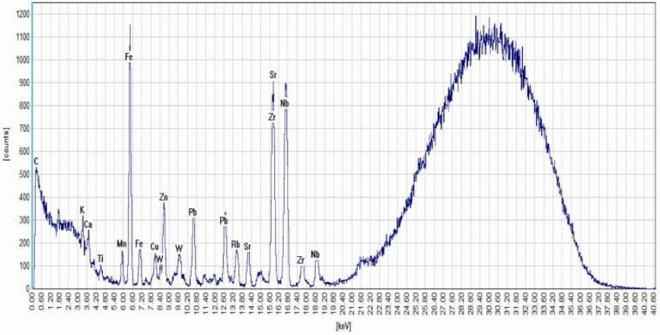
Rice husk (RH), an abundant agricultural by-product obtained during rice milling, has attracted increasing attention due to its potential applications in agriculture, environmental remediation, and industrial production. However, its elemental composition may change depending on environmental conditions, cultivation practices, and processing methods, leading to the possible contamination with toxic heavy metals that pose environmental and health concerns. This study investigated the elemental composition of rice husk obtained from Darma Rice Mill, Katsina State, Nigeria, using Energy Dispersive X-ray Fluorescence (EDXRF) spectroscopy. The rice husk samples were collected, prepared, and analyzed to determine the concentration of major and trace elements. The results revealed the presence of several elements at varying concentrations, with silicon (Si) identified as the dominant beneficial element due to the naturally siliceous nature of rice husk. Other essential elements such as potassium (K), calcium (Ca), iron (Fe), sulfur (S), and aluminum (Al) were also detected. However, lead (Pb) recorded an exceptionally high concentration and exceeded the permissible limits recommended by the World Health Organization (WHO) and the Food and Agriculture Organization (FAO), indicating possible environmental contamination. Trace elements including niobium (Nb), tungsten (W), tin (Sn), tantalum (Ta), nickel (Ni), copper (Cu), and zinc (Zn) were detected at relatively low concentrations. The findings highlight the potential environmental and public health risks associated with improper reuse or disposal of contaminated rice husk and emphasize the need for continuous monitoring, proper management, and treatment strategies to minimize heavy metal contamination.
References
Adamu, M. H., & Salihi, I. U. (2025). Characterization of Rice Husk for Use in Environmental Remediation: A Multi-Technique Analytical Study. Journal of Materials Engineering, Structures and Computation, 4(3), 138–146.https://doi.org/10.5281/%20zenodo.16996839.
Adamu, . D. G. K., Dankawu , . U. M., Maharaz, . . M. N., Chifu, . E. N., Zarma, . S. S., Silkwa, . N. W., & Ahmadu, . M. (2023). Evaluation of Chemical Compositions of Rice Husk from Local Rice Species Using X-RAY Fluorescence Technique. FUDMA Journal of Sciences, 7(4), 82-89. https://doi.org/10.33003/fjs-2023-0704-1777.
Ayinde, A. R., & Bello, T. (2025). Characterization of rice husk ash obtained from five rice producing companies in Nigeria. In Recent advances in materials and engineering research, 1–10. https://doi.org/10.21741/9781644903537-2
Bello, S., Nasiru, R., Garba, N. N., & Adeyemo, D. J. (2019). Carcinogenic and Non-Carcinogenic Health Risk Assessment of Heavy Metals Exposure from Shanono and Bagwai Artisanal Gold Mines, Kano State, Nigeria. Scientific African, 6, e00197. https://doi.org/10.1016/j.sciaf.2019.e00197.
Bodie, A. R., Micciche, A. C., Atungulu, G. G., Rothrock Jr, M. J., & Ricke, S. C. (2019). Current Trends of Rice Milling Byproducts for Agricultural Applications and Alternative Food Production Systems. Frontiers in Sustainable Food Systems, 3, 1-13. https://doi.org/10.3389/fsufs.2019.00047.
Collin, M. S., Venkatraman, S. K., Vijayakumar, N., Kanimozhi, V., Arbaaz, S. M., Stacey, R. G. S., ... & Anusha, J. (2022). Bioaccumulation of Lead (Pb) and Its Effects on Human: A Review. Journal of Hazardous Materials Advances, 7, 100094. https://doi.org/10.1016/j.hazadv.2022.100094.
FAO/WHO. (2025). Ad Hoc FAO/WHO Expert Meeting on Water Quality in Agrifood Systems and Food Safety Implications.
Flora, G., Gupta, D., & Tiwari, A. (2012). Toxicity of Lead: A Review with Recent Updates. Interdisciplinary Toxicology, 5(2), 47-58. https://doi.org/10.2478/v10102-012-0009-2.
Gaima, A. D., Dankawu, U. M., Zarma, S. S., Abdullahi, A. G., Ndikilar, C. E., Emmanuel, I. T., & Musa, A. (2022). Assessment of Chemical Composition of Rice Husk Using Energy Dispersive X-Ray Fluorescence Technique from Kano State, North Western Nigeria. The International Journal of Science & Technolege, 10(4), 31-36. https://doi.org/10.24940/theijst/2022/v10/i4/st2204-005.
Gupta, A., Priyanka K., & Vinita S. (2025). “Physical, Chemical Composition and Morphological Analysis of Rice Husk Reinforced Epoxy Composites.” Oxford Open Materials Science 5(1). https://doi.org/10.1093/oxfmat/itaf012.
Handbook of Practical X-Ray Fluorescence Analysis. (2006). Springer. https://doi.org/10.1007/978-3-540-36722-2.
Idris, A., Kimpa, M. I., Mustapha, R., & Abubakar, A. A. (2024). Analysis of Morphological and Elemental Composition in Rice, Beans, and Groundnut Husk. Nigerian Journal of Physics, 33(2), 16-21. https://doi.org/10.62292/njp.v33i2.2024.224.
Igwebike-ossi, C. D. (2017). Elemental Analysis of Rice Husk Using Proton-Induced X-Ray Emission (Pixe) Spectrometry. Journal of Applied Sciences and Environmental Management, 13(4), 801-811.
Islam, M. T., Hossen, M. F., Asraf, M. A., Kudrat-E-Zahan, M., & Zakaria, C. M. (2024). Production and Characterization of Silica from Rice Husk: An Updated Review. Asian Journal of Chemical Sciences, 14(2), 83-96. https://doi.org/10.9734/ajocs/2024/v14i2296.
Nathan, Abutu A., Hile D. Donald, and Ochang Micheal. 2016. “Exploring the Silicon Composition of Rice Husk Ash and Clay Soil Along River Niger-Lokoja, Nigeria”. Journal of Scientific Research and Reports 11 (6):1-7. https://doi.org/10.9734/JSRR/2016/27541.
Nnadiukwu, B. C., Okafor, C. C., Nwosu, P. I., & Okafor, C. N. (2023). Tropical Journal of Natural Product Research, 7(2), 1-8. https://doi.org/10.26538/tjnpr/v7i2.24.
Odesina. A. (2008). Essential Chemistry for Senior Secondary Schools. Ogun State: Tonad Publishers Limited, 30
Singh, B. (2018). Rice Husk Ash. In Waste and Supplementary Cementitious Materials in Concrete (pp. 417-460). Woodhead Publishing.
Taiwo, A. M., Adenekan, A. A., Olatunde, K. A., Oladoyinbo, F. O., & Oyedepo, J. A. (2024). Assessment of Potentially Toxic Metals in Selected Local and Foreign Rice Brands from Southwestern Nigeria: Implications for Human Health. Journal of Food Composition and Analysis, 133, 106428. https://doi.org/10.1016/j.jfca.2024.106428.
Yuan, S., Hou, Y., Liu, S., & Ma, Y. (2024). A Comparative Study on Rice Husk, as Agricultural Waste, in the Production of Silica Nanoparticles via Different Methods. Materials, 17(6), 1-11. https://doi.org/10.3390/ma17061271.
Downloads
Published
Issue
Section
License
Copyright (c) 2026 Abdullahi Tanimu, Naziru Saminu, Shamsuddeen Sani Alhassan (Author)

This work is licensed under a Creative Commons Attribution-NonCommercial 4.0 International License.
- Attribution — You must give appropriate credit, provide a link to the license, and indicate if changes were made. You may do so in any reasonable manner, but not in any way that suggests the licensor endorses you or your use.
- NonCommercial — You may not use the material for commercial purposes.
- No additional restrictions — You may not apply legal terms or technological measures that legally restrict others from doing anything the license permits.