
A Detection System for Varicella Zoster using Random Multimodel Deep Learning Technique
DOI:
https://doi.org/10.70882/josrar.2026.v3i5.185Keywords:
Varicella Zoster Virus, Infections, Diagnosis, Random Multimodel Deep LearningAbstract
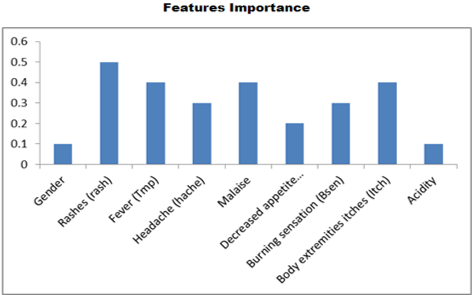
Varicella Zoster Virus (VZV) infections require precise diagnosis for effective management. This study utilizes Random Multimodel Deep Learning (RMDL) to identify VZV infections based on WHO standard clinical features, including fever, rash, headache, malaise, itch, acidity, and decreased appetite. The RMDL model demonstrated exceptional performance, achieving 99.9% accuracy, 98% precision, and 99% specificity. The RMDL model’s capacity to capture intricate relationships between features enhances diagnostic accuracy, underscoring its potential as a reliable tool for developing diagnostic systems for VZV infections. The findings have significant implications for clinical practice and public health, and future research may investigate the use of additional datasets and hybrid models to further improve diagnostic capabilities.
References
Alvarez, J. L., Smith, R. D., & Patel, K. (2022). Transfer learning for dermatological image classification in resource-limited settings. Journal of Medical Imaging and Health Sciences, 9(2), 45–53. https://doi.org/10.1016/j.jmihi.2022.02.004
Baracco, G. J., Eisert, S., Saavedra, S., Hirsch, P., Marin, M., & Ortega-Sanchez, I. R. (2019). Clinical and economic impact of various strategies for varicella immunity screening and vaccination of health care personnel. American Journal of Infection Control, 47 (10), 1053–1060. https://doi.org/10.1016/j.ajic.2019.03.024
Bejan, C. A., Xia, F., Yetisgen, M., & South, B. R. (2020). Automating discharge summary documentation with machine learning. Journal of the American Medical Informatics Association, 27(2), 237–245. https://doi.org/10.1093/jamia/ocz194
Bialek, S. R., Perella, D., Zhang, J., Mascola, L., & Vitek, C. R. (2020). Impact of a routine two-dose varicella vaccination program on varicella epidemiology. Pediatrics, 145 (1), e20191657. https://doi.org/10.1542/peds.2019-1657
Bugaje, M. A., Yusuf, H., Abdulkadir, I., & Ahmed, A. A. (2021). Seroprevalence of Varicella Zoster Virus infection among primary school children in Northern Nigeria. Nigerian Journal of Paediatrics, 48(4), 212–218. https://doi.org/10.4314/njp.v48i4.5
Centers for Disease Control and Prevention. (2018). Guidelines for evaluating public health surveillance systems. https://www.cdc.gov/mmwr/preview/mmwrhtml/00051458.htm
Centers for Disease Control and Prevention. (2020). Varicella (chickenpox) surveillance. https://www.cdc.gov/chickenpox/surveillance/index.html
Centers for Disease Control and Prevention. (2023). Clinical overview of varicella-zoster virus. https://www.cdc.gov/chickenpox/hcp/clinical-overview.html. Accessed 25th April, 2025.
Chae, S., Kwon, S., & Lee, D. (2018). Predicting infectious disease using deep learning and big data. International Journal of Environmental Research and Public Health, 15(5), 899. https://doi.org/10.3390/ijerph15050899 . Accessed 25th April, 2025.
Chaves, S. S., Zhang, J., Civen, R., Watson, B. M., Carbajal, T., & Perella, D. (2019). Varicella disease among vaccinated persons: Clinical and epidemiological characteristics, 1995–2005. Journal of Infectious Diseases, 200 (2), 389–395. https://doi.org/10.1086/644649
Gershon, A. A., & Gershon, M. D. (2022). Varicella-zoster virus: Virology and clinical manifestations. In D. L. Kasper & A. S. Fauci (Eds.), Harrison’s principles of internal medicine 21, 1392–1398. McGraw-Hill.
Heidarysafa, M., Kowsari, K., Brown, D. E., Jafari, M., & Barnes, L. E. (2018). RMDL: Random Multimodel Deep Learning for classification. arXiv. https://arxiv.org/abs/1805.01890 . accessed 12th May, 2025
Kim, Y. J., Lee, C. N., & Kim, Y. E. (2020). Clinical characteristics of varicella-zoster virus infection in Korean adults. Journal of Korean Medical Science, 35(15), e101. https://doi.org/10.3346/jkms.2020.35.e101
Kimberly, W., Roberts, C., & Ganesan, V. (2020). Detecting varicella rash using deep convolutional neural networks. Journal of Medical Imaging, 7(4), 044502. https://doi.org/10.1117/1.JMI.7.4.044502
Lee, B. R., Feikema, S. M., & LeBaron, C. W. (2019). Evaluation of the effectiveness of varicella vaccination. Pediatrics, 103(5), e65. https://doi.org/10.1542/peds.103.5.e65
Mendoza, L., Waterfield, K., & Hall, C. B. (2021). Complications of varicella-zoster virus infection in immunocompromised patients. Clinical Microbiology Reviews, 34(2), e00034-20. https://doi.org/10.1128/CMR.00034-20
Peiffer-Smadja, N., Rawson, T. M., Ahmad, R., Buchard, A., Georgiou, P., Lescure, F. X., Birgand, G., & Holmes, A. H. (2020). Machine learning for clinical decision support in infectious diseases: A narrative review of current applications. Clinical Microbiology and Infection, 26(5), 584–595. https://doi.org/10.1016/j.cmi.2019.09.009
Sangwon, L., Kim, H., & Park, S. (2018). Anticipating infectious disease outbreaks using deep learning and big data. Journal of Infection Prevention, 19(5), 172–179. https://doi.org/10.1177/1757177418776123
Sharma, M., Jain, B., Kargeti, C., Gupta, V., & Gupta, D. (2020). Detection and diagnosis of skin diseases using Residual Neural Networks (ResNet). International Journal of Image and Graphics, 21(3), 2140002. https://doi.org/10.1142/S0219467821400027
World Health Organization (2018). Varicella and herpes zoster vaccines. https://www.who.int/publications/m/item/vaccine-preventable-diseases-surveillance-standards-varicella. Acceased 26th April, 2025.
Downloads
Published
Issue
Section
Categories
License
Copyright (c) 2026 Abraham E. Evwiekpaefe, Fiyinfoluwa Ajakaiye, Mishael Y. Didam, Rimamtari D. Nyatse, Biniya Ma’aruf (Author)

This work is licensed under a Creative Commons Attribution-NonCommercial 4.0 International License.
- Attribution — You must give appropriate credit, provide a link to the license, and indicate if changes were made. You may do so in any reasonable manner, but not in any way that suggests the licensor endorses you or your use.
- NonCommercial — You may not use the material for commercial purposes.
- No additional restrictions — You may not apply legal terms or technological measures that legally restrict others from doing anything the license permits.