
A Deep Learning Architecture for Smart Fish Farm Management and Early Mortality Prediction
DOI:
https://doi.org/10.70882/josrar.2026.v3i4.123Keywords:
Aquaculture, Artificial Intelligence, Deep Reinforcement Learning, Internet of Things (IoT), Smart Fish FarmingAbstract
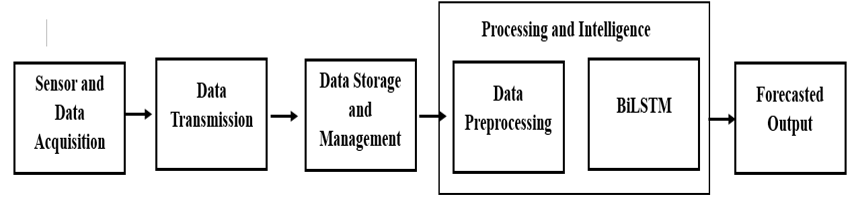
The rapid growth of aquaculture has intensified the need for intelligent, data-driven systems capable of improving fish farm productivity, sustainability, and operational efficiency. Traditional manual management approaches remain limited by labor intensity, inconsistent monitoring, and delayed decision-making, especially in dynamic aquatic environments. This study presents a Deep Learning–based Fish Farming Management System that integrates Internet of Things (IoT) sensing technologies with a Bidirectional Long Short-Term Memory (BiLSTM) network to provide real-time monitoring, predictive analytics, and intelligent decision support. IoT-enabled sensors continuously capture water quality and behavioral parameters, which are transmitted to a centralized data-processing architecture for storage, analysis, and automated alerts. The BiLSTM model primarily focuses on fish mortality classification, where it analyzes temporal patterns in environmental and behavioral data to predict mortality risk with high reliability. In addition, the system supports auxiliary predictive and recommendation functions, including anomaly detection and rule-assisted recommendations for feeding, aeration, and environmental adjustments, which are derived from learned temporal trends and domain constraints rather than independently optimized predictive models. Experimental results for the mortality classification task demonstrate outstanding performance, with the model achieving 96.55% accuracy, 96.97% precision, 96.67% recall, a Cohen’s Kappa score of 0.9482, and an average AUC of 0.9947, significantly outperforming benchmark models.
References
Abid, M., Rahman, A., Hussain, S., & Khan, F. (2024). Smart biofloc monitoring system using IoT and machine learning for sustainable aquaculture. Aquacultural Engineering, 104, 102381.
Capetillo-Contreras, J., Martínez-Cruz, A. L., & Rivas-Araiza, E. (2024). Artificial intelligence approaches for water quality optimization in aquaculture: A systematic review. Environmental Monitoring and Assessment, 196(3), 1–19.
Çakir, M., Yildiz, O., & Aydin, I. (2023). Performance evaluation of machine learning classifiers for aquaculture applications. Computers and Electronics in Agriculture, 206, 107642.
Chahid, A., El Hassani, A. H., & Benazzi, A. (2022). Reinforcement learning-based fish growth monitoring in intelligent aquaculture systems. Applied Artificial Intelligence, 36(1), 1–17.
Chen, Y., Zhang, H., & Wang, X. (2022). Deep learning-based underwater anomaly detection for aquaculture surveillance. Ocean Engineering, 245, 110456.
Chiu, M. C., Tsai, C. Y., & Lin, T. T. (2022). Smart aquaculture management using IoT and AI-based surrogate models with Bayesian optimization. Biosystems Engineering, 219, 1–15.
Dhinakaran, R., Gopalakrishnan, S., Kumar, M., & Prakash, N. (2023). IoT-enabled environmental control system with machine learning for fish farming. Journal of Ambient Intelligence and Humanized Computing, 14(4), 3897–3910.
Gladju, R. J., Kamalam, G. M., & Kanagaraj, M. (2022). Applications of artificial intelligence and machine learning in fisheries and aquaculture: A review. Aquaculture International, 30(3), 1231–1252.
Hemal, S., Patel, R., & Shah, K. (2024). Aquabot: An AI-powered recommendation system for intelligent fish farming. Expert Systems with Applications, 236, 121384.
Howarth, J., Ellis, T., & Turnbull, J. F. (2025). A decision support system for mortality risk prediction in aquaculture using generalized linear models. Aquaculture, 575, 739833.
Hu, J., Li, D., & Zhao, Y. (2022). Vision-based intelligent feeding system for aquaculture using convolutional neural networks. Computers and Electronics in Agriculture, 193, 106645.
Isaac, S., Lass, B. T., Isiaka, T. M., Bello, U. M., & Peter, M. (2023). Deep Learning Networks for Simultaneous Multiple Crude Oil Price Predictions.
Islam, M. S., Rahman, M. M., & Hasan, M. A. (2023). IoT and machine learning-based prediction of fish species survival in aquaculture. Sensors, 23(7), 3479.
Kaur, H., Singh, R., & Gill, S. S. (2023). Deep learning for precision aquaculture: Techniques, applications, and challenges. Artificial Intelligence Review, 56(2), 1453–1492.
Khan, M. A., & Byun, Y. C. (2023). Hybrid genetic algorithm and ensemble learning model for dissolved oxygen prediction in aquaculture. Applied Soft Computing, 132, 109870.
Kristmundsson, Á., Jónsson, B., & Sigurðsson, S. (2023). Fish activity monitoring using multibeam echosounders and machine learning. ICES Journal of Marine Science, 80(5), 1421–1432.
Lan, Y., Sun, M., & Zhang, Q. (2022). Digital twin-driven smart aquaculture: Architecture and applications. IEEE Access, 10, 104321–104334.
Li, D., & Du, Q. (2022). Deep learning for fish detection and classification in aquaculture using convolutional neural networks. Aquacultural Engineering, 96, 102196.
Li, X., Wang, Y., & Liu, H. (2022). Machine learning approaches for water quality prediction in aquaculture systems. Environmental Science and Pollution Research, 29(24), 36421–36435.
Lim, J. S. (2024). Artificial intelligence, robotics, and big data for autonomous aquaculture systems. Aquaculture Reports, 29, 101489.
Liu, Z., Chen, W., & Yang, X. (2022). Real-time fish locomotion detection using YOLO-based deep learning models. Pattern Recognition Letters, 158, 11–18.
López-Barajas, M., Pérez, J., & Ruiz, I. (2023). Automated fish net inspection using deep learning-based image analysis. Ocean Engineering, 266, 113142.
Mandal, S., & Ghosh, S. (2024). Artificial intelligence for sustainable aquaculture: A comprehensive review. Sustainable Computing: Informatics and Systems, 41, 100946.
Nazmi, A., Rahman, M. M., & Hossain, M. A. (2023). Comparative analysis of machine learning and statistical models for marine fish production forecasting. Marine Policy, 148, 105403.
Shreesha, K. S., Ramesh, B., & Kumar, V. (2023). Deep learning-based fish behavior recognition for intelligent aquaculture. Neural Computing and Applications, 35(8), 5671–5685.
Sung, W. T., Chang, C. L., & Lee, C. Y. (2023). Intelligent aquaculture monitoring using deep learning and data fusion techniques. IEEE Sensors Journal, 23(4), 3711–3722.
Ubina, N., Cruz, J. P., & dela Cruz, R. (2023). AIoT-based digital twin framework for intelligent fish farming. Future Internet, 15(6), 198.
Xi, L., Zhang, Y., & Chen, H. (2023). Smart prawn farm management using wearable devices and machine learning. Computers and Electronics in Agriculture, 205, 107565.
Downloads
Published
Issue
Section
License
Copyright (c) 2026 Samson Isaac, Barna Thomas Lass, Ebi-Okan Akpakoro, Rukayyat Bala, Basil Omojo Abalaka (Author)

This work is licensed under a Creative Commons Attribution-NonCommercial 4.0 International License.
- Attribution — You must give appropriate credit, provide a link to the license, and indicate if changes were made. You may do so in any reasonable manner, but not in any way that suggests the licensor endorses you or your use.
- NonCommercial — You may not use the material for commercial purposes.
- No additional restrictions — You may not apply legal terms or technological measures that legally restrict others from doing anything the license permits.