
Fractional-Order Mathematical Modeling of HIV/AIDS Transmission Dynamics via a Generalized Adams–Bashforth–Moulton Numerical Scheme
DOI:
https://doi.org/10.70882/josrar.2026.v3i3.198Keywords:
HIV/AIDs, Fractional, Adam-Bashforth-Moulton, Transmission, Control, StrategiesAbstract
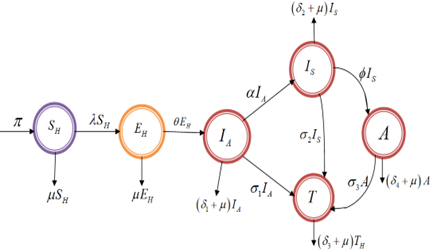
HIV/AIDS remains one of the major global public health challenges due to its high transmission rate, long-term health complications, and socio-economic impact on affected populations. Despite several intervention strategies, the disease continues to spread, particularly in regions with inadequate access to treatment and preventive measures. Motivated by the need to better understand the transmission dynamics of HIV/AIDS and the impact of treatment strategies, this paper focuses on the dynamics of HIV/AIDS transmission using a fractional-order mathematical model to assess the effect of treatment and contact rates on HIV/AIDS. The model presents the existence and uniqueness of the solution in the fractional-order sense, demonstrating the well-posedness of the model. The model's stability is analysed to understand the dynamics of the disease, including the basic reproduction number. These findings show treatment rates of exposed, asymptomatic, and symptomatic individuals play a critical role in reducing the reproduction number below one, implying control of the disease, whereas contact rates increase disease transmission and maintain the disease's presence. Sensitivity and simulation analyses show that transmission-related parameters have a positive impact on disease transmission, while treatment-related parameters have a negative sensitivity, leading to a reduction in the disease burden. The dynamics of population states for different treatment and contact rates are discussed using the fractional Adams–Bashforth–Moulton numerical scheme. Further contour and surface plots reveal that increased treatment and lower contact rates result in a significant reduction in the HIV/AIDS incidence, while poor control measures and increased contact rates increase the infection. The results highlight that early treatment of exposed individuals and treatment of infected individuals (asymptomatic and symptomatic) are key to reducing the disease burden. In summary, the study underlines the need for effective control measures incorporating treatment expansion and reduction in transmission pathways for the successful control and possible eradication of HIV/AIDS in the population.
References
Abah E., Bolaji B., Atokolo W., Amos J., Acheneje G.O., Omede B.I, Amos J., Omeje D. (2024), Fractional mathematical model for the Transmission Dynamics and control of Diphtheria, International Journal of mathematical Analysis and Modelling, Vol.7, ISSN:2682-5694.
Abro K., A. Atangana, J.F. Gómez-Aguilar, (2021) An analytic study of bio heat transfer Pennes model via modern non-integers differential techniques, Eur. Phys. J. Plus 136 http://dx.doi.org/10.1140/epjp/s13360-021-02136-x.
Agahiu, N., Bolaji B., Acheneje, G. O., & Atokolo W (2024). Approximate solution of fractional order mathematical model on the co-transmission of Zika and Chikungunya virus using Laplace-Adomian decomposition Method. Int. J. Mathematics. 07(03), 47-81.
Ahmed, I., Goufo, E.F.D., Yusuf, A., Kumam, P., Chaipanya, P., & Nonlaopon, K. (2021). "An epidemic prediction from analysis of a combined HIV-COVID-19 co-infection model via ABC fractional operator." Alexandria Engineering Journal, 60(3), pp. 2979–2995.
Ali Z., Zada A., Shah K., (2017) Existence and stability analysis of three point boundary value problem, Int. J. Appl. Comput. Math. 3 651–664, http://dx.doi. org/10.1007/s40819-017-0375-8.
Ameh, P.O., Omede, B.I, & Bolaji.B. (2020). Dynamical analysis of a two strain treatment model for Anthrax in a population where it is deployed as bio-terrorism weapon. Journal of the Nigerian Society for Mathematical Biology. Volume 3, pp. 34 – 77.
Amos, J., Omale, D., Atokolo, W., Abah, E. Omede, B. I., Acheneje, G. O., Bolaji, B. (2024). Fractional mathematical model for the Transmission Dynamics and control of Hepatitis C, FUDMA Journal of Sciences, Vol.8, No.5, pp.451-463, DOI: https://doi.org/10.33003/fjs-2024-0805-2883.
Atokolo, W., Aja, R. O., Aniaku, S. E., Onah, I. S., & Mbah, G.C. (2022). "Approximate solution of the fractional order sterile insect technology model via the Laplace-Adomian Decomposition Method for the spread of Zika virus disease," International Journal of Mathematics and Mathematical Sciences, 2022(1), Article 2297630.
Atokolo, W.A., Remigius Aja, O., Omale, D., Ahman, Q. O., Acheneje, G.O., Amos, J. (2024). "Fractional mathematical model for the transmission dynamics and control of Lassa fever," Journal of Fractional Calculus and Applied Mathematics, 2773-1863, DOI: https://doi.org/10.1016/j.fraope.2024.100110
Atokolo, W.A., Remigius Aja, O., Omale, D., Paul, R.V., Amos, J., Ocha, S.O. (2023), "Mathematical modeling of the spread of vector-borne diseases with influence of vertical transmission and preventive strategies," FUDMA Journal of Sciences, Vol. 7, No. 6 (Special Issue), pp. 75–91, https://doi.org/10.33003/fjs-2023-0706-2174.
Baskonus. H.M., Bulut H., (2015) on the numerical solutions of some fractional ordinary differential equations by fractional Adams Bashforth-Moulton Method, Open Math. 13 1.
Bolaji B., Ani F., Omede, B. I, Acheneje, G. O, Ibrahim A. (2024). A model for the control of transmission dynamics of human Monkeypox disease in sub-Saharan Africa. J. Nig. Soc. Phys. Sci. 6 1800. Available online at: https://journal.nsps.org.ng/index.php/jnsps -
Bolaji, B, Odionyenma U. B., Omede B. I., Ojih, P., and Abdullahi, B., Ibrahim, A. (2023). Modelling the transmission dynamics of Omicron variant of COVID-19 in densely populated city of Lagos in Nigeria, J. Nig. Soc. Phys. Sci. 5 1055. Available online at: https://journal.nsps.org.ng/index.php/jnsps -
Chen, Y., Wong, K., & Zhao, L. (2023). "Modeling the impact of vaccination strategies on hepatitis C and COVID-19 coinfection dynamics." Journal of Vaccine, 41(15), pp. 2897–2905.
Chikaki, E., Ishikawa, H. (2009), "A Dengue transmission model in Thailand considering sequential infections with all four serotypes," J. Infect. Dev. Ctries., 3(9), pp. 711–722.
Das, R., Patel, S., & Kumar, A. (2024), "Mathematical modeling of hepatitis C and COVID-19 coinfection in low- and middle-income countries: challenges and opportunities," BMC Public Health, 24(1), pp. 587.
Diethelm, K. (1999). The Frac PECE subroutine for the numerical solution of differential equations of fractional order.
Jalija .E, Amos .J, Atokolo, W., Omale .D.Abah . U.Alih.U, P.A.Alabi, and BolajiB. (2025) Numerical investigations on Dengue fever model through singular and non-singular fractional operators. International Journal of Mathematical Analysis and Modelling (2025) 8(1):216-242
Emmanuel, L., Omale, D., Atokolo, W., Amos, J., Abah, E., Ojonimi, A., Onoja, T., Acheneje, G., & Bolaji, B. (2025). Fractional mathematical model for the dynamics of pneumonia transmission with control using fixed point theory. GPH-International Journal of Mathematics, 8(5), 55-86. https://doi.org/10.5281/zenodo.16364036.
Jalija .E., Amos .J., Atokolo ,W., Abah .E., Agbata B.C.,Acheneje G.O, Shyamsunder, Bolarinwa Bolaji (2025), Numerical solution of fractional order typhoid fever model via the generalized fractional Adams-Bashforth-Moulton approach. Network Modeling Analysis in Health Informatics and Bioinformatics (2026) 15:68 https://doi.org/10.1007/s13721-026-00743-1.
Odiba P. O, Acheneje, G. O, Bolaji B. (2024). A compartmental deterministic epidemiological model with non-linear differential equations for analysing the co-infection dynamics between COVID-19, HIV, and Monkeypox diseases. Healthcare Analytics, 5 100311. Available online at: https://doi.org/10.1016/j.health.2024.100311 .
Ojonimi A.A., Amos J., Atokolo W., Omale D., Emmanuel L.M., Abah E., Acheneje G.O., Bolaji B. Numerical solution of fractional order Hepatitis B model via the generalized fractional Adams–Bashforth–Moulton approach. Journal of Science Research and Reviews 2(5) (2025) 33–48. https://doi.org/10.70882/josrar.2025.v2i5.119.
Omale, D., Atokolo, W., .Akpa, M., (2020). Global stability and sensitivity analysis of transmission dynamics of tuberculosis and its control, A case study of Ika general hospital Ankpa, Kogi State, Nigeria. Acad. J. Stat. Math. 6, 5730-7151.
Omale, D., Ojih, P., Atokolo, W., Omale, A., Bolaji.B. (2021), Mathematical model for transmission dynamics of HIV and Tuberculosis co-infection in Kogi State, Nigeria. Journal of Mathematical Computational Science. 11, No. 5, 5580-5613. Available online at: https://doi.org/10.28919/jmcs/6080.
Omame, A.M., Abbas, M., Onyenegecha, C.P. (2022), "A fractional order model for the co-interaction of COVID-19 and hepatitis B virus." Journal of Mathematical Biology, pp. 112–118.
Omede, B. I., Bolarinwa Bolaji, Olumuyiwa, P. J., Ibrahim, A. A. and Oguntolu F. A (2023). Mathematical analysis on the vertical and horizontal transmission dynamics of HIV and Zika virus co-infection. Franklin open 6 100064. https://doi.org/10.1016/j.fraope.2023.100064. -
Omede, B. I., Olumuyiwa, P. J., Atokolo, W., Bolaji, B. & Ayoola, T. A. (2023). A mathematical analysis of the two-strain tuberculosis model dynamics with exogenous re-infection. Healthcare Analytics 4, 100266. https://doi.org/10.1016/j.health.2023.100266 –
Omede, B.I., Israel, M., Mustapha, M. K., Amos, J., Atokolo, W., & Oguntolu, F. A. (2024). "Approximate solution to the fractional soil-transmitted helminth infection model using Laplace-Adomian Decomposition Method," International Journal of Mathematics, 07(04), pp. 16–40.
Omonu, G. U., Ameh, P.O., Omede, B.I, & Bolaji.B (2019), Mathematical modelling of Tuta Absoluta on Tomato plants. Journal of the Nigerian Society for Mathematical Biology. 2(1): 14-31.
Philip J., Omale D., Atokolo W., Amos J., Acheneje G.O., Bolaji B. (2024), Fractional mathematical model for the Transmission Dynamics and control of HIV/AIDs, FUDMA Journal of Sciences, Vol.8, No.6, pp.451-463, https://doi.org/10.33003/fjs-2024-0805-2883.
Smith, J., Johnson, A.B., & Lee, C. (2023), "Modeling the coinfection dynamics of hepatitis C and COVID-19: A systematic review," Journal of Epidemiology and Infection, 151(7), pp. 1350–1365.
Udoka, B. O., Nometa, I. & Bolaji, B. (2023). Analysis of a model to control the co-dynamics of Chlamydia and Gonorrhea using Caputo fractional derivative. Mathematical Modelling and Numerical Simulation with Applications, 2023, 3(2), 111–140. Available online at: https://doi.org/10.53391/mmnsa.1320175 -
Ullah, A. Abdeljawad Z., Hammouch T. Z., Shah K. (2020). "A hybrid method for solving fuzzy Volterra integral equations of separable type kernels," Journal of King Saud University - Science, 33, https://doi.org/10.1016/j.jksus.2020.101246.
Yunus, A.O, M.O. Olayiwola, M.A. Omolaye, A.O. Oladapo, (2023). A fractional order model of lassa fever disease using the Laplace-Adomian decomposition method, Health Care Anal. 3 100167, www.elsevier.com/locate/health. Health Care Analytics.
Zhang, R. M. Li, (2022) bilinear residual network method for solving the exactly explicit solutions of nonlinear evolution equations, Nonlinear Dynam. 108 http://dx.doi.org/10.1007/s11071-022-07207-x.
Zhang, R.F., Li, M.-C., J.Y. Gan, Q. Li, Z.-Z. Lan, (2022). Novel trial functions and rogue waves of generalized breaking soliton equation via bilinear neural network method, Chaos Solitons Fractals 154
Downloads
Published
Issue
Section
License
Copyright (c) 2026 Enejoh Jalija, Jeremiah Amos, David Omale, William Atokolo, Emmanuel Abah, Johnson Juwon Orugun, Bolarinwa Bolaji (Author)

This work is licensed under a Creative Commons Attribution-NonCommercial 4.0 International License.
- Attribution — You must give appropriate credit, provide a link to the license, and indicate if changes were made. You may do so in any reasonable manner, but not in any way that suggests the licensor endorses you or your use.
- NonCommercial — You may not use the material for commercial purposes.
- No additional restrictions — You may not apply legal terms or technological measures that legally restrict others from doing anything the license permits.