
Mechanistic Evaluation of the Antidiabetic Potential of Newbouldia laevis: Evidence from Phytochemical Profiling and Enzyme Inhibition Studies
DOI:
https://doi.org/10.70882/josrar.2026.v3i2.179Keywords:
α-Amylase inhibition, α-Glucosidase inhibition, Antidiabetic activity, Medicinal plants, Oxidative stress, PhytochemicalsAbstract
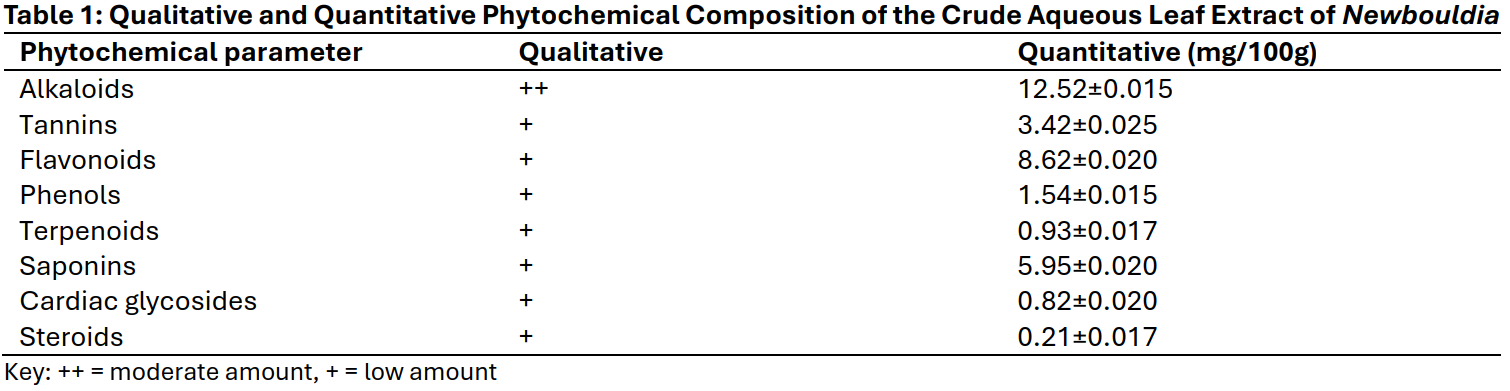
Newbouldia laevis is widely utilized in traditional medicine for the management of metabolic and inflammatory disorders; however, its pharmacological properties require scientific validation. This study evaluated the phytochemical composition and in vitro antioxidant, anti-inflammatory, and antidiabetic activities of the crude aqueous leaf extract of Newbouldia laevis. Standard phytochemical screening methods and spectrophotometric assays, including DPPH, nitric oxide scavenging, ferric reducing antioxidant power (FRAP), protein denaturation, proteinase inhibition, α-amylase, and α-glucosidase inhibition assays, were employed, with IC₅₀ values determined. The extract contained alkaloids (12.52 mg/100 g) in moderate amounts and lower levels of flavonoids (8.62 mg/100 g), saponins (5.95 mg/100 g), tannins (3.42 mg/100 g), phenols, terpenoids, cardiac glycosides, and steroids. It exhibited notable antioxidant activity in DPPH (IC₅₀ = 6.33 µg/ml) and FRAP (IC₅₀ = 7.73 µg/ml) assays, indicating high radical scavenging and reducing capacity comparable to ascorbic acid/BHT under similar conditions, alongside moderate nitric oxide scavenging (IC₅₀ = 28.45 µg/ml), and anti-inflammatory activities. The extract also demonstrated notable α-amylase (IC₅₀ = 9.29 µg/ml) and α-glucosidase inhibition (IC₅₀ = 17.88 µg/ml); however, it exhibited lower potency than acarbose, with approximately 3-fold and 2.8-fold higher IC₅₀ values for α-amylase (9.29 vs. 3.17 µg/ml) and α-glucosidase (17.88 vs. 6.37 µg/ml), respectively. These findings suggest that the extract could possess multi-target bioactivity mediated by its phytochemical constituents. It may be concluded that Newbouldia laevis has significant therapeutic potential; therefore, further in vivo studies and isolation of active compounds are recommended, contributing novel evidence to its pharmacological validation
References
Alqahtani, A. S., Hidayathulla, S., Rehman, M. T., ElGamal, A. A., Al-Massarani, S., Razmovski-Naumovski, V., Alqahtani, M. S., El Dib, R. A., & AlAjmi, M. F. (2019). Alpha-amylase and alpha-glucosidase enzyme inhibition and antioxidant potential of 3-oxolupenal and katononic acid isolated from Nuxia oppositifolia. Biomolecules, 10(1), 61. https://doi.org/10.3390/biom10010061
Ansari, P., Khan, J. T., Chowdhury, S., Reberio, A. D., Kumar, S., Seidel, V., Abdel-Wahab, Y. H. A., & Flatt, P. R. (2024). Plant-based diets and phytochemicals in the management of diabetes mellitus and prevention of its complications: A review. Nutrients, 16(21), 3709. https://doi.org/10.3390/nu16213709
Antar, S. A., Ashour, N. A., Sharaky, M., Khattab, M., Ashour, N. A., Zaid, R. T., Roh, E. J., Elkamhawy, A., & Al-Karmalawy, A. A. (2023). Diabetes mellitus: Classification, mediators, and complications: A gate to identify potential targets for the development of new effective treatments. Biomedicine & Pharmacotherapy, 168, 115734. https://doi.org/10.1016/j.biopha.2023.115734
Benzie, I. F. F., & Strain, J. J. (1996). The ferric reducing ability of plasma (FRAP) as a measure of antioxidant power: The FRAP assay. Analytical Biochemistry, 239, 70–76.
Bray, G. A., & Greenway, F. L. (1999). Pharmacological treatment of the overweight patient. Endocrine Reviews, 20, 805–775.
Chandimali, N., Bak, S. G., Park, E. H., Lim, H.-J., Won, Y.-S., Kim, E.-K., Park, S.-I., & Lee, S. J. (2025). Free radicals and their impact on health and antioxidant defenses: A review. Cell Death Discovery, 11, 19. https://doi.org/10.1038/s41420-024-02278-8
Du, C., & Zhao, Z. (2025). Characteristic analysis of adverse reactions to natural and synthetic alpha-glucosidase inhibitors: A descriptive analysis using World Health Organisation–VigiAccess. Journal of Chromatography B, 1267, 124800. https://doi.org/10.1016/j.jchromb.2025.124800
Garrat, D. C. (1964). The quantitative analysis of drugs (3rd ed., pp. 456–458). Chapman and Hall.
Gyamfi, M. A., Yonamine, M., & Aniya, Y. (1999). Free-radical scavenging action of medicinal herbs from Ghana: Thonningia sanguinea on experimentally induced liver injuries. General Pharmacology, 32, 661–667.
Harborne, J. B. (1973). Phytochemical methods: A guide to modern techniques of plant analysis (pp. 40–75). Chapman & Hall.
Harborne, J. B. (1984). Phytochemical methods: A guide to modern techniques of plant analysis (2nd ed.). Chapman & Hall.
Harborne, J. B. (1998). Phytochemical methods: A guide to modern techniques of plant analysis (2nd ed., pp. 88–185). Chapman & Hall.
Hossain, M. J., Al-Mamun, M., & Islam, M. R. (2024). Diabetes mellitus, the fastest growing global public health concern: Early detection should be focused. Health Science Reports, 7(3), e2004. https://doi.org/10.1002/hsr2.2004
Iwu, M. M. (2000). Handbook of African medicinal plants. CRC Press.
Lawal, B., Sani, S., Onikanni, A. S., Ibrahim, Y. O., Agboola, A. R., Lukman, H. Y., Olawale, F., Jigam, A. A., Batiha, G. E., Babalola, S. B., Mostafa-Hedeab, G., Lima, C. M. G., Wu, A. T. H., Huang, H. S., & Conte-Junior, C. A. (2022). Preclinical anti-inflammatory and antioxidant effects of Azanza garckeana in STZ-induced glycemic-impaired rats, and pharmacoinformatics of its major phytoconstituents. Biomedicine & Pharmacotherapy, 152, 113196. https://doi.org/10.1016/j.biopha.2022.113196
Lindsay, R. T., & Rhodes, C. J. (2025). Reactive oxygen species (ROS) in metabolic disease—Don’t shoot the metabolic messenger. International Journal of Molecular Sciences, 26(6), 2622. https://doi.org/10.3390/ijms26062622
Maffettone, A., Rinaldi, M., & Fontanella, A. (2018). Postprandial hyperglycemia: A new frontier in diabetes management? Italian Journal of Medicine, 12(2), 108–115. https://doi.org/10.4081/itjm.2018.961
Mizushima, Y., & Kobayashi, M. (1968). Interaction of anti-inflammatory drugs with serum proteins, especially with some biologically active proteins. Journal of Pharmacy and Pharmacology, 20, 169–173.
Mohammed, A., Saidu, B. S., Aliyu, N., & Simon, M. P. (2025). Antioxidant activity and inhibition of carbohydrate-hydrolyzing enzymes by underutilized parts from some plant-based foods and their effect on postprandial hyperglycemia. Food Chemistry International, 1–10. https://doi.org/10.1002/fci2.70045
Ogunlesi, M., Okiei, W., Ofor, E., & Awonuga, O. (2009). Determination of the concentration of zinc and vitamin C in oysters and some medicinal plants used to correct male factor infertility. Journal of Natural Products, 2, 89–97.
Osigwe, C. C., Akah, P. A., & Nworu, C. S. (2017). Biochemical and haematological effects of the leaf extract of Newbouldia laevis in alloxan-induced diabetic rats. Journal of Biosciences and Medicines, 5, 18–36. https://doi.org/10.4236/jbm.2017.56003
Oyedapo, O., & Famurewa, A. J. (1995). Antiprotease and membrane stabilizing activities of extracts of Fagara zanthoxyloides, Olax subscorpioides and Tetrapleura tetraptera. International Journal of Pharmacognosy, 33, 65–69.
Panjamurthy, K., Manoharan, S., & Ramachandran, C. R. (2005). Lipid peroxidation and antioxidant status in patients with periodontitis. Cellular and Molecular Biology Letters, 10, 255–264.
Singh, S., Bansal, A., Singh, V., Chopra, T., & Poddar, J. (2022). Flavonoids, alkaloids and terpenoids: A new hope for the treatment of diabetes mellitus. Journal of Diabetes & Metabolic Disorders, 21(1), 941–950. https://doi.org/10.1007/s40200-021-00943-8
Sofowora, A. (1993). Medicinal plants and traditional medicine in Africa. Spectrum Books Ltd.
Sun, Y., Rawish, E., Nording, H. M., & Langer, H. F. (2021). Inflammation in metabolic and cardiovascular disorders—Role of oxidative stress. Life, 11(7), 672. https://doi.org/10.3390/life11070672
Thenmozhi, V., Elango, V., & Sadique, J. (1989). Anti-inflammatory activity of some Indian medicinal plants. Ancient Science of Life, 8, 258.
Trease, G. E., & Evans, W. C. (2002). Pharmacognosy (15th ed.). Saunders Publishers.
Tungmunnithum, D., Thongboonyou, A., Pholboon, A., & Yangsabai, A. (2018). Flavonoids and other phenolic compounds from medicinal plants for pharmaceutical and medical aspects: An overview. Medicines, 5(3), 93. https://doi.org/10.3390/medicines5030093
Venkatesan, S., Smirne, C., Aquino, C. I., Surico, D., Remorgida, V., Ola Pour, M. M., Pirisi, M., & Grossini, E. (2026). Nitric oxide signaling in cardiovascular physiology and pathology: Mechanisms, dysregulation, and therapeutic frontiers. International Journal of Molecular Sciences, 27(2), 629. https://doi.org/10.3390/ijms27020629
Worthington, K. (1993). Alpha-amylase. In Worthington enzyme manual (pp. 36–41). Worthington Biochemical Corporation.
Downloads
Published
Issue
Section
License
Copyright (c) 2026 Shirley Onagbonfeoana Ebhohon, Paschal Chikama Akubuiro, Udoka Isimhenmhen Edward, Pongri Wazakarda Adarki (Author)

This work is licensed under a Creative Commons Attribution-NonCommercial 4.0 International License.
- Attribution — You must give appropriate credit, provide a link to the license, and indicate if changes were made. You may do so in any reasonable manner, but not in any way that suggests the licensor endorses you or your use.
- NonCommercial — You may not use the material for commercial purposes.
- No additional restrictions — You may not apply legal terms or technological measures that legally restrict others from doing anything the license permits.