
Quality Assessment of Sweetpotato Roots (Ipomoea batatas L.) as Influenced by Ridge Height, Vine Cutting and Vine Orientation
DOI:
https://doi.org/10.70882/josrar.2026.v3i2.175Keywords:
Crude protein, Carbohydrate, Calcium, Iron, Ridge height, Vine cuttingsAbstract
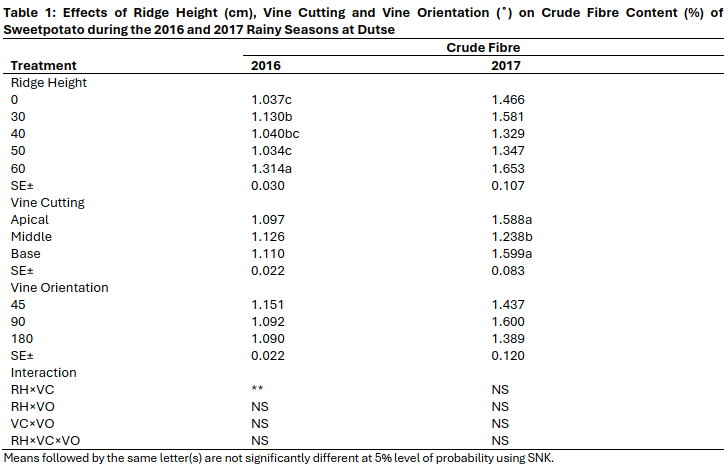
Sweetpotato in sub-saharan Africa is presently receiving attention as it is a cheap source of calories and helps in the fight against malnutrition. In view of these, two field trials were conducted during the 2016 and 2017 rainy seasons at the Research Farm Federal University Dutse (11°70' N, 9°34' E, and 460 m above sea level, in the Sudan savannah zone of Nigeria to determine effect of ridge height, vine cutting and vine orientation on nutritional quality of sweetpotato. The treatments consisted of ridge heights (0 cm (flat ground), 30 cm, 40 cm, 50 cm and 60 cm), vine cuttings (apical, mid and basal) and vine orientations (45°, 90° and 180°) laid out in a split plot design, with the ridge heights and vine cuttings in the main plot and vine orientations in the sub plot and replicated three times.. Ridging had significant effects on quality attributes with higher quantities of nutrient elements in higher ridges. Carbohydrate content was higher in the apical vine cutting, calcium and crude fibre contents were higher in the base than in other vine cuttings. In conclusion it can be recommended that for better plant establishment and subsequent root yield and better quality attributes ridging from 30cm, apical vine cuttings should be used. For higher fibre content the basal vine cutting should be used.
References
Adam, K . L. (2005). Sweetpotato Organic Production. Retrieved from http://attra.ncat.org/attrapub/sweetpotato. html.
Agyarko, K., Kwakye, P. K., Bonsu, M., Osei, B. A., and Agyei Frimpong, K. (2006). The Effect of Organic Soil Amendments on Root-knot Nematodes, Soil Nutrients and Growth of Carrot. Journal of Agronomy 5:641-646.
Agyarko, K., H.K. Dapaah, S. Buah and K.A. Frimpong, (2014). Sweet potato (Ipomoea batatas) yield parameters, soil chemical properties and cost benefit ratios following incorporation of poultry manure and inorganic NPK fertilizers in low nutrient Ghanaian soils. Int. J. Plant Soil Sci., 3: 129-138.
Akinboye, O. E., Oyekale, K. O., Aiyelari, E. A. (2015). Effects of Land Preparation Methods on the Growth and Yield of Sweet Potato (Ipomoea Batatas LAM). International Journal of Research in Agriculture and Forestry, 2(1): 33-39.
Ali, A., S. A. Ayuba and S. O. Ojeniyi. 2006. Effect of tillage and fertilizer on soil chemical properties, leaf nutrient content and yield of soyabean in the guinea savanna zone of Nigeria. Niger. J. Soil Sci. 16:126-130.
Amara, B., Abay, F. and Tsehaye, Y. (2014). Evaluation of Sweetpotato (Ipomea batatas L.) Varieties for Total Storage Root Yield in South and South East Zones of Tigray. Ethiopia. Am. J. Trade Policy. 1: 74-78.
Andreas, O., Kapinga, R., Lemaga, B., Ortiz, O. Kroschel, J., and Lynam, J. (2009). Unleashing Potential of Sweetpotato in Sub-Saharan Africa. Challenge theme paper 5: Integrated Crop Management, International Potato Center (CIP), Social Sciences Working Paper 1. Pp 134-136.
Association of Official Analytical Chemist (AOAC) (2005). Official methods of analysis. Washington, D.C. in Journal of AOAC International 92(1):61-73·
Belehu, T. (2003). Effect of Planting Density and Cultivar on Yield and Yield Components of Sweetpotato in Ethiopia. University of Pretoria etd. Chapter 8: pp 174-185.
Black, C. A. (1965). Method of Soil Analysis, Part 2, Chemical and Microbiological Properties, American Society of Agronomy, Inc, Publisher, Madison, Wisconsin USA. Pp 776.
Chude, V. O., Olayiwola, S. O., Osho, A. O. and Daudu, C. K. (2011). Fertilizer Use and Management Practices for Crops in Nigeria 4th Edition, produced by Federal Fertilizer Department, Federal Ministry of Agriculture and Rural Development, Abuja, Nigeria. Pp 112-113.
Climate Charts (2016). Retrieved from http:// https://www.climate-charts.com/Countries/NIGERIA.html.
Laban, T. F., Peace, K., Robert, M., Maggiore, K., Hellen, M. and Muhumuza, J. (2015). Participatory Agronomic Performance and Sensory Evaluation of Selected Orange-Fleshed Sweetpotato Varieties in South Western Uganda. Global J. Sci. Frontier Res., 15: 25-30.
Nedunchezhiyan M., G. Byju and S.K. Jata. (2012). Sweet Potato Agronomy. In: Nedun-chezhiyan M, Byju G (Eds) Sweet Potato. Fruit, Vegetable and Cereal Science and Biotechnology 6 (Special Issue 1), pp 1-10.
Ouda, B. A. and Mahadeen, A.Y. (2008). Effect of fertilizers on growth, yield, yield components, quality and certain nutrient contents in broccoli (Brassica oleracea). International Journal of Agriculture and Biology, 10(6): 627-632.
Parwada, C., Gadzirayi, C.T. and Sithole, A. B. (2011). Effect of Ridge Height and Planting Orientation on Sweetpotato (Ipomea batatas L.) Production. Journal of Agricultural Biotechnology and Sustainable Development 3: 72-76.
Radwan, S. M. A. and Awad, N. M. (2002). Effect of Soil Amendment with Various Organic Wastes with Multi-Biofertilizer on Yield of Peanut Plants in Sandy Soil. Journal of Agricultural Sciences of Mansoura Univ.; 27:3129-3138.
Snedecor, G. W. and Cochran, W. G. (1976). Statistical Methods. The Iowa State University, 6th edition, Ames, Iowa, U.S.A. pp 593.
Woolfe, J. A. (1992). Sweetpotato: “An Untapped Food Resource’’, Cambridge University Press. Pp 118-179.
Downloads
Published
Issue
Section
License
Copyright (c) 2026 Journal of Science Research and Reviews

This work is licensed under a Creative Commons Attribution-NonCommercial 4.0 International License.
- Attribution — You must give appropriate credit, provide a link to the license, and indicate if changes were made. You may do so in any reasonable manner, but not in any way that suggests the licensor endorses you or your use.
- NonCommercial — You may not use the material for commercial purposes.
- No additional restrictions — You may not apply legal terms or technological measures that legally restrict others from doing anything the license permits.