
Mechanistic Insights and RSM-Based Optimization of Aluminium Corrosion Inhibition Using Banana Leaf Extract
DOI:
https://doi.org/10.70882/josrar.2026.v3i2.170Keywords:
Acidic corrosion, Adsorption behavior, Banana leaf extract, Green corrosion inhibitor, Phytochemical constituents, Statistical optimizationAbstract
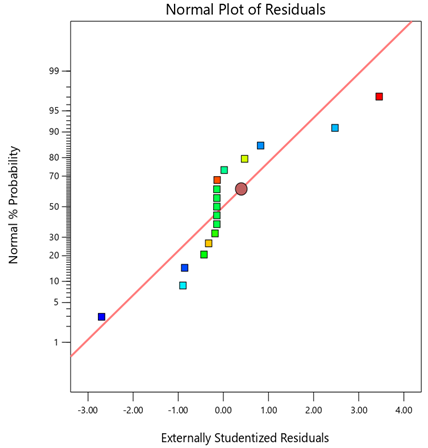
The corrosion inhibition performance of banana (Musa spp.) leaf extract on aluminium in acidic medium was evaluated using Response Surface Methodology (RSM) considering immersion time, temperature, and inhibitor concentration. The regression model exhibited strong predictive accuracy, with predicted and experimental inhibition efficiencies closely aligned along the 45° line. Residual normality was confirmed, with most residuals following the reference line and only minor deviations at approximately –3.0 and +3.8. The externally studentized residuals analysis showed that only one observation (predicted efficiency ≈ 75%) exceeded the critical limit of ±3.71733, while the remaining runs were within acceptable limits. Cook’s distance values ranged from 0.02 – 0.74, all below the influence threshold of 0.8845, with the highest values recorded for Run 2 (0.74), Run 15 (0.56), and Run 7 (0.51). Leverage values varied between 0.05 and 0.32, remaining below the critical value of 0.4706 and above the average leverage of 0.2353. DFFITS diagnostics identified Run 2 (+2.3) and Run 16 (–1.8) as relatively influential compared with the threshold of ±1.45521. Similarly, DFBETAS analysis for the intercept showed influential values for Run 2 (+1.05) and Run 17 (–0.95) relative to the limit of ±0.7276. The Box–Cox transformation produced an optimal λ ≈ 1.0 (95% CI), indicating stable variance and no need for response transformation. Perturbation analysis indicated a sensitivity order of immersion time > temperature > inhibitor concentration, with immersion time and temperature exerting negative effects while concentration showed a mild positive influence. Overall, the robust statistical diagnostics and predictive performance confirm the effectiveness of banana leaf extract as a sustainable green inhibitor for aluminium corrosion in acidic environments.
References
Adamu, A. A., Iyun, O. R. A., & Habila, J. D. (2025). Adsorption and thermodynamic studies of the corrosion inhibition effect of Desmodium adscendens extract on carbon steel in 2 M HCl. BMC Chemistry, 19, 163. https://doi.org/10.1186/s13065-025-01541-y
Adeleke O. Adebayo, O. A., Ibrahim, M. A., & Bello, A. S. (2024). Green corrosion inhibitors for aluminium and steel in acidic environments: Advances, mechanisms, and future perspectives. Journal of Materials Research and Technology, 28, 4123–4141. https://doi.org/10.1016/j.jmrt.2024.02.114
Adewale, O., Olajire, A. O., Olusegun, S. J., & Olayanju, D. S. (2024). Statistical evaluation and modeling of green corrosion inhibitors for aluminium in acidic environments using response surface methodology. Journal of Molecular Liquids, 401, 124566. https://doi.org/10.1016/j.molliq.2024.124566
Carlos, M., Torres, C. M., Garcia, D., & López, J. A. (2024). Sustainable corrosion protection strategies based on green chemistry principles. Progress in Organic Coatings, 189, 108326
Chu, T. S., Mai, W. J., Li, H. Z., Wei, B. X., Xu, Y. Q., & Liao, B. K. (2025). Insights into the corrosion inhibition performance of plant extracts of different genera in H₂SO₄ medium. International Journal of Molecular Sciences, 26(2), 561. https://doi.org/10.3390/ijms26020561
El Haddad, A. S., & Fouda, A. E. A. S. (2025). Investigating Xanthium spinosum extract as an eco friendly corrosion inhibitor for aluminium in acidic environments. Journal of Cleaner Chemical Engineering, 3(2), 102136. https://doi.org/10.1016/j.rechem.2025.102136
Fatima, Z., El Hajjaji, F. Z., Lgaz, H., Chung, I. M., & Chaouiki, A. (2024). Environmentally friendly corrosion inhibitors: Progress, challenges, and future directions. Journal of Molecular Liquids, 398, 124085. https://doi.org/10.1016/j.corsci.2024.111842
Hassan, M. H., Riaz, M., & Shah, S. A. A. (2025). Influence diagnostics for regression coefficients under multicollinearity: Applications of DFBETAS and related measures. Communications in Statistics – Simulation and Computation, 54(3), 1021–1038. https://doi.org/10.1080/03610918.2024.2387654
Ibrahim, A. M., Ahmed, M. N., & Okeola, A. F. (2024). Experimental design and response surface methodology applied to green corrosion inhibitors: predictive performance and statistical validation. Journal of Electrochemical Science and Technology, 15(3), 493–507. https://doi.org/10.33961/jecst.2024.00607
Imane, A. B., Adjal, F., Zaabar, A., Benchikh, A., Guerniche, D., Ait Ramdane-Terbouche, C., Piedade, A. P., Ibrahim, M. Z., Nasrallah, N., & Abdi, A. (2024). Cleome arabica L. extract as a novel green corrosion inhibitor for carbon steel in HCl solution: Insights from experimental and theoretical studies. RSC Advances, 14, 36423–36436.
Mehdi, G. M., Salimi, A., & Rezaei, H. (2024). Electrochemical behavior and corrosion resistance of aluminium alloys in acidic media: Recent developments and mitigation strategies. Corrosion Science, 228, 111842. https://doi.org/10.1016/j.corsci.2024.111842
Milad, S, M. (2024). Response surface methodology and Box–Cox transformation in optimizing green corrosion inhibitors: A review. Surfaces, 7(2), 380–403. https://doi.org/10.3390/surfaces7020024
Mohammed, S., Al-Sabagh, M. S., El-Haddad, M. N., & El-Shamy, A. M. (2025). Natural polymeric and plant-based corrosion inhibitors for metals in aggressive media: Mechanistic insights and applications. Journal of Molecular Liquids, 414, 125034. https://doi.org/10.1016/j.molliq.2025.125034
Motawea, M. M. (2025). Parsley extract as a green corrosion inhibitor for aluminum in 1 M HCl environment. Recycling and Sustainable Chemistry, 5, 102861. https://doi.org/10.1016/j.rechem.2025.102861
Nasir, S. N., & Atif, A. A. (2024). Empirical evaluation of the gamma-Pareto regression residuals for influence diagnostics. Journal of Statistical Computation and Simulation, 94(16), 3573–3598. https://doi.org/10.1080/00949655.2024.2397693
Naveen, N. K., Singh, A. K., & Ebenso, E. E. (2025). Plant-derived phytochemicals as sustainable corrosion inhibitors for metals in aggressive environments. Surfaces and Interfaces, 47, 104212.
Okuma, S. O., Nwaeju, C. C., & Tuaweri, T. J. (2024). Optimization and predictive modelling of gravimetric corrosion characteristics of Irvingia gabonensis leaves extracts as anti corrosion inhibitor of mild steel in HCl solution. Journal of Applied Materials and Technology, 5(1), 1–10. https://doi.org/10.31258/Jamt.5.1.1 10
Oluwaseun O. Adeyemi, O. O., Adewuyi, A., & Lawal, G. I. (2025). Optimization of plant-based corrosion inhibitors using response surface methodology and Box–Behnken design. Heliyon, 11(2), e25941 https://doi.org/10.1016/j.heliyon.2025.e25941
Peter, D. P. (2025). Green corrosion inhibition of mild steel in acidic media using Wahlenbergia riparia extract: Experimental design and model diagnostics. Results in Chemistry, 14, 101055.
Saleem, N., Akbar, A., Irshad, A. U. R., Özdemir, B., & Ahmad Khan, J. (2025). Influence diagnostics in gamma Pareto regression model with Cook’s distance for standardized and adjusted residuals: Simulation and application. Journal of Mathematics, 2025, Article 3440237. https://doi.org/10.1155/jom/3440237
Shathani, P., Ogunmuyiwa, E. N., Obadele, B. A., & Oladijo, O. P. (2025). Plant leaf extracts as green corrosion inhibitors of steel in acidic and seawater environments: A review. Environmental Science and Pollution Research International, 32(51), 28954–28975. https://doi.org/10.1007/s11356-025-37116-6
Singh, P., & Verma, C. P. (2025). Evaluation of predictive accuracy and mechanistic insights of plant based corrosion inhibitors using response surface methodology. Corrosion Reviews, 43(1), 67–88. https://doi.org/10.1515/corrrev 2024 0042
Siti, S. A., Abdullah, M. N., & Hashim, N. (2024). Agricultural waste extracts as eco-friendly corrosion inhibitors for aluminium in acidic solutions. Results in Engineering, 21, 101742.
Udom, I. G. (2025). Thermodynamic, kinetic and adsorptive parameters of corrosion inhibition of aluminium using Sorghum bicolor leaf extract in H₂SO₄ solution. Communications in Physical Sciences, 12(3), 778–798.
Umoren, S. A., Solomon, M. M., Obot, I. B., & Suleiman, R. K. (2021). Date palm leaves extract as a green and sustainable corrosion inhibitor for low carbon steel in 15 wt.% HCl solution: The role of extraction solvent on inhibition effect. Environmental Science and Pollution Research, 28(30), 40879 – 40894. https://doi.org/10.1007/s11356-021-13567-5
Yousif, Q. A., Malhotra, S. S., Bedair, M. A., Ansari, A., & Hadi, A. K. (2025). Safflower plant extract as a sustainable corrosion inhibitor for carbon steel in hydrochloric acid media: Combined electrochemical and computational study. RSC Advances, 15, 21006 – 21025
Zhang, L., Chen, Q., & Li, X. (2025). Statistical modelling and adsorption analysis of eco friendly inhibitors for aluminium corrosion in acidic media. Journal of Materials Engineering and Performance, 34(4), 2058–2072. https://doi.org/10.1007/s11665 025 07354 9
Zhiqiang, C, Z., Liu, Y., & Wang, X. (2025). Diagnostic measures for identifying influential observations in regression and machine learning models. Mathematics, 13(2), 311.
Zineb, E, I, Z., Lgaz, H., & Chung, I. M. (2024). Adsorption and thermodynamic studies of eco-friendly corrosion inhibitors: Mechanistic insights and statistical validation. Surfaces and Interfaces, 44, 103567
Downloads
Published
Issue
Section
License
Copyright (c) 2026 Clifford Baba Okpanachi, Ekwu Mark Ameh, Lucky Ekwoba, Rotimi Larayetan, Edwin Abalaka, Emmanuel Ejukwa (Author)

This work is licensed under a Creative Commons Attribution-NonCommercial 4.0 International License.
- Attribution — You must give appropriate credit, provide a link to the license, and indicate if changes were made. You may do so in any reasonable manner, but not in any way that suggests the licensor endorses you or your use.
- NonCommercial — You may not use the material for commercial purposes.
- No additional restrictions — You may not apply legal terms or technological measures that legally restrict others from doing anything the license permits.