
Conceptual Evaluation of a Small-Scale Gravity-Based Pumped Hydro Storage System with Permanent Magnet Generators (PMG) for Rural Renewable Energy Stabilization in Nigeria
DOI:
https://doi.org/10.70882/josrar.2026.v3i2.163Keywords:
PMG, Gravity, Sustainability, Micro-hydro, Off-gridAbstract
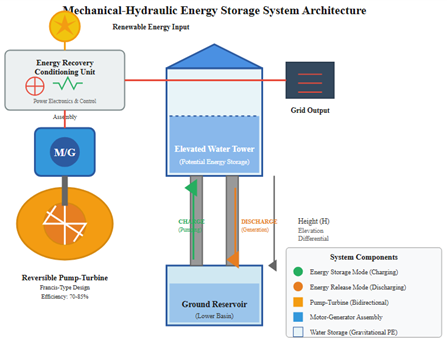
Intermittency remains a critical bottleneck for renewable energy adoption in developing regions, as supply fluctuations disrupt grid stability. This study evaluates a hybrid energy system designed to improve power delivery continuity by integrating gravity-fed energy storage (GES) with high-efficiency recovery mechanisms. To address the cradle-to-grave challenges of chemical batteries, a mechanical-hydraulic synergy was modeled to capture surplus energy and convert it into gravitational potential. The system's operational logic utilizes surplus power to drive a hydraulic pump, lifting water to an elevated reservoir; during periods of low supply, this water descends to drive a micro-hydro turbine integrated with a Permanent Magnet Generator (PMG) for electrical conversion. The research utilized a configuration consisting of an elevated water tower (10–20 meters), a micro-hydro recovery unit, and precision instrumentation including flow meters and pressure sensors to track energy movement. Performance was mathematically modeled using gravitational energy equations and verified through semi-urban wind-yield simulations, with the recovery subsystem demonstrating a modeled round-trip efficiency in the range of 72–81%. Results suggest that the hybrid approach could potentially achieve substantially higher reliability compared to standalone intermittent systems, which exhibited approximately 45% reliability under equivalent conditions. The system's projected 50-year service life and favorable levelized cost of storage relative to lithium-ion alternatives further support its viability. This battery-free design represents a potentially scalable, low-maintenance pathway toward rural electrification, offering meaningful mechanical inertia to help stabilize weak-grid infrastructure while mitigating the environmental risks associated with electrochemical disposal.
References
Chaturvedi, D. K., Yadav, S., Srivastava, T., & Kumari, T. (2020). Electricity storage system: A gravity battery. 2020 Fourth World Conference on Smart Trends in Systems, Security and Sustainability (WorldS4), 412–416. https://doi.org/10.1109/worlds450073.2020.9210321
Díaz-González, F., Sumper, A., Gomis-Bellmunt, O., & Villafáfila-Robles, R. (2023). A review of energy storage technologies for renewable energy integration: Grid inertia and frequency stability considerations. Applied Energy, 341, 121056. https://doi.org/10.1016/j.apenergy.2023.121056 .
Hunt, J. D., Zakeri, B., Lopes, R., Barbosa, P. S. F., Nascimento, A., de Castro, N. J., Brandão, R., Schneider, P. S., & Wada, Y. (2021). Life-cycle assessment of gravity energy storage systems for large-scale application. Journal of Energy Storage, 39, 102601. https://doi.org/10.1016/j.est.2021.102601
International Hydropower Association (IHA). (2024). World Hydropower Outlook 2024. London: IHA. Retrieved from https://www.hydropower.org/publications/world-hydropower-outlook-2024
Kougias, I., Szabó, S., Monforti-Ferrario, F., & Moya, A. (2023). The role of hydropower storage in supporting renewable energy integration: A review of pumped hydro storage applications. Renewable and Sustainable Energy Reviews, 173, 113073. https://doi.org/10.1016/j.rser.2022.113073
Kropotin, P. (2023). Gravity energy storage systems with weight lifting. THERMOPEDIA. https://doi.org/10.1615/thermopedia.010359
Ngoma, D. H., Masenga, B., & Petro, L. (2025). Optimization of excess energy storage from an islanding micro-hydropower system as an alternative to dump loads. Discover Energy, 5(3), Article 3. Springer Nature. https://doi.org/10.1007/s43937-024-00003-7
Pius Sarmeje, C., Medugu, D. W., & Danladi, A. (2025). Optimization and integration of vertical axis wind turbines in hybrid renewable energy systems: A systematic review. FUDMA Journal of Sciences, 9(12), 171–177. https://doi.org/10.33003/fjs-2025-0912-4065
Ruoso, A. C., Caetano, N. R., & Rocha, L. A. O. (2019). Storage gravitational energy for small scale industrial and residential applications. Inventions, 4(4), 64. https://doi.org/10.3390/inventions4040064
Smutný, M., Gugushvili, T., & Musil, M. (2023). Guidelines on environmental impact assessment of hydropower projects. United Nations Economic Commission for Europe (UNECE). Retrieved from https://unece.org/environmental-impact-assessment-hydropower
Swe, W. (2018). Application of pumped hydroelectric energy storage for photovoltaic based rural electrification. ResearchGate. https://doi.org/10.13140/RG.2.2.34844.95368
Tao, R., Song, X., & Ye, C. (2022). Pumped storage technology, reversible pump turbines and their importance in power grids. Water, 14(21), 3569. https://doi.org/10.3390/w14213569.
Vincent, S. A., Tahiru, A., Lawal, R. O., Aralu, C. E., & Okikiola, A. Q. (2024). Hybrid renewable energy systems for rural electrification in developing countries: Assessing feasibility, efficiency, and socioeconomic impact. World Journal of Advanced Research and Reviews, 24(2), 2190–2204. https://doi.org/10.30574/wjarr.2024.24.2.3515.
Downloads
Published
Issue
Section
License
Copyright (c) 2026 Bashar S. Qasim, Yusuf M. Ahijjo, Muazu Musa, Sadiya Umar, Samira A. Hassan, Muhammad B. Abdullahi, Tinke I. Peni (Author)

This work is licensed under a Creative Commons Attribution-NonCommercial 4.0 International License.
- Attribution — You must give appropriate credit, provide a link to the license, and indicate if changes were made. You may do so in any reasonable manner, but not in any way that suggests the licensor endorses you or your use.
- NonCommercial — You may not use the material for commercial purposes.
- No additional restrictions — You may not apply legal terms or technological measures that legally restrict others from doing anything the license permits.