
Forests as Natural Barrier or Facilitators? The Role of Vegetation Structure in Mosquito Dispersal Patterns
DOI:
https://doi.org/10.70882/josrar.2026.v3i1.155Keywords:
Forest fragmentation, Vegetation structure, Mosquito dispersal, Malaria, Dengue, Landscape ecology, Microclimate, Remote sensingAbstract
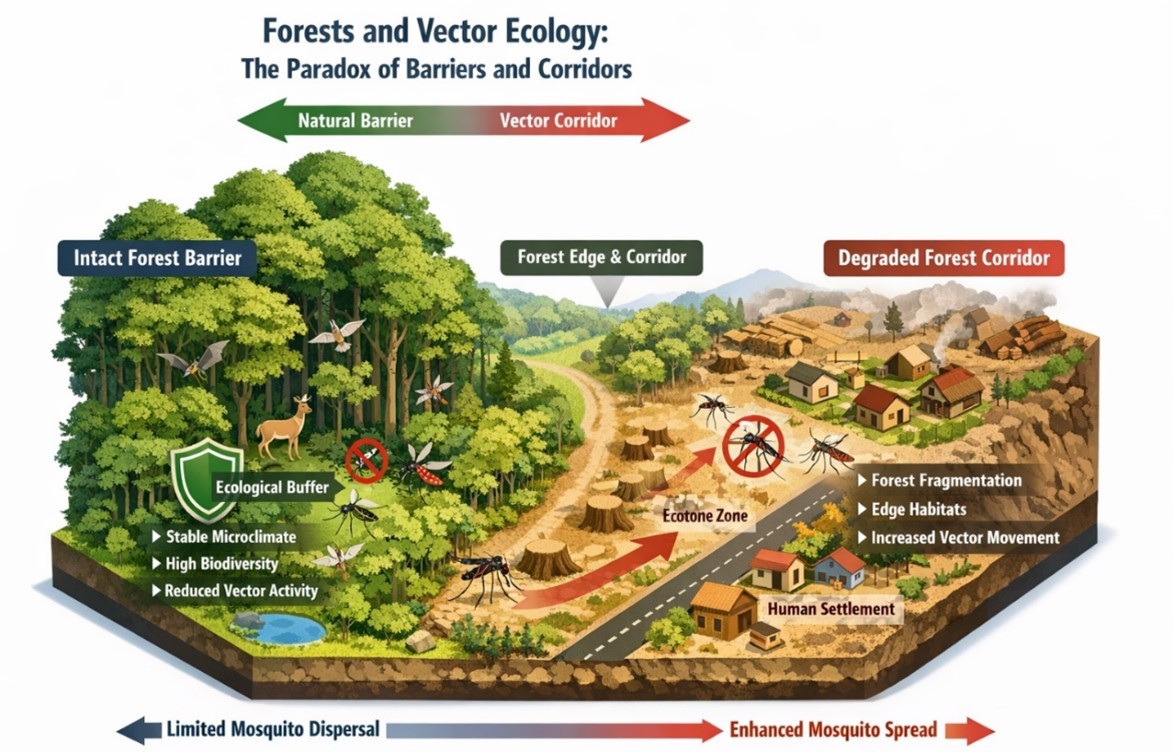
Mosquito-borne diseases such as malaria, dengue, Zika, and chikungunya continue to pose major global health challenges, particularly across tropical and subtropical regions. While the role of climate, human mobility, and land use change in shaping disease transmission has been widely studied, the influence of forest vegetation structure on mosquito dispersal remains underexplored. Forests can simultaneously act as natural barriers, through dense canopy cover, lower temperatures, and reduced light, and as facilitators when fragmented or disturbed, creating transitional ecotones conducive to vector survival and flight. Recent research integrating landscape ecology, entomology, and remote sensing has revealed that vegetation heterogeneity, canopy height, and microclimate gradients directly mediate mosquito flight range, host-seeking behavior, and pathogen transmission potential. For example, Anopheles species often exploit partially cleared forest edges, while Aedes mosquitoes thrive in peri-urban forest mosaics that combine vegetation cover with artificial breeding habitats. Using Light Detection and Ranging (LiDAR)-based canopy measurements, Normalized Difference Vegetation Index (NDVI) modeling, and mark–release–recapture experiments, scientists are quantifying how vegetation structure predicts vector mobility across landscapes. This review synthesizes current knowledge (2021–2025) on how forest attributes modulate mosquito dispersal and vector-borne disease risks, emphasizing tropical ecosystems in Africa, South America, and Southeast Asia. We discuss mechanistic pathways linking vegetation and vector ecology, evaluate forest management implications for disease prevention, and identify future research priorities integrating remote sensing and ecological modeling.
References
Abbasi, E. (2025). Innovative approaches to vector control: integrating genomic, biological, and chemical strategies. Annals of Medicine and Surgery, 87(8), 5003-5011.
Ali, N. and Lucas, E. (2025). Landscape Transformations and the Ecology of Mosquito-Borne Diseases: Assessing the Role of Vegetation Changes and Human Settlements.
Cao, Y., Martins, R., Lee, J., & Wu, J. (2025). Navigating One Health impacts of rugged terrain: challenges and opportunities. BioScience, biaf126.
Carbone, A., Hough, I., Vivone, G., Chanussot, J., Restaino, R., Dupont, H., & Uzu, G. (2025). OPNet: A deep-learning approach for estimating particulate matter’s oxidative potential from satellite imagery. Atmospheric Environment: X, 100406.
Carbone, G., Boiardi, G., Infantino, C., Cunico, D., & Esposito, S. (2025). Vectors on the Move: How Climate Change Fuels the Spread of Arboviruses in Europe. Microorganisms, 13(9), 2034.
Castellanos-Labarcena, J. (2025). A multidimensional and multiscale approach to understanding insect biodiversity (Doctoral dissertation, University of Guelph).
Eastwood, G., Sang, R. C., Lutomiah, J., Tunge, P., & Weaver, S. C. (2020). Sylvatic mosquito diversity in Kenya—considering enzootic ecology of arboviruses in an era of deforestation. Insects, 11(6), 342.
Fairbanks, E. L., Baylis, M., Daly, J. M., & Tildesley, M. J. (2025). Quantifying vector diversion effects in zoonotic systems: A modelling framework for arbovirus transmission between reservoir and dead-end hosts. bioRxiv, 2025-07.
Feng, Q., Yang, H., Liu, Y., Liu, Z., Xia, S., Wu, Z., & Zhang, Y. (2024). Interdisciplinary perspectives on forest ecosystems and climate interplay: a review. Environmental Reviews, 33, 1-21.
Fisher, G. B., Elmore, A. J., Fitzpatrick, M. C., McNeil, D. J., Atkins, J. W., & Larkin, J. L. (2024). Mapping recent timber harvest activity in a temperate forest using single date airborne LiDAR surveys and machine learning: lessons for conservation planning. GIScience & Remote Sensing, 61(1), 2379198.
Fornace, K. M., Laporta, G. Z., Vythilingham, I., Chua, T. H., Ahmed, K., Jeyaprakasam, N. K., & Lau, Y. L. (2023). Simian malaria: a narrative review on emergence, epidemiology and threat to global malaria elimination. The Lancet Infectious Diseases, 23(12), e520-e532.
Fornace, K. M., Laporta, G. Z., Vythilingham, I., Chua, T. H., Ahmed, K., Jeyaprakasam, N. K., & Lau, Y. L. (2023). Simian malaria: a narrative review on emergence, epidemiology and threat to global malaria elimination. The Lancet Infectious Diseases, 23(12), e520-e532
Frumkin, H., & Thomson, M. C. (2023). Climate Change and Health in the Tropics: Current Status and Future Trends. Manson's Tropical Diseases E-Book, 33.
Han, B., Zheng, R., Zeng, H., Wang, S., Sun, K., Chen, R. & He, J. (2024). Cancer incidence and mortality in China, 2022. Journal of the National Cancer Center, 4(1), 47-53.
Kweka, G. J. (2023). Navigating the conundrum of agricultural commodity price fluctuations and household welfare in Tanzania.
Lainhart, T., Sheffield, J., Russell, J., Coyne, J., & Hovanski, Y. (2025). Evaluating performance of friction stir lap welds made at ultra-high speeds. Journal of Manufacturing and Materials Processing, 9(8), 263.
Lambrechts, L., Noppe, Y., Pardons, M., Cole, B., Rutsaert, S., De Wit, S., & Vandekerckhove, L. (2023). Linking inducible HIV-1 reservoir to rebound after treatment interruption. In IAS 2023, the 12th IAS Conference on HIV Science (pp. 77-78).
Mertens, J. E. (2025). The Influence of Climate Change on Vector-Borne Diseases in a Wilderness Medicine Context. Wilderness & Environmental Medicine, 36(1), 44-60
Moreno, G., Bartolome, J. W., Gea-Izquierdo, G., & Cañellas, I. (2013). Overstory–understory relationships. In Mediterranean oak woodland working landscapes: dehesas of Spain and ranchlands of California (pp. 145-179). Dordrecht: Springer Netherlands.
Musacchio, L., Ozdenerol, E., Bryant, M., & Evans, T. (2005). Changing landscapes, changing disciplines: seeking to understand interdisciplinarity in landscape ecological change research. Landscape and Urban Planning, 73(4), 326-338.
Ngugi, M. M., Stock, S. C., Mganga, K. Z., Loginova, I., Munene, R., Mweu, B., & Dippold, M. A. (2025). Belowground traits of perennial grasses shape restoration strategies in tropical grasslands. Plant and Soil, 1-19.
Nguyen, V. T., Dryden, D. S., Broder, B. A., Tadimari, A., Tanachaiwiwat, P., Mathias, D. K., ... & Lee, Y. (2025). A Comprehensive Review: Biology of Anopheles squamosus, an Understudied Malaria Vector in Africa. Insects, 16(2), 110.
Oliveira, T. M., Laporta, G. Z., Bergo, E. S., Chaves, L. S. M., Antunes, J. L. F., Bickersmith, S. A. and Sallum, M. A. M. (2021). Vector role and human biting activity of Anophelinae mosquitoes in different landscapes in the Brazilian Amazon. Parasites & Vectors, 14(1), 236.
Ribeiro, A. L. P., Machado, Í., Cousin, E., Perel, P., Demacq, C., Geissbühler, Y., and RAISE Study Collaborators. (2024). The burden of Chagas disease in the contemporary world: the RAISE study. Global Heart, 19(1), 2.
Ribeiro, A. L. P., Machado, Í., Cousin, E., Perel, P., Demacq, C., Geissbühler, Y., ... & RAISE Study Collaborators. (2024). The burden of Chagas disease in the contemporary world: the RAISE study. Global Heart, 19(1), 2.
Robinson, N. M., Beranek, C. T., Southwell, D. M., & DeGabriel, J. L. (2025). Contrasting the influence of extent and severity of fire on the occupancy of two marsupial gliders in New South Wales. Wildlife Research, 52(11), WR24212.
Rulli, M. C., D’Odorico, P., Galli, N., John, R. S., Muylaert, R. L., Santini, M., & Hayman, D. T. (2025). Land use change and infectious disease emergence. Reviews of Geophysics, 63(2), e2022RG000785.
Tustin, D. S., Breen, K. C., & Van Hooijdonk, B. M. (2022). Light utilisation, leaf canopy properties and fruiting responses of narrow-row, planar cordon apple orchard planting systems—A study of the productivity of apple. Scientia Horticulturae, 294, 110778.
Murdock, H. E., Staffell, I., Jansen, M., & de Nazelle, A. (2025). Expert views diverge on how to decarbonize transport. Sustainability: Science, Practice and Policy, 21(1), 2569499.
Downloads
Published
Issue
Section
License
Copyright (c) 2026 Journal of Science Research and Reviews

This work is licensed under a Creative Commons Attribution-NonCommercial 4.0 International License.
- Attribution — You must give appropriate credit, provide a link to the license, and indicate if changes were made. You may do so in any reasonable manner, but not in any way that suggests the licensor endorses you or your use.
- NonCommercial — You may not use the material for commercial purposes.
- No additional restrictions — You may not apply legal terms or technological measures that legally restrict others from doing anything the license permits.