
Development of an IoT-Based Fish Pond Water Quality Monitoring System
DOI:
https://doi.org/10.70882/josrar.2025.v2i6.147Keywords:
IoT, Fish farming, Monitoring System, Water qualityAbstract
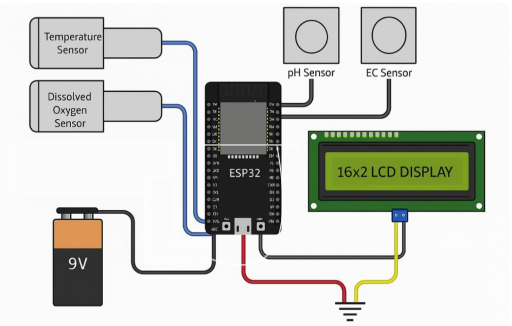
Aquaculture has remained a critical component of global food security, especially in developing countries where fish farming serves as a key source of nutrition and income. The productivity and sustainability of fish farms are largely dependent on maintaining optimal water quality. Traditional methods of monitoring pond water quality involve manual sampling and chemical test kits, which are time-consuming, labor-intensive, and often reactive rather than proactive. To address these challenges, this study presents the development of a low-cost Internet of Things (IoT)-based system designed to monitor essential water quality parameters in real time. The developed system integrates multiple sensors—namely, temperature, dissolved oxygen (DO), ammonia, pH, and electrical conductivity (EC)—connected to a microcontroller (ESP32), which processes the data and displays it on a local LCD screen. This design eliminates the need for continuous manual testing and provides immediate, on-site access to water quality information. The device is enclosed in a waterproof housing and powered by a solar-rechargeable battery, ensuring its suitability for rural and remote aquaculture environments with limited infrastructure. Unlike many existing solutions that rely on internet connectivity for cloud-based dashboards and remote notifications, this system operates entirely offline. It is particularly beneficial for small- and medium-scale fish farmers who require affordable, standalone monitoring tools. The system enables timely intervention when parameters deviate from acceptable levels, improving fish health and farm efficiency. This work contributes a practical and scalable solution to water quality management in aquaculture and lays a foundation for future enhancements such as data logging and alert systems.
References
Agossou, B. E. (2021). IoT & AI Based System to improve Fish Farming: Case study of Benin [Master’s thesis, Kobe Institute of Computing]. ResearchGate. https://doi.org/10.13140/RG.2.2.14773.81122
Agus Suwardono, Prahesti, F. E., Elsanda Merita Indrawati, & Moh. Abd Jalil Ashofa. (2024). IoT Based Catfish Farm Monitoring with ESP32 Microcontroller and DS18B20 Sensor. JST (Jurnal Sains Dan Teknologi), 13(3), 508–516. https://doi.org/10.23887/jstundiksha.v13i3.85996
Anggraini, E., Putra, G. B., & Kurniawan, R. (2024). Design of a nodemcu-based system for monitoring and controlling the water quality of catfish tarp pond. IOP Conference Series: Earth and Environmental Science, 1419(1), 012040. https://doi.org/10.1088/1755-1315/1419/1/012040
Babalola, T. E., Babalola, A. D., & Goroti, A. V. (2024). Development of an IoT Based Water Quality Monitoring Device for Domestic Fish Ponds. ABUAD Journal of Engineering Research and Development (AJERD), 7(1), 82–90. https://doi.org/10.53982/ajerd
Bossuet, J. (2023, December 18). A start for people-centred digital transformation of small-scale fisheries in Kenya. WorldFish. https://worldfishcenter.org/blog/start-people-centred-digital-transformation-small-scale-fisheries-kenya-1
Boyd, C. E. (2015). Water quality: An introduction. Springer.
Chiu, M.-C., Yan, W.-M., Bhat, S. A., & Huang, N.-F. (2022). Development of smart aquaculture farm management system using IoT and AI. Journal of Agriculture and Food Research, 9, 100357. https://doi.org/10.1016/j.jafr.2022.100357
Cusack, C., Manglani, O., Jud, S., Westfall, K., Fujita, R., Sarto, N., Brittingham, P., & McGonigal, H. (2021). New and emerging technologies for sustainable fisheries: A comprehensive landscape analysis. Environmental Defense Fund.
FAO, & WorldFish. (2020). Information and communication technologies for small-scale fisheries (ICT4SSF) - A handbook for fisheries stakeholders. Food and Agriculture Organization of the United Nations; WorldFish. https://doi.org/10.4060/cb2030en
FAO. (2020). The State of World Fisheries and Aquaculture 2020: Sustainability in Action. Food and Agriculture Organization of the United Nations. https://www.fao.org/documents/card/en/c/ca9229en
Flores-Iwasaki, M., Guadalupe, G. A., Pachas-Caycho, M., Chapa-Gonza, S., Mori-Zabarburú, R. C., & Guerrero-Abad, J. C. (2025). Internet of Things (IoT) Sensors for Water Quality Monitoring in Aquaculture Systems: A Systematic Review and Bibliometric Analysis. AgriEngineering, 7(3), 78. https://doi.org/10.3390/agriengineering7030078
Food and Agriculture Organization of the United Nations. (2024). The State of World Fisheries and Aquaculture 2024 - Blue Transformation in action. Knowledge for policy. https://knowledge4policy.ec.europa.eu/publication/state-world-fisheries-aquaculture-2024-blue-transformation-action_en
Hemal, M. M., Rahman, A., Nurjahan, Islam, F., Ahmed, S., Kaiser, M. S., & Ahmed, M. R. (2024). An Integrated Smart Pond Water Quality Monitoring and Fish Farming Recommendation Aquabot System. Sensors, 24(11), 3682. https://doi.org/10.3390/s24113682
Longobardi, L., Sozinho, V., Altarturi, H., Cagua, E. F., & Tilley, A. (2025). Peskas: Automated analytics for small-scale, data-deficient fisheries. SoftwareX, 29, 102028. https://doi.org/10.1016/j.softx.2024.102028
Maheshwari, P. & Singh, S. (2025). The Impact of Climate Change on Fish Physiology and Behaviour: A Review. International Journal of Creative Research Thoughts, 13(5) 2320-2882 www.ijcrt.org
Nayoun, M. N. I., Hossain, S. A., Rezaul, K. M., Siddiquee, K. N. e A., Islam, M. S., & Janna, T. (2024). Internet of Things-Driven Precision in Fish Farming: A Deep Dive into Automated Temperature, Oxygen, and pH Regulation. Computers, 13(267). https://doi.org/10.3390/computers13100267
Sung, W.-T., Griha Tofik Isa, I., & Hsiao, S.-J. (2023). An IoT-Based Aquaculture Monitoring System Using Firebase. Computers, Materials & Continua, 76(2), 2179–2200. https://doi.org/10.32604/cmc.2023.041022
Tilley, A., & Rossignoli, C. (2024, July 1). The data revolution in small-scale fisheries management. WorldFish. https://worldfishcenter.org/impact-story/data-revolution-small-scale-fisheries-management
Verma, D. K., Higginbottom, M. S., Barad, R. R., Satyaveer, Chandra, I., Maurya, N. K., & Ranjan, D. (2024). Digitalization as innovative development in aquaculture and fisheries as future importance. In Futuristic Trends in Agriculture Engineering & Food Sciences (Vol. 3, Book 15, Part 6, Chapter 1). IIP Series. https://doi.org/10.58532/V3BCAG15P6CH1
Zhou, L., Yang, Y., & Yu, Y. (2019). Research on intelligent monitoring system of aquaculture water quality based on IoT. Journal of Physics: Conference Series, 1213(4), 042027. https://doi.org/10.1088/1742-6596/1213/4/042027
Downloads
Published
Issue
Section
License
Copyright (c) 2025 Journal of Science Research and Reviews

This work is licensed under a Creative Commons Attribution-NonCommercial 4.0 International License.
- Attribution — You must give appropriate credit, provide a link to the license, and indicate if changes were made. You may do so in any reasonable manner, but not in any way that suggests the licensor endorses you or your use.
- NonCommercial — You may not use the material for commercial purposes.
- No additional restrictions — You may not apply legal terms or technological measures that legally restrict others from doing anything the license permits.