
Application of an STL–ARIMA Hybrid Framework for Monthly Rainfall Forecasting in Maiduguri, Nigeria
DOI:
https://doi.org/10.70882/josrar.2026.v3i1.146Keywords:
STL–ARIMA Hybrid Model, Rainfall Forecasting, Maiduguri Climate Variability, Seasonal-Trend Decomposition, Climate Change (SDG 13)Abstract
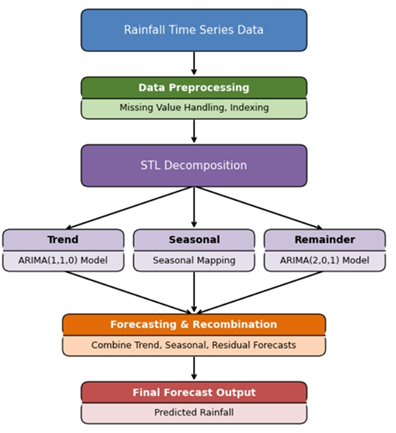
The problems of climate variability in Sahel regions with severe rainfall anomalies bring serious challenges to the water resource management and mitigation of the flood disasters. This paper analyzes the effectiveness of a hybrid STL-ARIMA model to predict monthly rainfall in Maiduguri, Nigeria, which is a town that was affected by the 2024 floods. The article compares the hybrid, traditional Seasonal ARIMA (SARIMA) and Exponential Smoothing by Holt-Winter to assess previous rainfall data of 1981-2023. The suggested method employs Seasonal-Trend Decomposition by Loess (STL) to single out non-linear and seasonal trends that are too complicated then subjecting the time series to ARIMA modeling. With regards to performance, it can be seen that the STL-ARIMA model is far ahead of the conventional approach with a Root mean square error of 29.54mm, as opposed to 43.94mm and 43.01mm using the SARIMA and Holt-Winter models respectively. The hybrid model minimized the Mean Squared Error (MSE) by nearly 55% and it was more effective in terms of capturing the sharp variance variation and extreme wet-season peaks, which are characteristic of the area. These results provide a strong scientific foundation in enhancing flood early warning systems directly related to SDG 13 (Climate Action) goals in Northeastern Nigeria.
References
Adefolalu, D. O. (1986). Rainfall trends in Nigeria. Theoretical and Applied Climatology, 37(4), 205-219. https://doi.org/10.1007/BF00867578
Biasutti, M. (2019). Rainfall trends in the African Sahel: Characteristics, processes, and causes. Wiley Interdisciplinary Reviews: Climate Change, 10(4), e591. https://doi.org/10.1002/wcc.591
Biermann, F., Hickmann, T., Kang, Y. H., Sénit, C. A., & Sun, Y. (Eds.). (2025). Essential Concepts for Implementing the Sustainable Development Goals: An A-Z Guide. Routledge. https://doi.org/10.4324/9781003519560
Canton, H. (2021). World meteorological organization—WMO. In The Europa directory of international organizations 2021 (pp. 388-393).Routledge. https://doi.org/10.4324/9781003179900
Chadwick, R., Good, P., Martin, G., & Rowell, D. P. (2016). Large rainfall changes consistently projected over substantial areas of tropical land. Nature Climate Change, 6(2), 177-181.
Elagib, N. A., Al Zayed, I. S., Saad, S. A. G., Mahmood, M. I., Basheer, M., & Fink, A. H. (2021). Debilitating floods in the Sahel are becoming frequent. Journal of Hydrology, 599, 126362. https://doi.org/10.1016/j.jhydrol.2021.126362
Epule, T. E., Ford, J. D., & Lwasa, S. (2018). Climate change stressors in the Sahel. GeoJournal, 83(6), 1411-1424. https://doi.org/10.1007/s10708-017-9831-6
Hyndman, R. J., & Athanasopoulos, G. (2018). Forecasting: principles and practice. OTexts.
Intergovernmental Panel Climate Change IPCC (2023) https://www.ipcc.ch/report/ar6/syr/downloads/report/IPCC_AR6_SYR_SPM.pdf?utm_source=chatgpt.com
Intergovernmental Panel on Climate Change. (2023). Climate change 2023: Synthesis report. https://www.ipcc.ch/report/ar6/syr/downloads/report/IPCC_AR6_SYR_SPM.pdf
Jayawardene, H. K. W. I., Sonnadara, D. U. J., & Jayewardene, D. R. (2005). Trends of rainfall in Sri Lanka over the last century. Sri Lankan Journal of Physics, 6.
Karabulut, M., Gürbüz, M., & Korkmaz, H. (2008). Precipitation and temperature trend analyses in Samsun. Journal International Environmental Application & Science, 3(5), 399-408.
Lem, K. H. (2024). The STL-ARIMA approach for seasonal time series forecast: A preliminary study. In ITM Web of Conferences (Vol. 67, p. 01008). EDP Sciences. https://doi.org/10.1051/itmconf/20246701008
Nicholson, S. E., Fink, A. H., & Funk, C. (2018). Assessing recovery and change in West Africa's rainfall regime from a 161‐year record. International Journal of Climatology, 38(10), 3770-3786. https://doi.org/10.1002/joc.5530
Obot, N. I., & Onyeukwu, N. O. (2010). Trend of rainfall in Abeokuta, Ogun State, Nigeria: a 2-year experience (2006–2007). Journal of Environmental Issues and Agriculture in Developing Countries, 2(1), 70-81.
Ouyang, Z., Ravier, P., & Jabloun, M. (2021). STL decomposition of time series can benefit forecasting done by statistical methods but not by machine learning ones. Engineering Proceedings, 5(1), 42. https://doi.org/10.3390/engproc2021005042
Ratnayake, U., & Herath, S. (2005). Changing rainfall and its impact on landslides in Sri Lanka. J Mt Sci 2: 218–224. https://doi.org/10.1007/BF02973195
Umar, I. A., Bukar, W. M., Mustapha, A., Kyari, A., Bukar, M. A., Ibrahim, H. H., ... & Kachalla, U. (2025). Flood Risk and Resilience: Evidence from the 2024 Flood in Maiduguri, Nigeria. International Journal of Environment and Climate Change, 15(1), 490-505. https://doi.org/10.9734/ijecc/2025/v15i14708
Umuakpero, J., Ovwigho, B. O., Okpara, J. E., Ejiodu, P. O., & Akpogheneoyibo–Owigho, O. (2025). Agronomic and Social Effects of 2022 Flooding on Cassava Production in Delta State, Nigeria. Journal of Science Research and Reviews, 2(2), 86-91. https://doi.org/10.70882/josrar.2025.v2i2.75
United Nations. (2024). The Sustainable development Goals report 2024. Department of Economic and Social Affairs. https://unstats.un.org/sdgs/report/2024/
United Nations Environment Programme. (2024). https://doi.org/10.70436/nuijb.v3i02.268
Washington, R., Harrison, M., Conway, D., Black, E., Challinor, A., Grimes, D., ... & Todd, M. (2006). African climate change: taking the shorter route. Bulletin of the American Meteorological Society, 87(10), 1355-1366. https://doi.org/10.1175/BAMS-87-10-1355
World Meteorological Organization. 2024. State of the Climate in African 2024. WMO_No 1370 https://wmo.int/sites/default/files/2025-05/Africa_2024final1.pdf
Downloads
Published
Issue
Section
License
Copyright (c) 2026 Journal of Science Research and Reviews

This work is licensed under a Creative Commons Attribution-NonCommercial 4.0 International License.
- Attribution — You must give appropriate credit, provide a link to the license, and indicate if changes were made. You may do so in any reasonable manner, but not in any way that suggests the licensor endorses you or your use.
- NonCommercial — You may not use the material for commercial purposes.
- No additional restrictions — You may not apply legal terms or technological measures that legally restrict others from doing anything the license permits.